Trump Feasts With Xi In Ancient Chinese Palace As White House Staff Eat McDonald's In Car Park Outside
As Trump lunched with Xi in a sealed compound, his entourage ate McDonald's in the car park, highlighting the summit's odd mix of spectacle and exclusion.


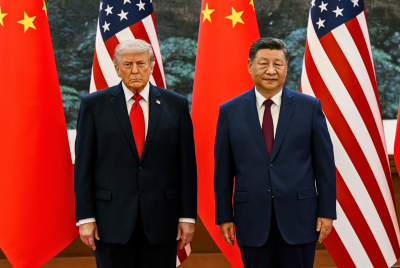
Donald Trump feasted on a private lunch with Xi Jinping inside Beijing's secluded Zhongnanhai compound on Friday, while much of the US president's travelling team – from White House aides to embassy staff – sat outside in a car park eating McDonald's, according to reports.
The split-screen moment unfolded during Trump's three-day visit to the Chinese capital, his first trip back to Beijing since returning to the White House. The summit with Xi, held behind heavy security and with minimal press access, was billed by both sides as a chance to reset a relationship strained by trade disputes, military tensions, and competing influence in Asia. Instead, the most vivid image to emerge so far has been the contrast between the leaders' polished choreography inside Zhongnanhai and the paper bags of fast food handed out to the Americans left waiting outside.
McDonald's, Motorcade Fumes And A Very Private Summit
The reporters in the White House press pool described bags from McDonald's being delivered to staff and journalists confined to vans and vehicles in the Zhongnanhai car park as Trump's lunch with Xi stretched on.
Trump and Xi lunch menu:
— Danny Kemp (@dannyctkemp) May 15, 2026
Minced Codfish in Seafood Soup
Crispy and Stir-Fried Lobster Balls
Pan-Seared Beef Fillet Stuffed with Morel Mushrooms
Kung Pao Chicken and Scallops
Braised Seasonal Greens, Bamboo Shoots, Mushrooms, and Beans
Stewed Beef in a Bun
Steamed Pork and… pic.twitter.com/mr5GRqZaqU
Some of those tucking into burgers and fries were US Embassy workers and members of Trump's own travelling staff, who had been excluded from the closed-door meal inside China's historic seat of Communist Party power. The press, kept at arm's length from the talks, received their McDonald's through van windows while they waited for the presidential motorcade to re-emerge.
It was an oddly on-brand detail for this presidency. White House Chief of Staff Susie Wiles has previously said Trump eats McDonald's every day, and the president has leaned into that image. On the 2024 campaign trail, he briefly worked a drive-thru window at one of the chain's outlets. More recently, he had a McDonald's order delivered directly to the Oval Office during an event touting his elimination of taxes on tips for service workers.
White House Chief of Staff Susie Wiles said it wasn't President Trump's idea to work at a McDonald's for a campaign event in 2024, but revealed the president "eats it every single day."
— CBS News (@CBSNews) May 8, 2026
She credited the campaign team for the idea, which became a viral moment. pic.twitter.com/oiUeoje7Fr
Here, though, it was everyone except Trump who ended up with the fast food.
Inside Zhongnanhai, the president was treated to a considerably more formal setting. Before lunch, Xi led Trump on a walking tour of the compound, which once housed imperial gardens and now houses China's top leadership.
'Zhongnanhai is where the CPC Central Committee and the State Council work, and it is also where I work and live,' Xi told Trump, according to Chinese state accounts. 'After the founding of New China, Chinese leaders including Mao Zedong, Zhou Enlai and others all lived here.'
As they strolled through the manicured grounds with interpreters in tow, Xi pointed out some of the site's more venerable residents: its trees. 'All these trees are 200 to 300 years old. There's a big one that's about 400 years old,' he said. 'There's even one that's 1,000 years old. It's somewhere else.'
Xi framed the invitation as a personal gesture, saying he wanted to reciprocate for Trump's hospitality when he hosted the Chinese leader at Mar-a-Lago in 2017. Then, it was Trump offering a carefully stage-managed glimpse of his own home turf. This time, it was Xi giving the tour.
Optics, Trade Talk And An Unusually Quiet President
If the McDonald's in the car park spoke to Trump's familiar populist brand, his demeanour in Beijing told a different story. The president, who in Washington often stops to take shouted questions from reporters almost daily, was noticeably restrained.
He declined to respond when journalists called out to him during a visit to the Temple of Heaven on Thursday and again on Friday as he entered and left Zhongnanhai. The silence appeared to be a nod to Xi's own media style. The Chinese leader rarely holds press conferences and prefers tightly choreographed public appearances with little unscripted interaction.
Trump's social media feed also quietened during the trip, with fewer posts than usual over the three days in Beijing. For a president who normally provides running commentary on major foreign visits, the lack of public colour around the talks was striking.
Substantive details from the Trump–Xi summit have been scarce. Trump told Fox News that soybeans, aircraft and oil were among the topics raised in a two-hour meeting on Thursday. By Friday, his public description of the outcome remained broad.
'A lot of good has come of it,' he said, adding that there were 'some fantastic trade deals' that he described as 'great for both countries.'
On security, Trump said he and Xi were aligned over US and Israeli military action against Iran. 'We feel very similar about (how) we want it to end,' he said. 'We don't want them to have a nuclear weapon.' He also claimed that both sides want the Strait of Hormuz reopened as quickly as possible, which he said had been effectively closed by Iran.
'We want them to get it ended because it's a crazy thing there,' Trump said. 'A little bit crazy. And it's no good, it can't happen.'
Before their private lunch, the two leaders held what was described as a working tea, another encounter from which reporters were kept at a distance.
So, for now, the most tangible image of this Trump–Xi summit is not a signed trade pact or a joint communiqué, but something more mundane and more revealing: a US president behind the walls of an ancient Chinese palace, and his own people outside in idling vans, eating McDonald's from the bag.
© Copyright IBTimes 2026. All rights reserved.
- Recommended For You