Mecca Defence Pact Explained: The Turkiye, Saudi Arabia and Pakistan NATO-Style Alliance
Mecca Joint Defence Agreement unites three major Muslim militaries
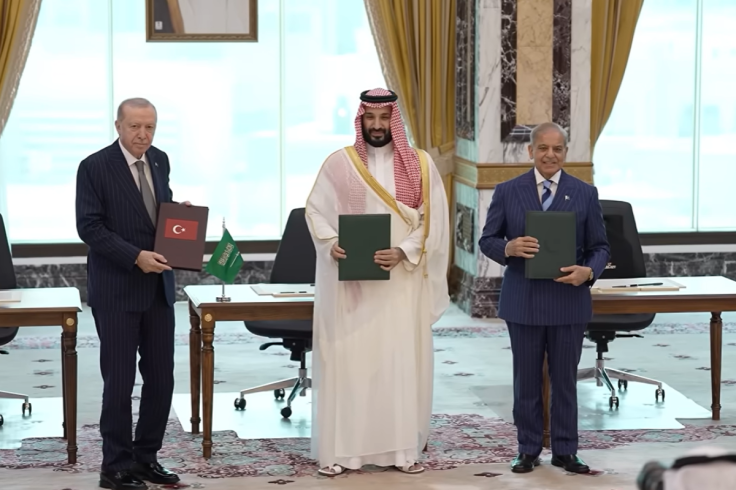
Turkiye, Saudi Arabia and Pakistan have signed a mutual defence pact that treats an attack on any one of them as an attack on all three, formalising a security partnership between three of the Muslim world's most powerful militaries.
The agreement, named the Mecca Joint Defence Agreement, was signed on 7 August by Turkish President Recep Tayyip Erdogan, Saudi Crown Prince Mohammed bin Salman and Pakistani Prime Minister Shehbaz Sharif, according to a joint statement published by the Saudi Press Agency and Pakistan's Ministry of Foreign Affairs.
The Mecca Mutual Defence Agreement is being read as an anti-Iran pact. That's the wrong lens.
— 𝐌𝐢𝐜𝐡𝐚𝐞𝐥 𝐀𝐫𝐢𝐳𝐚𝐧𝐭𝐢 (@ColdBrief) August 10, 2026
Saudi Arabia, Türkiye, and Pakistan didn't just sign a defense pact. They built the legal skeleton for something bigger - Article 51 language from the UN Charter, Article 5 language… pic.twitter.com/uvKsDKvf7v
What the Pact Actually Commits To
The core clause states that an armed attack against any one of the three states will be regarded as an attack against them all. Turkish Foreign Minister Hakan Fidan has described the arrangement as 'technically' similar to NATO's Article 5, the alliance's own collective defence principle.
Under the deal, the foreign and defence ministers of the three countries, along with their military chiefs, will hold regular committee meetings. A permanent secretariat will be established, based in Saudi Arabia, though the pact does not yet spell out fixed troop commitments or automatic military obligations.
Turkiye Insists the Pact Does Not Target Iran
Negotiations on the pact began shortly after October 2023, but gained pace as the war between the US-Israel-led coalition and Iran escalated and Saudi Arabia came under repeated attack from Iran and Iran-aligned groups including the Houthis in Yemen.
Pakistan and Turkiye have not faced direct attacks during the Iran war so far, but both have strong incentives to prevent the conflict spreading, given their proximity to the region. The deal also comes amid growing questions in Riyadh over how far it can continue to rely on its long-standing security relationship with Washington.
Fidan has rejected suggestions that the pact was designed as a response to Iran specifically. 'There is no common threat that we have put in writing,' he said, adding that no country would be viewed as a target unless it attacked one of the three signatories directly.
It's sad this alliance wasn't formed to defend Gaza, such trio - if fully sovereign & allied with Iran - would make Israel kneel, and make any U.S. sanction irrelevant.
— MenchOsint (@MenchOsint) August 11, 2026
On the contrary, this Saudi-led alliance was formed after US, Israel & Gulf allies failed to defeat Iran. https://t.co/kDToCA7W15 pic.twitter.com/PPKr1gaYqJ
Who Could Join Next and Who Is Reluctant
Fidan said Turkiye wants the alliance to grow beyond its founding members, and named Egypt as a 'natural partner' likely to join once unspecified 'technical issues' are resolved. Ali Bakir, a professor of international relations at Qatar University, said Egypt's entry would 'significantly increase the pact's political weight, regional influence and operational effectiveness'.
Former Qatari Prime Minister Sheikh Hamad bin Jassim Al Thani has separately said he hopes all Gulf Cooperation Council members will 'take the initiative to join' the pact. Analysts have named Qatar and Kuwait as the most likely Gulf candidates, given both felt exposed during the Iran war.
Not everyone expects rapid expansion, though. Karim Elgendy, an associate fellow at Chatham House, described the arrangement as 'a coalition of the willing that will grow on a case-by-case basis, shaped by each capital's own risk calculus', rather than a bloc set to expand automatically.
The pact marks the first formal collective defence commitment binding Turkiye, a NATO member with the alliance's second-largest army, to Saudi Arabia and nuclear-armed Pakistan. For a region unsettled by the Iran war and doubts over the durability of US security guarantees, it signals a shift toward Muslim-majority states building their own deterrence framework, one that could reshape alliances across the Gulf and South Asia depending on which countries eventually join.
© Copyright IBTimes 2026. All rights reserved.
- Recommended For You