Loyalty to MAGA Over the Pope? Why 39% of Republican Catholics Think Vatican Is 'Too Critical' of Donald Trump
Pope Leo XIV's criticism of Trump sparks a political and religious divide among US Catholics.

A growing share of Republican Catholics in the United States now believe the Vatican is too critical of Donald Trump, with a new Pew Research Center poll showing 39% hold that view following a public clash between the former president and Pope Leo XIV over Iran and immigration.
According to Irish Star, a survey conducted between 26 May and 1 June captured opinion in the immediate aftermath of an unusually direct exchange between the American-born pontiff and Trump. The row, which played out across interviews and social media, centred on US foreign policy and migration, but has since spilled into something broader: a test of political loyalty within the Catholic electorate.
Republican Catholics and the 'MAGA Over Pope' Divide
The numbers suggest a measurable shift. While overall approval of Pope Leo XIV among US Catholics remains relatively strong at 78%, support among Republican Catholics has dropped sharply. Around 72% now view him favourably, down from 84% in August last year, a 12-point decline that outpaces any dip among Catholic Democrats, whose approval fell from 89% to 84% over the same period.

That gap is not just statistical; it points to a deeper fracture in how authority is perceived. Among Catholic Democrats, 70% said Trump had been too critical of the pope, with only 3% arguing the reverse. Republican Catholics, however, were more divided: 39% said Leo had gone too far in criticising Trump, while 33% felt the president had overstepped.
This is where the tension becomes less about theology and more about political identity. For some on the right, criticism of Trump who remains the dominant figure in Republican politics appears to carry more weight than deference to the Vatican. It is a striking inversion for a faith that traditionally emphasises hierarchical authority.
Vatican–Trump Clash Fuels Approval Drop
The immediate trigger for the fallout was a disagreement over Trump's stance on Iran and his hardline immigration policies. In April, Pope Leo warned against what he described as a 'delusion of omnipotence' among leaders pursuing conflict in the Middle East, a remark widely interpreted as a rebuke of escalating rhetoric around Iran.
Trump responded forcefully. In a social media post, he labelled the pope 'WEAK on Crime, and terrible for Foreign Policy,' escalating what might otherwise have remained a diplomatic disagreement into a public feud.
The rhetoric intensified in a subsequent interview with conservative commentator Hugh Hewitt. Trump claimed without evidence that the pontiff was effectively aiding Iran. 'The pope would rather talk about the fact that it's OK for Iran to have a nuclear weapon,' he said. 'And I don't think that's very good. I think he's endangering a lot of Catholics and a lot of people.'
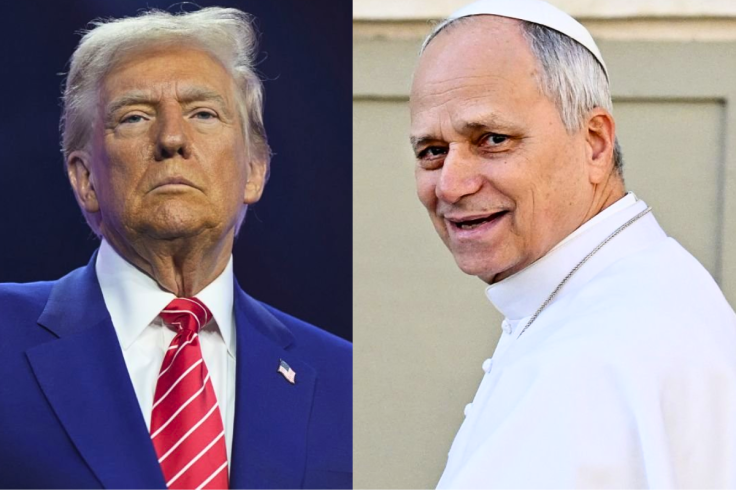
There is no indication Pope Leo has ever supported Iran obtaining nuclear weapons. His position, consistent with long-standing Church teaching, has been to oppose nuclear proliferation and advocate for dialogue. Responding to the criticism, Leo told reporters that the Catholic Church 'for years has spoken out against all nuclear weapons, so there is no doubt there.'
He added that his comments were grounded in religious doctrine rather than politics. 'The mission of the church is to preach the Gospel, to preach peace. If someone wants to criticise me for announcing the Gospel, let him do it with the truth,' he said.
Politics, Faith and a Fractured Audience
If the exchange felt unusually sharp, that is because it was. Popes rarely engage in direct rhetorical back-and-forth with political leaders, let alone one with such a defined domestic following. Yet the fallout has been amplified online, where clips of Trump's remarks and Leo's responses have circulated widely across X and YouTube, drawing sharply divided reactions.
Some conservative commentators have framed the pope's interventions as political overreach, while others particularly among Catholic leaders have defended his stance as consistent with Church teaching on peace and migration. The debate has not exactly been subtle; at times, it has veered into the kind of culture-war shorthand that reduces complex doctrine to partisan talking points. It is messy stuff.
The situation escalated further when Trump posted, then deleted, an image likening himself to Jesus Christ, prompting backlash even among some supporters. He later dismissed the controversy, suggesting he believed the image depicted him as a doctor. The explanation did little to quell criticism.
Meanwhile, diplomatic efforts have quietly continued. Secretary of State Marco Rubio visited the Vatican days after Trump renewed his criticism, in what officials described as an attempt to ease tensions. Whether that will have any lasting effect is unclear.
What is clear is that Pope Leo's standing among US Catholics remains broadly intact but increasingly polarised. His overall approval rating is comparable to that of his predecessor, Pope Francis, in the final years of his papacy. Yet within that headline figure lies a more complicated reality: a Church audience that is no longer politically cohesive, and perhaps never was.
© Copyright IBTimes 2026. All rights reserved.
- Recommended For You