Angry Backlash Erupts as JD Vance is Accused of Using Pope Leo XIV for Political Gain
When politics meets the papacy, even a single unproven phone call can become a test of faith and credibility.

JD Vance is facing a sharp backlash in Washington and online this week after claiming in a New York Times interview that he spoke directly with Pope Leo XIV 'in the last few months,' a boast Vatican-connected sources now openly question.
The row erupted after Vance, the US vice president and a high-profile Catholic convert, sat down with columnist Ross Douthat for a wide-ranging interview about his faith, foreign policy and the White House's escalating confrontation with Iran. The conversation, which might have drifted into the usual culture-war terrain, instead triggered an awkward and very specific question: did Vance really have a recent back-channel to the Pope, at the very moment Donald Trump was denouncing him over the war?
JD Vance's Pope Leo XIV Claim Under Scrutiny
In the interview, published last week, Douthat asked Vance directly, 'Did you talk to the pope at all in the last few months?' According to the transcript, Vance initially tried to dodge, pivoting to a general tribute about his 'respect for the Holy Father' until Douthat cut in and pressed him to answer.
At that point, Vance replied, 'Have I spoken to the pope in the last few months? Yes.' He went on to describe his relationship with Pope Leo XIV as a 'positive' one and knocked back any suggestion that he was quietly aligning himself with Vatican calls for peace, insisting he was not 'secretly on team peace.' When pushed for details, he refused, citing a policy against divulging private conversations.
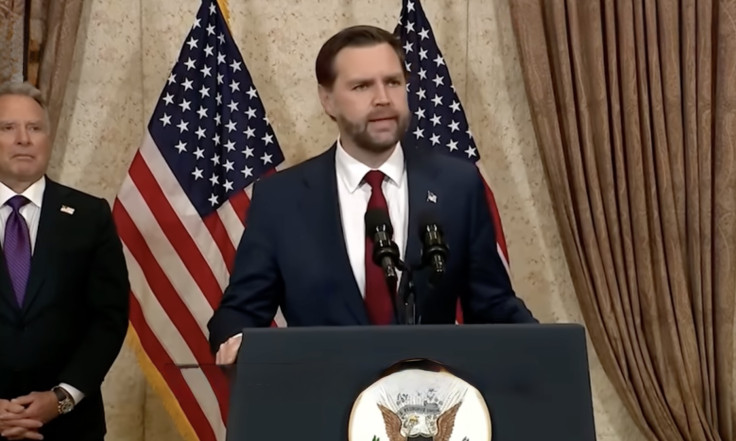
It can be recalled that this is not some minor protocol question. The alleged contact, as critics quickly pointed out, would have taken place while Trump and Vance were publicly hammering Pope Leo over his opposition to the US-led war in Iran. Earlier this year Trump branded the pontiff 'weak' after Leo condemned the president's 'genocidal' language and his threat to 'wipe out' Iranian civilisation before an eventual ceasefire.
That tension is why the detail matters. If Vance was indeed talking directly to the Pope while fronting a hawkish administration that mocked him in public, it would suggest a much more complicated, even cynical, diplomatic dance.
Vatican Sources Say There is 'No Record'
Into that gap stepped Christopher Hale, a writer and politician whose book Letters from Leo charts the Pope's interventions in world affairs. In a thread posted on X on 22 June, Hale said two Vatican sources with 'intimate knowledge' of the Holy See's diplomatic relationships had told him they were unaware of any recent conversation between Vance and Pope Leo XIV and were 'sceptical' it had taken place.
'Through my own reporting, I can find no record of that call,' Hale wrote. He stressed that it was still 'very possible' the men had spoken, but said any such exchange must have happened 'outside the normal channels of Vatican diplomacy, the protocol that ordinarily produces a record.'

'Either way, the call has left no trace on either side of the Atlantic,' he added. In another post he described the silence as 'what makes it strange,' noting that the reported contact would have occurred precisely when Trump and Vance were publicly criticising Leo over Iran.
IBTimes UK cannot independently verify Hale's sourcing, so everything should be taken with a grain of salt. What is clear, however, is that the Vatican usually goes out of its way to publicise Leo's outreach to heads of government. Official readouts were released after his call with Canadian prime minister Mark Carney, and the Holy See has likewise confirmed his conversations with French president Emmanuel Macron, Russian president Vladimir Putin and Mexico's Claudia Sheinbaum.
The absence of any such confirmation in Vance's case, at the very least, looks highly unusual by recent standards.
Social Media Erupts Over JD Vance and the Pope
The news came after months of heated argument between the White House and Rome over Iran, and users on X and other platforms moved quickly from scepticism to outright fury. Many accused Vance of casually using Pope Leo XIV as a political prop to soften his image with Catholic voters while the administration keeps its hard line abroad.
'Why won't Leo address it directly?' one user asked, reflecting the frustration among Catholics and non-Catholics alike that the Vatican has not simply confirmed or denied the contact.

Another wrote, 'Scumbag Vance should not be able to lie at will about the Pope ...,' while a third dismissed the vice president's claim outright, posting, 'He lies about talking to the pope. Par for the course.'
This is the kind of stuff that rarely lands quietly in American politics. Trump won a majority of Catholic voters in his successful 2024 re‑election bid, and the coalition he built remains crucial for Republicans in a country where Catholic identity is as much emotional as doctrinal.
For starters, that is why some Church watchers think the alleged call, real or not, is politically loaded. Vance gains obvious advantage if conservative Catholics believe he has a 'positive' personal line to Leo, one that might balance out Trump's public feud with the pontiff.
Why Attacking Pope Leo XIV Carries a Political Cost
Catholic Church expert Dr Pattenden, speaking about Trump's earlier attacks on the Pope, argued that going after the Holy Father is usually a losing strategy. 'Generally, for a political leader, it has been a bad idea to attack the Pope because it's a no‑win situation,' he said.

'The risk of alienating Catholic voters in a place like the United States is very substantial, even if they agree with President Trump over Pope Leo's position on various subjects,' he added. 'A lot of Catholics respond emotionally to the Pope, they don't like the sight of the president bullying him.'
That logic now sits awkwardly beside Vance's claim. On one level he is part of an administration that publicly brands the Pope 'weak.' On another, he presents himself as a confidant of the same man, shielded by the conventions of private diplomacy from having to show proof.
Hale's reporting hints at two possibilities, neither especially tidy. Either Vance did speak with Pope Leo XIV through an informal, unrecorded channel, cutting out the Vatican diplomats who normally manage such contacts. Or the conversation never happened and the vice president overstated his access in front of a prominent Catholic interviewer, assuming nobody would check.
In both scenarios, the optics are messy. For a politician already dogged by charges of opportunism, the impression that he might be free‑wheeling with the truth about a call to the Pope is not a minor detail. Whether the Vatican eventually clarifies the matter, or chooses to leave that silence hanging, will say a lot about who it thinks really benefits from keeping this story alive.
© Copyright IBTimes 2026. All rights reserved.
- Recommended For You