

'Masked Agents Terrorising Streets': NYC Mayor Slams Trump's Hardline Immigration Policies in Fiery Speech
Mamdani criticises immigration enforcement and inequality in a speech contrasting Trump's vision of America.
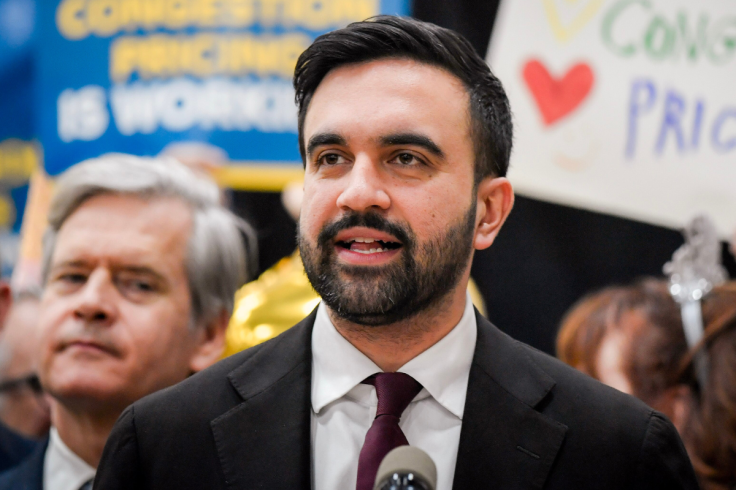
Zohran Mamdani used a July 3 speech at New York City Hall to lash out at immigration crackdowns and widening inequality, drawing a clear line between his politics and Donald Trump's as the United States marked its 250th anniversary.
The New York mayor's remarks, delivered from behind George Washington's desk, put the 'masked agents terrorizing our streets' line at the centre of a speech designed to sting.
The news came after Mamdani, speaking in the historic building in lower Manhattan, set out to mark America's semiquincentennial with a defence of immigrants and a broadside against what he sees as the country's drift towards exclusion.
It can be recalled that his address was timed against Trump's own Fourth of July messaging, and the contrast could hardly have been sharper. While Trump declared that the 'American dream is back', Mamdani argued that the dream still depends on whether the country is willing to live up to its own promises.
'Masked Agents Terrorising Streets' And The Politics Of The Speech
Mamdani's most inflammatory line was also the one that travelled fastest. 'We see masked agents terrorising our streets, eating food cooked by our undocumented neighbors before spiriting them away in unmarked vans,' he said, in remarks that appeared to target immigration enforcement under the Trump era without naming the president directly.
This sort of language is not subtle, and it was never meant to be. He wanted a jolt.
He cast the speech as a rebuke to a country where power, in his telling, has tilted too far towards the few. The mayor said America has been sold as a place of limitless possibility, while children still go hungry and billionaires keep pulling the rope in the same direction.
'We see a city of contradictions within a nation of contradictions,' he said, before describing a nation where 'monopolies that dominate every industry' and 'oligarchs who buy elections' sit uneasily beside working people trying to stay afloat.
The rhetoric was vintage Mamdani, sharp-edged and unapologetically populist. His critics will say it was performative stuff. His supporters will argue it was one of the few speeches this year that sounded like it was aimed at ordinary people rather than donors or cable news panels.
Why George Washington's Desk Mattered
The setting did a lot of the work. Mamdani spoke from behind the historic mayor's desk once used by George Washington, a detail that gave the speech a theatrical quality and, predictably, gave his opponents fresh ammunition.
Washington's desk was not just a prop, it was the point. Mamdani used it to argue that American greatness is not fixed in bronze, but something still being argued over. He said the country is exceptional not only because of its military strength, but because 'nothing is fixed into place.'
That idea ran through the rest of the address. Surrounded by naturalised citizens, Mamdani spoke about a country that welcomes people from elsewhere and then too often tells them to be grateful for scraps. He said that, in the eyes of the powerful, America belongs only to those with 'the right accent or the right shade of skin'. It was a pointed line, and not one designed to win over moderates.

The irony, of course, was immediate and obvious to critics. Some argued that attacking wealth from Washington's desk was rich, considering the former president's own status as a wealthy slave owner. Others went further and used the speech to question Mamdani's legitimacy as an immigrant politician, a reaction that was as ugly as it was predictable.
Trump, Immigration And The Online Backlash
The immediate backlash moved fast across social media. Republican candidate Bruce Blakeman called the speech 'a dark and vindictive appraisal of America's past, present and future,' and accused Mamdani of being a 'dangerous subversive.'
Other posts were more personal, questioning whether Mamdani, because of his background, understood what it means to be American.
There was also support, mainly from people who saw the speech as a rebuttal to Trump's harder line on immigration and a defence of the city's immigrant identity. Mamdani has previously taken a hard stance against US military funding for Israel, and in this speech he folded that into a broader critique of foreign wars, health insurers and landlords who, in his words, treat negligence as a business model.
He said he saw America in 'the father who tucks his children into bed beneath a ceiling stained with leaks' and in workers whose tax dollars go towards 'bombs and bailouts.'
Whether the speech shifts anything in policy terms is another question. What is not in doubt is that Mamdani chose confrontation, and did so with enough symbolism, and enough bite, to make sure the country noticed. That was the point, after all, though some of the reaction has been pretty mad.
© Copyright IBTimes 2026. All rights reserved.