2028 or Never: The Realistic Timeline for The Winds of Winter That May Never Exist
The fantasy epic that once raced ahead of its readers has slowed to such a crawl that its next chapter now feels like a test of faith as much as patience.

The Winds of Winter remains unfinished, with George R.R. Martin confirming in January 2024 that he still has roughly 1,100 manuscript pages completed and no publication date in sight, more than a decade after he began work on the next instalment in A Song of Ice and Fire.
The 75-year-old author, speaking in recent interviews and through his publisher, has repeatedly acknowledged the stalled progress, leaving readers to contemplate whether the sixth volume will arrive by 2028 or not at all.
When Martin launched A Song of Ice and Fire in the 1990s, the pace seemed brisk and reassuring. A Game of Thrones appeared in 1996, A Clash of Kings in 1998, and A Storm of Swords in 2000. A two-year gap between instalments for a fantasy saga of that scale felt not only manageable but almost luxurious. Fans could reasonably imagine a completed seven-book series arriving within a conventional author's career.
A Feast for Crows did not reach shelves until 2005. That five-year delay, now almost quaint by Martin's later standards, was the first real sign that the story had begun to outrun its creator. The plot had spread across continents, with a ballooning cast of point-of-view characters whose paths had to intersect in coherent, satisfying ways. According to Martin's own blog posts at the time, the narrative became unwieldy enough that he ultimately split the planned book in two.
That decision gave readers A Feast for Crows mostly set in King's Landing, the Riverlands, Dorne and the Iron Islands while pushing the northern and eastern storylines into what became A Dance with Dragons. On paper, the fix sounded straightforward. In reality, it created what Martin later labelled the 'Meereenese Knot,' a tangle of plotlines and character arcs centred on Daenerys' storyline that resisted every structural trick he tried.
Martin has written that the problem dogged him from 2005 until he finally hit on a solution involving a new point-of-view chapter, widely believed by readers to belong to Ser Barristan Selmy. The book eventually surfaced in 2011 the same year HBO launched Game of Thrones, the adaptation that would dominate the next decade of his professional life.
Martin has said he lifted at least two chapters from A Dance with Dragons and moved them into the sixth volume as early as 2010. In 2011, buoyed by what still looked like a manageable workload, he publicly floated 2014 as a target finish date.
The television series had sprinted past the published novels, and Martin's role as executive producer and public figure for a global franchise had grown to the size of a second full-time job.

How The Winds of Winter Fell Behind Its Own Hype
By Martin's own admission, The Winds of Winter is more complex than any of its predecessors. The scale of the war in Westeros, the looming Others, and the unfinished business in Meereen and the North all converge here. What was once a tightly focused political fantasy became, by book five, a sprawling epic with dozens of active narrators. Each additional subplot is another set of dominos he has to line up without collapsing the entire structure.
As the franchise expanded to prequels, sequels and stage projects, Martin was drawn deeper into development and promotion. Officially, he serves as executive producer on multiple spin-offs. Unofficially, the series turned him into a travelling spokesperson for an enterprise much larger than one man and a DOS word processor. The time that once went exclusively into book pages is now shared with writers' rooms, meetings and conventions.
During the pandemic, there was a brief surge of optimism. With travel suspended, Martin used his blog to report a burst of productivity on The Winds of Winter, describing isolation as a chance to concentrate on the manuscript.
In October 2022, he told Penguin Random House he was 'about three-quarters of the way done' and elsewhere estimated he had between 1,100 and 1,200 pages drafted, with perhaps 400 to 500 left. That implied a total around 1,700 pages a doorstop even by his own standards, but at least a doorstop moving towards completion.
2028 or Never
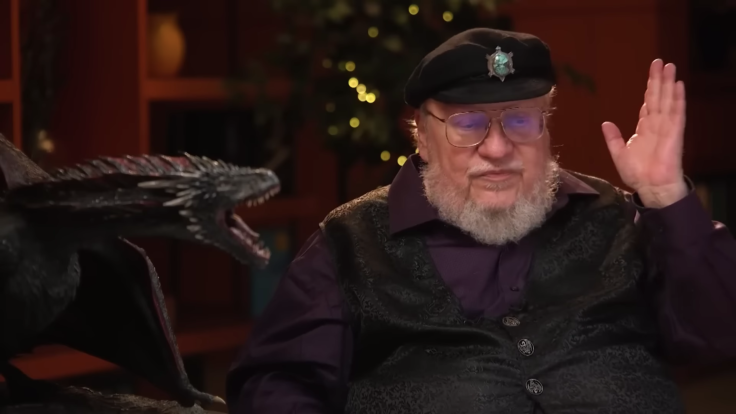
By 2023, Martin was telling interviewers that his page count had not meaningfully changed. In January 2024, he told The Hollywood Reporter he had 'around 1,100 manuscript pages finished,' repeating almost exactly the number cited in 2022. For all practical purposes, work on The Winds of Winter has been frozen for at least two years.
If Martin's 75% figure is correct and he truly has 400 to 500 pages left, then an optimistic scenario runs like this. He clears his schedule, treats the book as his main job rather than one project among many, and spends the next year or so pushing to a complete first draft. Even allowing another two years for revision, editing and production, an early 2027 release would be conceivable.
Nobody who has watched the last decade unfold expects the optimistic path to hold. A more realistic view accepts that Martin will continue juggling other commitments. He appears unlikely to abandon his executive producer roles or the broader Game of Thrones universe he helped build. He has also been candid, at times, about waning motivation and the pressure that now clings to every sentence he writes in this world.

In that light, 2028 looks less like a fan joke than a genuine outer edge. If the manuscript inches forward at the pace implied by his recent comments, there is no reliable way to predict a delivery date. Nothing, at this stage, is confirmed, and any projected year should be taken with a heavy dose of scepticism.
The uncomfortable truth is that The Winds of Winter now occupies a strange cultural space: both urgently awaited and increasingly hypothetical. The pages we know exist are real enough. Whether readers will ever hold them between two covers is the part no one, including George R.R. Martin, can honestly promise.
© Copyright IBTimes 2026. All rights reserved.
- MOST POPULAR IN Entertainment