

Trump's DOJ Defence of a UFC Fight on the White House Lawn Is That the Lawsuit 'Arrived Too Late' To Matter
The Justice Department argues against emergency injunction to stop UFC Freedom 250 on White House grounds.

The Justice Department has told a federal judge that a lawsuit seeking to block a UFC fight on the White House's South Lawn is too little, too late to matter.
Justice Department lawyers filed a court brief on Tuesday evening urging US District Judge Amit P. Mehta to reject an emergency bid to stop UFC Freedom 250, a mixed martial arts event scheduled for 14 June on the South Lawn of the White House. The DOJ argued that months of planning, over £46 million ($60 million) in production costs, and the imminent health risks to 14 professional athletes made the challenge practically unworkable.
The lawsuit, filed the previous Saturday by the Public Integrity Project on behalf of two Virginia residents, alleged that federal officials violated the law by staging a private sporting event on public land without congressional authorisation or environmental review.
The DOJ's brief dismissed all claims as 'meritless' and accused the plaintiffs of waiting until the eve of the event to act, calling their legal effort a 'heckler's veto' dressed up as civic concern.
The Emergency Injunction Bid the DOJ Called a 'Heckler's Veto'
The two plaintiffs, Paul Romano, a retired Air Force sergeant and Vietnam War medevac veteran from Springfield, Virginia, and Susan Douglas, a Democratic civic activist, filed their lawsuit on Saturday, 7 June. Their suit, backed by the Washington-based Public Integrity Project, named the National Park Service, the Interior Department, and Interior Secretary Doug Burgum as defendants. The event, they argued in court filings, was 'deeply corrupt' and amounted to a hand-off of two of America's most protected national monuments to a private, for-profit corporation.
The core legal argument in the complaint rested on three points. First, that National Park Service regulations generally prohibit commercial sporting events on federal parkland, including the South Lawn and the Lincoln Memorial, where fighter weigh-ins are planned for the night before the event.
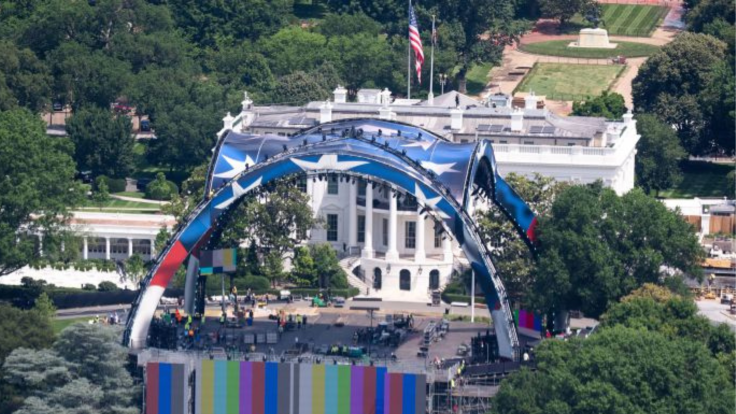
Second, that the 92-foot, 600-tonne structure erected on the South Lawn and nicknamed 'The Claw' required express congressional authorisation under DC land law before it could be built. Third, that no environmental impact review was conducted before construction began on the South Lawn, in violation of the National Environmental Policy Act. Bloomberg Law reported on the environmental claims in detail.
The plaintiffs also argued that a temporary NPS regulation created to ease restrictions on events tied to America's 250th anniversary did not apply to UFC Freedom 250. Their filing stated the event was 'neither 'for the celebration of the 250th anniversary of American Independence' nor, crucially, being 'planned, organised and executed' by the federal government,' citing language from the amended NPS regulations themselves. They sought an emergency injunction, asking Judge Mehta to rule before Thursday.
DOJ's Court Brief: Timing, Athletes' Health and the Permit Question
The Justice Department's rebuttal, filed Tuesday evening, did not merely defend the event's legality; it took direct aim at the plaintiffs' credibility and motives. DOJ attorneys wrote in the court filing that 'no one is holding plaintiffs in a jiu jitsu lock, forcing them to watch UFC Freedom 250 against their will,' adding that 'the public interest does not favour allowing them to exercise a heckler's veto, particularly at this late date.'
The government argued that Romano and Douglas had waited silently for months while costs mounted, workers built the structure, and athletes began weight-cutting regimens, before suddenly demanding a court order days before the event.
On the permit question, the DOJ's position was direct. Attorneys told the court that 'with respect to the events on the South Lawn, the NPS permit regulations are beside the point. The White House is sponsoring and hosting this event, and the White House does not need a permit from NPS to host events on White House grounds.'
The brief also noted that the South Lawn is 'not a public forum' and therefore falls outside the scope of the NPS permitting regime. Regarding the congressional authorisation claim, the DOJ argued that federal law does not require Congress to approve 'temporary structures' on White House property, and that The Claw was already scheduled for dismantlement the Monday after the fight.
The DOJ's most visceral argument centred on athlete welfare. The brief warned that any delay 'could jeopardise the health of the 14 professional athletes involved in the event, as prolonged weight cutting can result in heat injuries, urinary and kidney problems, including kidney failure, seizures, and hypovolemia-induced shock.' With more than 120,000 spectators expected across the South Lawn and the Ellipse, the government's lawyers framed an injunction not as legal accountability but as an act of sabotage against a national celebration.
The Corruption Allegation Driving the Lawsuit
Separate from the statutory arguments, the Public Integrity Project built its case on a conflict-of-interest claim. The group's complaint noted that President Trump had purchased up to £38,500 ($50,000) in TKO Group Holdings stock, the UFC's parent company, earlier this spring, while UFC chief executive Dana White, a longstanding Trump ally and former campaign surrogate, was simultaneously selling VIP packages to the event for £1.15 million ($1.5 million) each. One TKO executive had publicly described the White House as 'the greatest earned-marketing tool of all time,' according to the complaint. White acknowledged in the lead-up to the event that the fight was Trump's idea, though he denied it was a birthday celebration.
Brendan Ballou, the Public Integrity Project's chief executive and lead attorney, told the Associated Press that 'this is a profound misuse of our sacred national monuments for private gain.' Ballou, a former Justice Department prosecutor who resigned in 2025 following Trump's pardons of January 6th rioters, also confirmed that the group anticipated a ruling on the emergency injunction this week. The group has previously filed lawsuits challenging the DOJ's proposed anti-weaponisation fund and the administration-brokered TikTok sale.
The White House, in a statement to Newsweek, dismissed the challenge as 'obstructionist, baseless, and dilatory,' insisting the event was 'no different than the various other White House-hosted events on the South Lawn and properly permitted events on the Ellipse and National Mall throughout the year.'
A separate administration official called the suit an attempt to 'prevent President Trump from hosting what will undoubtedly go down as one of the most historic sporting events in our Nation's history.'
© Copyright IBTimes 2026. All rights reserved.