

Donald Trump Showing Same Dementia Symptoms as Father Fred Trump at Age 80, Joanna Coles Claims
Joanna Coles claims Donald Trump may be showing age-related cognitive patterns similar to his father, sparking debate over his rhetoric and fitness.

Donald Trump is showing signs of ageing similar to those experienced by his father Fred Trump at a comparable stage of life, according to journalist Joanna Coles, who made the claim during a recent episode of Inside Trump's Head released this week in the United States, where she discussed the president's rhetoric and mental sharpness alongside author Michael Wolff.
For context, the remarks came as Trump has intensified his attacks on Democrats, repeatedly branding them 'communists' in recent speeches and public appearances, a line of attack that has resurfaced amid primary wins by Democratic Socialists in several congressional races.
Donald Trump Dementia Claims Surface in Podcast Discussion
Coles pointed directly to Trump's family history, noting that his father developed dementia later in life. 'Trump's symptoms of dementia started showing up when he was 80,' she said, referring to Fred Trump. She then suggested that similar patterns could be emerging in the president, framing it cautiously as part of a broader ageing process rather than a confirmed diagnosis.
Her point was less clinical than observational. As she put it, older individuals can sometimes recall distant memories more vividly than recent events, which may shape how they interpret the present. That framing matters, because it stops short of a medical claim, but it still lands as a pointed critique of Trump's current behaviour.

Wolff, who has written extensively about Trump, including Fire and Fury, took a slightly different angle. He linked Trump's rhetoric not only to age but to long-standing influences. Roy Cohn, Trump's mentor, was closely associated with Senator Joseph McCarthy, whose anti-communist crusades defined a political era. According to Wolff, that influence still echoes in Trump's language today.
'Trump exists in decades gone by,' Wolff said, suggesting that the president's worldview may be anchored in earlier political battles that no longer align neatly with current realities.
Age, Politics and a Familiar Line of Attack
Trump's repeated use of the term 'communist' has become more noticeable in recent months, particularly as progressive candidates gain traction within the Democratic Party.
Whether that framing resonates with voters or feels dated is another question, and one that Wolff addressed bluntly.
He argued that the rhetoric could reflect political pressure rather than cognitive decline.
'Everybody sees these numbers, these midterm numbers, and they're trying to do something,' he said, describing Trump's camp as 'flailing' in response to shifting political dynamics.
At the same time, Wolff acknowledged that age does play a role, though not necessarily in the way headlines might suggest. 'The people in the White House also appreciate the fact that he is old,' he said, adding that it is 'not necessarily dementia, but it is a frame of reference that he can't update.'
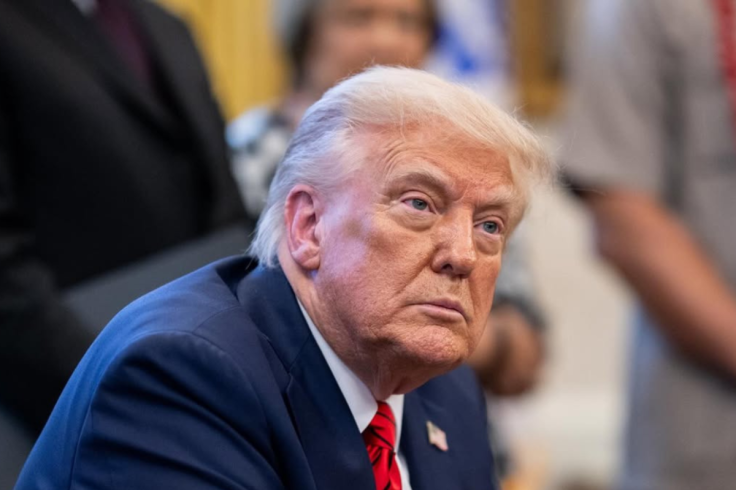
Online, the discussion has gained traction, with clips from the podcast circulating across platforms. Reactions appear mixed, with some users echoing concerns about Trump's age and others dismissing the comments as politically motivated speculation. IBTimes UK cannot independently verify the extent or authenticity of all online reactions, so they should be treated cautiously.
Still, the conversation taps into a broader issue that has shadowed American politics in recent years, the age of its leading figures. Trump, now approaching 80, is not alone in facing scrutiny over stamina, memory and judgement. The debate is as much about perception as it is about evidence, and perception, in politics, can be everything.
There is, notably, no medical confirmation supporting claims of dementia in Trump's case. Neither Coles nor Wolff presented clinical evidence, and no official diagnosis has been made public. What exists instead is a mix of personal observation, historical comparison and political interpretation.
Whether voters see that as a red flag or just more noise in an already loud election cycle remains unclear. But the line between sharp attack and dated talking point is getting thinner, and Trump's critics are starting to push on it more aggressively.
And then there is the uncomfortable question sitting just beneath all of this, one that neither Coles nor Wolff fully answers. At what point does political style become something else entirely?
© Copyright IBTimes 2026. All rights reserved.