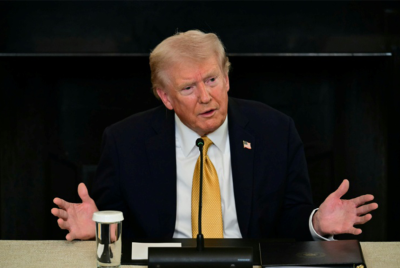
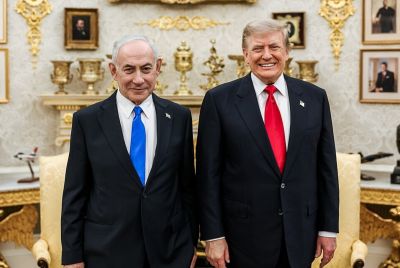
Trump and Netanyahu Assassination Reward Offered as Iran Parliament Drafts Multi-Million-Pound Legal Bounty
Iran escalates tensions with proposed legislation offering a bounty for the assassination of US President Trump.

Iran's parliament is drafting legislation that would legally obligate the government to pay £44 million (€50 million / $54 million) to any individual, corporation, or organisation that assassinates US President Donald Trump, marking a dramatic escalation in Tehran's campaign of retaliatory threats against Western and Israeli leaders following the joint US-Israeli military operation that killed Supreme Leader Ali Khamenei on 28 February 2026.
The bill, announced on 14 May by Ebrahim Azizi, Chairman of the Iranian Parliament's National Security and Foreign Policy Committee, extends its targets beyond Trump to include Israeli Prime Minister Benjamin Netanyahu and the Commander of US Central Command (CENTCOM). It represents the most explicit state-level formalisation yet of what had previously circulated as a grassroots and quasi-official campaign, and signals that Tehran is prepared to put legal mechanisms behind threats that Washington has treated as criminal conspiracies.
A Parliament Drafts Its Vengeance
Azizi made the announcement in a televised interview with Iranian state television, speaking in direct, unambiguous language. 'We believe the vile president of the United States, the ominous and disgraceful Zionist prime minister, and the CENTCOM commander must be targeted and subjected to reciprocal action,' he said, according to Iran International, a London-based Persian-language broadcaster. 'This is our right. Just as our Imam was martyred, the president of the United States must be dealt with by any Muslim or free person.'
He confirmed that the bill, titled 'Counter-Action by the Military and Security Forces of the Islamic Republic', stipulates that 'if any natural or legal person carries out this religious and ideological mission, the government is obliged to pay €50 million as a reward.' The bill remains under parliamentary review and has not been enacted into law, according to reporting by Iran International and IranWire.
The backdrop to this legislation is the 2026 Iran war, which began on 28 February when US and Israeli forces launched nearly 900 airstrikes across 12 hours targeting Iranian military infrastructure, air defences, missile sites, and leadership, killing Khamenei and over 40 senior officials, according to Britannica's documented account of the conflict. Iran's government declared 40 days of national mourning and rapidly assembled an interim leadership council. Mojtaba Khamenei, son of the slain Supreme Leader, subsequently assumed leadership.
🚨 Iran’s Islamist Terror Regime is proposing a €50,000,000 bounty for the murder of President Trump.
— Israel War Room (@IsraelWarRoom) May 15, 2026
The lawmaker behind the proposal also calls for the murder of Prime Minister Netanyahu and the Commander of US CENTCOM, Admiral Cooper. https://t.co/4UMWrGnSh1
A Campaign That Predates the Bill
The parliamentary proposal did not emerge in a vacuum. Since March 2026, a state-promoted grassroots fundraising campaign dubbed 'Kill Trump' has been actively circulating within Iran, promoted in part through mass text messages sent directly to mobile users across the country. Screenshots of those messages were shared with Iran International, which reported that the messages urged recipients to register their support via a designated website and confirm participation by SMS.
Tehran-based monitoring outlet Didban Iran reported that approximately 290,000 people had participated in the fundraising campaign, with pledged amounts reaching $25 million (£23 million). Pro-regime media outlet Masaf, linked to influential hardliner Ali Akbar Raefipour, separately claimed that $50 million (£46 million) in financial resources had already been secured for the campaign.
The cycle of reciprocal bounties has deepened with the involvement of state-adjacent cyber actors. The Iran-linked hacking group Handala, formally attributed to Iran's Ministry of Intelligence and Security (MOIS) by the US Department of Justice in March 2026, following the FBI's seizure of four of its websites, issued a statement declaring a $50 million (£46 million) reward for the 'elimination' of Trump and Netanyahu. The group cited the DOJ's own $10 million reward for information on Handala members as the trigger for their counter-declaration. Cybersecurity firm Check Point Research tracks Handala under the name Void Manticore, describing it as 'one of the most active groups pursuing strategic objectives through cyber operations' on behalf of the Iranian regime.
Washington's Counter-Measures
The United States has not stood idle. On 14 May, the same day Azizi announced the parliamentary bill, the State Department's Rewards for Justice programme published an advertisement offering up to $15 million (£13.8 million) for information capable of disrupting the financial networks of Kimia Part Sivan Company (KIPAS), which the State Department identifies as the drone-production arm of the IRGC's Quds Force. The official Rewards for Justice post on X read: 'Help us put a dent in the IRGC's revenue stream.'
The reciprocal bounty architecture reflects a broader pattern. In November 2024, the DOJ unsealed criminal charges detailing an alleged IRGC plot to assassinate Trump prior to the 2024 presidential election. An undercover video shown in a Brooklyn courtroom in February 2026 captured an alleged Iran-linked operative describing the plan, placing a vape pen on a napkin to represent his 'target' in a demonstration recorded by hidden camera and later published by the New York Post. The operative was accused of attempting to hire two men to kill Trump for $5,000 upfront. Trump has faced documented Iranian assassination threats since he authorised the 2020 drone strike that killed IRGC Quds Force commander Qassem Soleimani.
Help us put a dent in the IRGC’s revenue stream.
— Rewards for Justice (@RFJ_USA) May 14, 2026
Send us a tip on these bad boys, who manage this drone manufacturer. pic.twitter.com/gwt0jyUqfx
The Stakes Behind the Rhetoric
Iran's parliament is also operating in the context of severe military and economic strain. Iran disrupted shipping through the Strait of Hormuz, a waterway carrying approximately one-fifth of global oil and gas trade, following the joint US–Israeli strikes, triggering condemnation from Western governments, Persian Gulf Arab states, and international shipping groups. Iran has also launched missile and drone strikes against US-aligned Arab states including the UAE, Qatar, Bahrain, Kuwait, and Saudi Arabia, targeting military facilities and energy infrastructure.
The bounty bill, in this context, is as much a political signal to domestic hardliners and regional allies as it is a literal call to action. It converts grief over Khamenei's killing into formalised legislative vengeance, and places the Islamic Republic on record as a state that has put a legal price on the head of a sitting US president.
The bill remains under review in the Iranian parliament. It has not been signed into law.
© Copyright IBTimes 2026. All rights reserved.
- Recommended For You