Parental Shock Poll: 3 in 4 Back Social Media Ban for Under-16s, But Majority Doubt It Will Work
Parents express concern over social media's impact on children, but doubt the effectiveness of strict bans.

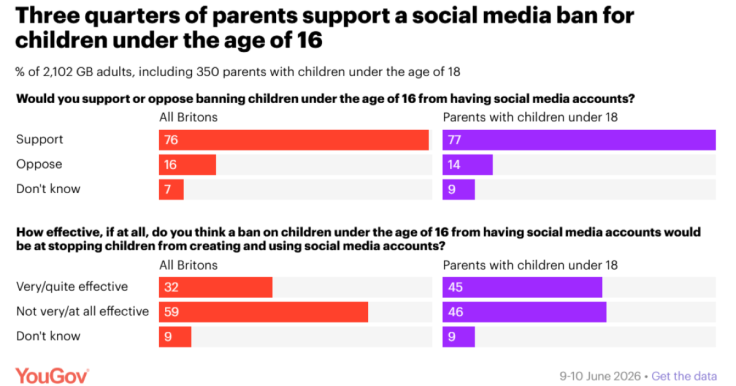
A large majority of parents support restricting social media use for children under the age of 16, according to YouGov research, reflecting deep and sustained concern about the role digital platforms play in childhood development.
The findings are reinforced by wider YouGov data showing that around eight in ten parents believe social media has a negative impact on children overall, underlining the scale of anxiety around online environments and their influence on young users.
In separate polling, YouGov found that 53 per cent of Britons believe sustained social media use is 'very harmful' to children under 16, while a further 36 per cent describe it as 'fairly harmful,' meaning almost nine in ten adults now view it negatively.
Parents most frequently associate social media with exposure to harmful content, reduced attention spans, sleep disruption, and increased pressure linked to comparison culture and online validation.
53% of Britons believe sustained social media use is very harmful to children, as a new report by medical leaders claims social media is the new smoking
— YouGov (@YouGov) May 26, 2026
Very harmful: 53%
Fairly harmful: 36%
Not very harmful: 5%
Not harmful at all: 1% pic.twitter.com/2oO0ugzLnm
Earlier, YouGov polling has also shown that concern is widespread beyond parents alone, with large majorities across the public consistently rating social media as damaging to children's mental health and development.
Strong Support For Restriction, But Limited Confidence In Effectiveness
Despite strong backing for restrictions, the same polling reveals a striking contradiction: more than half of parents do not believe a strict under-16 social media ban would be effective in practice.
This creates a clear divide between intent and expectation, with many parents expressing support for tighter controls in principle, but uncertainty over whether such measures could meaningfully change behaviour once children have access to devices.
The gap highlights a growing realism among parents about how digital habits develop in practice, particularly in households where smartphones and social media are already embedded in daily routines.
Some comparative data also suggests this scepticism is not unique to the UK. In international YouGov research on similar proposals, parents reported mixed expectations about enforcement outcomes even when they strongly supported the idea of restrictions.
Why Parents See Social Media As Harmful
YouGov and related research point to several recurring concerns raised by parents when discussing children's social media use:
- Exposure to inappropriate or distressing content
- Cyberbullying and peer comparison pressures
- Addictive platform design and endless scrolling features
- Reduced face-to-face interaction
- Sleep disruption linked to late-night usage
In qualitative responses, many parents also highlight algorithm-driven content systems, where children may be repeatedly shown emotionally intense or attention-grabbing material regardless of intent.
YouGov analysis shows that a majority of adults describe the mental health impact of social media on children as negative, with many citing anxiety, depression, and reduced self-esteem as key concerns.
The Enforcement Gap: Why Many Parents Doubt A Ban Would Work
A central issue emerging from the polling is not disagreement about risk, but doubt about control.
Parents questioning effectiveness point to the practical reality that age restrictions are often difficult to enforce in digital environments where:
- Accounts can be created with false ages
- Devices are shared across households
- Alternative platforms are easily accessible
- Children often learn workarounds quickly
Some digital safety analysts describe this as a 'compliance gap', where rules exist in principle but are difficult to enforce consistently in practice.
There is also concern among parents that strict bans could push younger users towards less-regulated or harder-to-monitor online spaces, rather than reducing overall exposure.
This has led many to view strict bans as symbolic rather than operational, addressing concern but not necessarily behaviour.
A Generational Shift In How Childhood Is Experienced
The findings reflect a broader transformation in how childhood itself is structured.
Children today are growing up in an environment where:
- Social interaction is partially digital
- Identity formation is influenced by online feedback
- Entertainment and communication are algorithmically curated
This has created what researchers describe as a highly mediated childhood, where boundaries between offline and online life are increasingly blurred.
Parents are therefore not only responding to risk, but also adapting to a rapidly changing developmental environment that did not exist a generation ago.
Concern, But Not Certainty: The Parenting Dilemma
What the polling ultimately reveals is not a simple demand for restriction, but a more complex parenting dilemma.
On one hand, there is strong instinctive support for reducing children's exposure to social media. On the other hand, there is recognition that:
- Children are highly digitally adaptable
- Enforcement is difficult in practice
- Total restriction may be unrealistic in everyday life
This tension results in a dual mindset: high concern paired with low confidence in solutions.
It also reflects a broader uncertainty about where responsibility lies with parents, platforms, or children themselves.
Some parents also note that social media is not uniformly negative, with a minority acknowledging benefits such as maintaining friendships, creative expression, and community participation, particularly for teenagers in marginalised groups.
What This Means For Digital Childhoods
Taken together, the findings suggest that concerns about social media are now deeply embedded in modern parenting culture.
However, they also indicate that solutions are not straightforward. While many parents support the idea of stricter limits, there is limited agreement on whether prohibition alone can meaningfully reshape behaviour.
Instead, the debate appears to be shifting towards a more complex question: how to build healthier digital habits rather than simply restricting access.
This reflects a broader shift in public opinion from asking whether social media is harmful to asking how its effects can realistically be managed in everyday family life.
© Copyright IBTimes 2026. All rights reserved.
- Recommended For You