Trump Ruthlessly Mocked for All-Caps 'Obuma' Tirade Over Rumoured State Fair Flop
Trump's post on Great American State Fair has triggered a wave of mockery online, as critics focus on an 'Obuma' typo and visual evidence of lower-than-claimed attendance.

Donald Trump has faced a fresh wave of online ridicule after posting a glowing endorsement of the Great American State Fair in Washington, DC, only to be met with immediate pushback regarding both his spelling and the event's actual turnout.
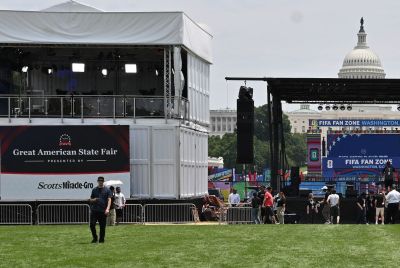
While the president claimed the National Mall exposition, currently running as part of the nation's 250th anniversary celebrations, was 'packed with happy people', visual evidence from the scene suggested a significantly different reality.
The controversy intensified when the president's all-caps tirade against 'Obuma' and 'Sleepy Joe Biden' went viral, turning a would-be boast into a case study in Obuma typo social media mockery that quickly dominated political discourse.
Trump used Truth Social on Monday to defend the fair and described the event as a 16-day showcase running from June 25 to July 10, with pavilions representing all 50 states and six territories, a 110-foot Ferris wheel and themed attractions linked to the wider America 250 project.
Trump Ruthlessly Mocked After Fair Post
Trump wrote that people should 'ask yourself this simple question' before declaring, in all caps, 'DO YOU THINK THAT OBUMA OR SLEEPY JOE BIDEN COULD HAVE DONE IT? THE ANSWER IS NO!' The post was meant as a boast, but social media users took it as more of a confession that the event needed rescuing.
There was a reason for the backlash. Live coverage from the National Mall on June 26 and June 28 showed the fair's attractions and exhibits, but the tone of the video reports suggested a scene that was active rather than overflowing. It was also reported that photo evidence from the event did not match Trump's claim that the fair was packed, and that is the kind of mismatch the internet never misses.
He is totally delusional https://t.co/H1HW4EoRgO
— Martina Navratilova (@Martina) June 29, 2026
The 'Obuma' dig also invited ridicule on its own terms. A misspelling in a presidential post is hardly a constitutional crisis, but it does make the whole thing look sloppy, and Trump's critics were quick to seize on that.
More broadly, the attack on Joe Biden sat awkwardly beside Trump's own long-running public image, which has included plenty of speculation about his energy and stamina, even if his allies dismiss that as noise.
A Mismatch Between Boasts And Reality
The Great American State Fair was billed as a patriotic centrepiece for the run-up to the country's 250th birthday. The event would stretch from the Capitol to the Washington Monument and include military flyovers, musical performances and civic programming, while organisers said it was intended to showcase American culture, history and innovation.
A big government-backed spectacle on the National Mall, with national symbolism baked into every banner and stage, should not look half-empty on camera. When it does, the reaction can turn savage in a hurry, and that is exactly what happened here.
Trump, though, did not seem in any mood for self-doubt. In the same post, he said Americans should 'appreciate what a fantastic job we did' and insisted that 'everybody' loved the fair.
Critics took that as classic Trump, a demand for applause that only made the silence louder. The whole exchange had the air of a never-ending hissy fit, which, fair or not, is precisely the kind of language his opponents love to pin on him.
Trump is bragging about putting a fair together because he's failed on the economy.
— Congressman Shri Thanedar (@RepShriThanedar) June 29, 2026
Inflation has risen under his watch to the highest level in years.
Job growth fell by more than 90% his first year back in office.
Inflation is now outpacing wages.
SAD! https://t.co/9KTmZyZD4u
Political Theatre And Public Perception
There is also a larger political point tucked inside the noise. Trump has made nationalism, spectacle and personal branding central to his political identity, so when a showcase event attached to his name appears underwhelming, the disappointment is not just about footfall.
It is about theatre, about control, about whether the image on screen matches the boast in the post. On Monday, it did not. And once that gap opens, the internet does the rest.
Ultimately, the incident underscores the degree to which personal branding and spectacle have become central to the president's identity.
When a showcase event tied to his name proves underwhelming, the fallout rarely ends with attendance numbers; it becomes a debate about control and the accuracy of the projected image.
For the internet, the 'Obuma' post became a convenient shorthand for a performance that did not quite live up to the promise, proving once again that in the digital age, a single typo can do as much damage as a thousand critics.
© Copyright IBTimes 2026. All rights reserved.
- Recommended For You