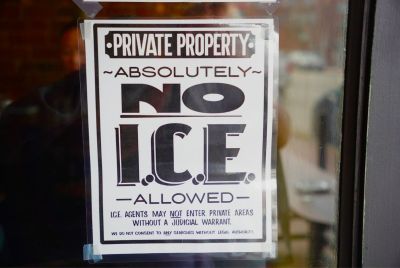
DOJ Reportedly Reviving Rare Civil War-Era Law To Charge Ice Protesters, Raising Free Speech Fears
An investigation found the DOJ has expanded its use of a seldom-invoked Civil War-era law in cases involving ICE protests.

The US Department of Justice has reportedly been relying on a rarely used Civil War-era conspiracy law to prosecute protesters accused of obstructing Immigration and Customs Enforcement officers, prompting concern from some legal experts and civil liberties advocates who say the strategy could have implications for free speech and peaceful protest.
According to a public review of federal court records, prosecutors have brought more than three dozen cases under the statute since President Donald Trump returned to office, with all of them linked to demonstrations against immigration enforcement.
To recall, the federal offence of conspiracy to impede or injure an officer has historically been used only sparingly. Before 2025, many of its most prominent modern applications were connected to prosecutions arising from the 6 January 2021 attack on the US Capitol involving groups such as the Proud Boys and the Oath Keepers.
Those cases were later dismissed or ended through presidential pardons after Trump returned to office.
Civil War-Era Law Sees New Use Against ICE Protesters
One of the latest defendants is Treasure Thoreson, a special education teacher from Minneapolis, who said Homeland Security agents arrested her at home in June on allegations of conspiracy.
According to WITF Organisation, federal prosecutors allege Thoreson and 14 others conspired to impede officers during protests outside the Whipple Federal Building, which served as ICE's headquarters during an immigration enforcement operation in Minnesota earlier this year. Court filings cited meetings and conversations on the encrypted messaging platform Signal as evidence supporting the conspiracy allegations. Acting on her lawyer's advice, Thoreson declined to discuss the details of the indictment.
The law carries a potential prison sentence of up to six years, making it considerably more serious than offences commonly associated with acts of civil disobedience, such as trespassing, disorderly conduct or refusing to disperse.
The review found that the Justice Department has filed more than three dozen prosecutions using the Civil War-era statute in at least 10 separate cases since 2025. It also reported that nearly 50 additional defendants in Minnesota, Michigan and Texas have faced conspiracy allegations under different federal statutes linked to protests against immigration enforcement.
The growing use of the offence has attracted scrutiny from legal observers who question whether prosecutors are expanding the reach of conspiracy law beyond its traditional purpose.
Aaron Terr, director of public advocacy at the Foundation for Individual Rights and Expression, said the circumstances differ from case to case. Some involve violence or property damage, conduct that is not protected by the First Amendment.
'The government can legitimately prosecute people for that. But some defendants aren't accused of personally engaging in that conduct,' Terr said.
'The concern there is that the government may be casting too wide a net. It may be lumping in innocent people or people who committed minor misdemeanors, based on their political beliefs.'
Terr argued that simply joining demonstrators blocking a detainee transport would not necessarily establish the criminal agreement required to prove conspiracy.
DOJ Defends Prosecutions as Courts Weigh Challenges
The Justice Department rejected suggestions that the cases target lawful protest.
In a statement, the department said, 'People should not mistake violence against law enforcement or impeding officers performing their duties with peaceful protest.'
Some prosecutions have already produced convictions. In Spokane, Washington, nine protesters were charged after demonstrators attempted to block a vehicle transporting immigration detainees. Six pleaded guilty, while three others chose to stand trial.
Among them were community organiser Jac Archer and military veteran Bajun Mavalwalla II, both of whom denied participating in violent acts. Prosecutors alleged the group entered into a conspiracy on the day of the protest to prevent officers carrying out their duties.
'Being charged with a federal felony, a conspiracy charge that holds the potential for six years in prison because I showed up to a protest, seems to me to be an attack on a fundamental right that all Americans hold,' Mavalwalla said.
All three defendants who stood trial were convicted. Richard Barker, the acting US attorney who had initially asked prosecutors to examine conspiracy charges before resigning rather than signing the indictment, later questioned the outcome.
'I question whether justice was truly served by today's verdict,' Barker stated, describing the prosecution as 'a Civil War-era law dusted off to punish members of our community who stood up for two young men who were unlawfully detained by ICE.'
Other cases have taken a different path. Charges against Chicago activists Joselyn Walsh and Michael Rabbitt, who were accused following a protest outside an ICE facility in Illinois, were dismissed after allegations of prosecutorial misconduct. Even so, both described the experience as deeply unsettling.
Katie Schwartzmann, legal counsel at Protect Democracy, believes additional prosecutions could follow. She argued the indictments should be viewed as 'an attempt to scare Americans', while urging people not to abandon peaceful political organising. Whether courts ultimately narrow or uphold the Justice Department's interpretation of the statute is likely to shape how the law is used in future protest cases.
© Copyright IBTimes 2026. All rights reserved.
- Recommended For You