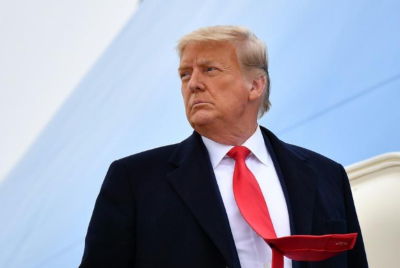
Donald Trump Third Term Ambitions Tested by Legal Experts as 22nd Amendment Loophole Dismissed
The constitution leaves no room for a third term but political rhetoric continues to test American democracy.

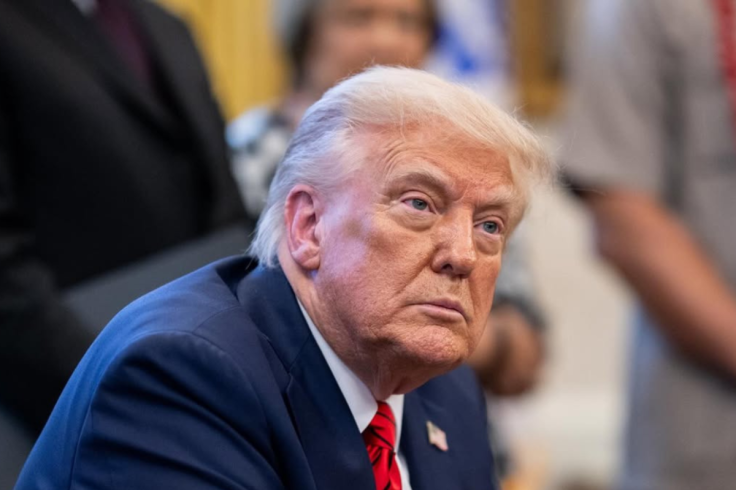
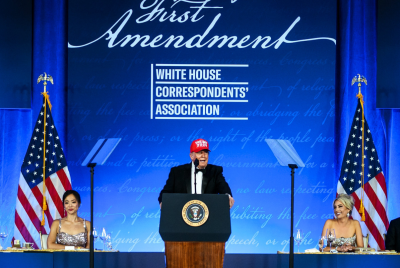
President Donald Trump has once again suggested he could seek a third term in the White House, using a speech at the rescheduled White House Correspondents' Dinner to joke about running again in 2028 despite the constitutional two-term limit.
The remarks quickly reignited debate over the 22nd Amendment, with constitutional scholars reiterating that US law bars anyone from being elected president more than twice. Although Trump has frequently mixed humour with political messaging on the subject, legal experts say repeated references to serving beyond two elected terms continue to attract attention because they concern a clear constitutional limit.
The comments follow similar remarks Trump made during a recent appearance in Michigan, where he again floated the possibility of serving beyond his current term. On Sunday, he also shared several AI-generated images on Truth Social that referenced another presidential campaign.
The renewed discussion comes months after Trump told NBC News that he was 'not joking' when asked whether he had considered remaining in office beyond a second elected term.
Could Trump Legally Serve a Third Term?
Trump has repeatedly referenced the possibility of remaining in office after 2028 throughout his second presidency.
Supporters have often characterised the comments as political humour or an effort to provoke opponents, while critics argue that repeated references to serving beyond constitutional limits deserve serious scrutiny regardless of intent.
Although no formal proposal exists to allow a third elected presidential term, Trump's continued remarks have prompted constitutional scholars to explain why such an outcome would face significant legal obstacles.
New media post from Donald J. Trump
— Commentary Donald J. Trump Truth Social Posts On X (@TrumpTruthOnX) August 1, 2026
( TS: Aug 1 2026, 1:30 PM ET ) pic.twitter.com/khkD4uPHQs
Legal experts overwhelmingly say the Constitution leaves little room for interpretation. The 22nd Amendment, ratified in 1951 following Franklin D. Roosevelt's four elected terms, states that no person shall be elected president more than twice.
During an earlier television interview, Trump discussed a hypothetical scenario in which Vice President JD Vance could win the presidency before resigning, allowing Trump to return to office.
Some allies, including Steve Bannon, have also publicly discussed possible constitutional theories that could permit another Trump administration. Constitutional scholars, however, have largely rejected those arguments.
James Sample, a professor of constitutional law at Hofstra University, said the 22nd Amendment must be read alongside the 12th Amendment, which governs presidential and vice-presidential eligibility.
Sample argues that because the Constitution states 'no person constitutionally ineligible to the office of President shall be eligible to that of Vice-President,' the proposed succession scenario would also be prohibited.
Anoo D. Vyas, an assistant professor of law at the University of Massachusetts, similarly said constitutional term limits should not be treated lightly, regardless of whether such comments are intended seriously.
Political Analysts See Strategic Value in the Remarks
While legal experts view the constitutional question as relatively settled, political scientists continue debating why Trump returns to the topic so frequently. David Schultz, professor of political science at Hamline University, believes the comments may help maintain political attention as the Republican Party begins preparing for the 2028 election cycle.
New media post from Donald J. Trump
— Commentary Donald J. Trump Truth Social Posts On X (@TrumpTruthOnX) August 3, 2026
( TS: Aug 2 2026, 8:07 PM ET ) pic.twitter.com/1bR5WL6Q6E
By keeping discussion focused on his future, Schultz argues, Trump remains central to the national political conversation rather than being viewed as a traditional second-term president approaching the end of his tenure.
Political analysts also note that Trump's remarks frequently generate widespread media coverage and public debate, regardless of whether any realistic constitutional pathway exists.
Although most legal scholars consider a third elected presidential term constitutionally impossible under current law, several argue that repeated public discussion of the issue remains significant.
Bruce Peabody, a political scientist at Fairleigh Dickinson University, has argued that constitutional limits deserve continued public attention even when proposals appear legally implausible.
Matthew Beckmann, professor of political science at the University of California, likewise said Americans should remain informed about constitutional processes while recognising that the United States' institutional checks and balances continue to play a central role in presidential succession. The discussion reflects a broader debate about the relationship between political rhetoric and constitutional norms.
No Legal Path Has Been Proposed
Despite Trump's repeated comments, neither the White House nor congressional Republicans have introduced legislation or a constitutional amendment aimed at allowing a third elected presidential term.
Changing the presidential term limit would require amending the Constitution, a process that demands approval by two-thirds of both chambers of Congress and ratification by three-quarters of US states, a threshold that has historically proven extremely difficult to achieve.
For now, Trump's remarks continue to generate political and legal debate rather than any concrete constitutional action.
Whether intended as political messaging, humour or something else, his references to serving beyond two elected terms have once again prompted constitutional experts to emphasise that, under the current Constitution, the two-term limit remains firmly in place.
© Copyright IBTimes 2026. All rights reserved.
- Recommended For You