

'Uncomfortable With Anyone Who Could Outshine Him': How Hegseth's Paranoia Is Rotting the Pentagon From Within
Defence Secretary Pete Hegseth's actions create a culture of suspicion, leading to significant military leadership changes.

Pete Hegseth has fired more than two dozen senior officers, subjected staff to polygraph tests and nondisclosure agreements and left the Pentagon's military planners sidelined during a live war, all in the name of loyalty.
A CNN investigation published on 9 June 2026, based on interviews with 15 current and former Pentagon officials, details how Defence Secretary Pete Hegseth has cultivated a culture of suspicion that has fractured the department's leadership and disrupted its operational decision-making. Officials describe a secretary deeply distrustful of those around him, civilian and military alike, and quick to interpret proximity to power as a threat rather than an asset.
The investigation reveals that the paranoia saturating Hegseth's office has filtered into other Pentagon divisions, breeding infighting among senior civilian leaders and silencing officers who might otherwise push back.
Firing of Gen. Randy George Exposes Pattern of Dismissals
On 1 April 2026, Army Chief of Staff Gen. Randy George formally requested a meeting with Hegseth to discuss the secretary's stated priorities: technology improvements, equipment upgrades and to brief him on the Army's work towards those goals.
The next day, Reuters confirmed that George had been fired, with three US defence officials saying the dismissal was effective immediately. George had more than a year remaining on his standard tenure as the 41st Chief of Staff of the Army.
The firing came via a curt phone call with little explanation. Minutes later, the ouster was reported publicly. George was still in a meeting with his senior directors when someone interrupted to say Hegseth was trying to reach him. He stepped out, took the call, and returned to a room where, according to CNN's reporting, people had already seen the tweet.
A Pentagon official described the scene: 'The staff proceeded to, one by one, either go and give him a handshake or a hug. It was solemn, as if someone had died.' By the following morning, George's office had been emptied.

George was not alone. Reuters also confirmed that Hegseth simultaneously fired General David Hodne, who led the Army's Transformation and Training Command, and Major General William Green, head of the Army's Chaplain Corps. Months earlier, Hegseth had removed the widely respected Army vice chief of staff, Gen. James Mingus, replacing him with his own senior military aide, Gen. Chris LaNeve, a move sources told CNN was a deliberate step toward positioning LaNeve to eventually take George's job.
Hegseth had also blocked four colonels from promotion to one-star general officer rank. Nine US officials told The Daily Beast that Hegseth had either blocked or delayed promotions for more than a dozen Black and female senior officers across all four branches of the military, with one official stating that 'there is not a single service that has been immune to this level of involvement by Hegseth.'
Polygraphs, NDAs and Mechanics of Loyalty Purge
The suspicion inside Hegseth's Pentagon has not been informal. Some troops were required to sign nondisclosure agreements before being read into certain operations. Polygraph tests were administered to staff in an attempt to identify leakers, according to a March 2025 internal memo from Hegseth's then chief of staff, Joe Kasper.
The memo stated that 'unauthorised disclosures of national security information' demanded 'immediate and thorough investigation' and confirmed that polygraphs would be used 'in accordance with applicable law and policy.' The White House ultimately ordered Hegseth to halt the polygraph programme after a senior adviser complained that members of his own team might be subjected to testing.
The leak-hunting extended far beyond Washington. CNN reported that US Central Command repeatedly questioned deployed service members over alleged leaks, and attempted to invoke classification powers to prevent troops from sharing even unclassified information. One source told CNN plainly: 'They act like we are the enemy.'
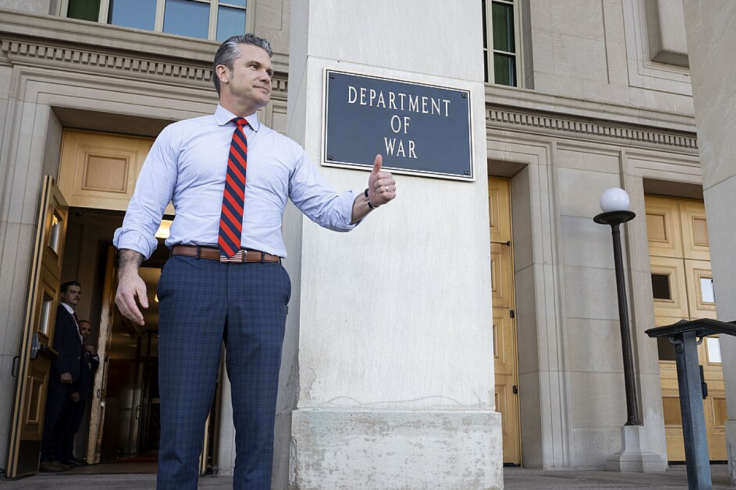
The internal atmosphere has reshaped how decisions are made. CNN quoted a Pentagon official as saying: 'A year-plus later, there is a lack of clear internal processes within the Pentagon... caused by mass paranoia. Everything is a case-by-case basis because there's no delegation, there's no trust. And if there's no delegation or trust, policy decisions can't be made.'
The same official described the daily calculus for those who remained: 'Every single day, every decision that we made, is this going to keep the boss employed, or is this going to get him fired? That was a planning factor.'
Navy Secretary's Ouster and Bipartisan Congressional Alarm
Weeks after George's forced retirement, Navy Secretary John Phelan was fired on 22 April 2026, a decision CNN reported came after Hegseth told Phelan to resign or be fired, following a conversation with President Trump. Pentagon spokesman Sean Parnell announced the departure 'effective immediately' on X. Phelan declined to resign; he was fired. Phelan was reportedly still trying to confirm whether the dismissal was legitimate when the announcement appeared publicly.
Sources familiar with the situation told Axios that friction had been building for months, partly over what Hegseth saw as Phelan moving too slowly on shipbuilding reforms, and partly over Phelan's reportedly close relationship with the president, a dynamic Hegseth viewed as an attempt to go around him. 'Phelan didn't understand he wasn't the boss,' one person familiar with the situation told Axios. Navy undersecretary Hung Cao, a 25-year Navy veteran, took over as acting secretary.
The back-to-back firings drew rare bipartisan condemnation on Capitol Hill. At a House Appropriations Defence Subcommittee hearing on 16 April 2026, Army Secretary Dan Driscoll called George 'an amazing, transformational leader' and confirmed he had been out of town in North Carolina when the firing took place, learning of it en route home.
When asked to explain George's removal, Hegseth told Congress it was 'very difficult to change the culture of a department that has been destroyed by the wrong perspectives with the same officers that were there.' House Appropriations Committee Chairman Tom Cole, a Republican from Oklahoma, called George's ouster 'a real loss,' telling the hearing, 'I just want the record to reflect how much we regret — I personally regret, at least — he's no longer in active service.'
Senator Mike Rounds, Republican chairman of the Senate Armed Services Subcommittee on Cybersecurity, said Phelan's firing caught him by surprise, telling The Hill that Phelan had been actively scheduling meetings with senators when his job was abruptly terminated. He added, 'He had been making appointments with all of us.'
Operational Fallout
The consequences of Hegseth's information controls have not remained within the Pentagon's corridors. CNN reported that in the lead-up to the war with Iran, Hegseth kept key military planners at arm's length, meaning senior members of the Joint Staff, the military's primary body for planning and advising the president and defence secretary, had limited visibility into the administration's strategic thinking. As a result, some planners were abruptly tasked with managing the logistics of moving significant US assets into the region, including the USS Gerald R. Ford carrier strike group, without adequate preparation time.
Since the start of the conflict, Hegseth has focused heavily on projecting the image of success, criticising journalists who report otherwise as 'incredibly unpatriotic' and directing the production of 'war videos' for the White House, a propaganda effort sources compared to the Department of Homeland Security's approach to immigration enforcement imagery. As reports contradicting his assessment of Iran's remaining military capability reached Trump, Hegseth reportedly turned his focus back to investigating internal leaks.
Pentagon spokesman Sean Parnell dismissed the CNN investigation in a statement, saying the anonymous sources cited were 'outsiders with a clear political agenda to smear the Department and undermine Secretary Hegseth's leadership through partisan hit pieces.' He added, 'Decisive steps were taken to align military leadership with the priorities of the President, the Secretary, and our warfighters.'
Trump, for his part, has shown no appetite for distancing himself from his defence secretary. At a recent Cabinet meeting, he gestured towards Hegseth and said, 'Secretary of War Pete Hegseth, central casting. He loves war,' a remark that, given what is unfolding inside the building across the Potomac, those who remain there may find harder to treat as a compliment.
© Copyright IBTimes 2026. All rights reserved.