Secret Service in 30-Minute Armed Standoff With Chinese Security During Tumultuous Trump-Xi Visit
Security brinkmanship and bruised egos turned a carefully staged Trump-Xi showcase in Beijing into a study in mistrust.

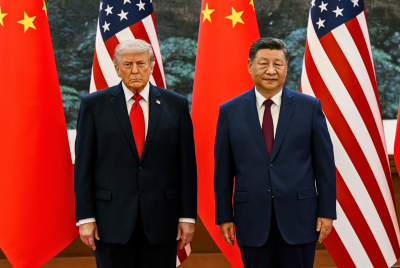
US Secret Service agents were locked in a 30-minute armed standoff with Chinese security officers in Beijing on Thursday during a high-stakes Trump–Xi meeting at the Temple of Heaven religious complex, according to reporters travelling with the US president. The clash unfolded as Donald Trump's motorcade arrived for talks with Chinese President Xi Jinping, turning a choreographed display of diplomacy into a stand-off over a single American agent's gun.
The news came after a rocky start to Trump's two‑day visit to China, originally slated for April but postponed over regional security concerns linked to his war with Iran. The trip, billed by the White House as a chance to stabilise the Trump-Xi relationship, was already under scrutiny before Air Force One touched down. Trump arrived in Beijing on Wednesday night and was greeted not by Xi but by Vice President Han Zheng, a protocol detail that did not go unnoticed among diplomats who obsess over such signals.
According to White House pool reporters, Chinese security at the Temple of Heaven barred a US Secret Service agent from entering the complex while armed, triggering a half-hour impasse in the capital's crisp autumn air. Both sides are reported to have refused to yield, with Chinese officers insisting on their no-weapons rule at the historic site and US agents insisting their colleague remain armed while in close proximity to the president.
AFP's White House correspondent Danny Kemp described what followed as 'intense,' saying on social media that access to the site was delayed for about 30 minutes while rival security teams argued over protocols. 'A compromise was eventually reached,' Kemp reported, without elaborating on whether the agent surrendered his weapon, stayed behind, or was granted entry under special terms. Neither US nor Chinese officials have publicly detailed what that compromise entailed.
Nobody is telling you how FUCKED every American ally on Earth just became.
— 🇺🇸 Ronald Carter (@USronaldcarter) May 16, 2026
Everyone is watching the Trump-Xi summit. The handshakes. The deal-making.
Nobody is talking about the fact that Trump just turned a democracy into a bargaining chip.
Taiwan. The island that built TSMC… pic.twitter.com/d0A357MLt7
The Temple of Heaven confrontation was not the only jarring security moment on the trip. Footage circulating online appears to show US Treasury figure Scott Bessent a prominent Trump loyalist and wealthy Republican donor being blocked at the entrance to the Great Hall of the People ahead of Thursday's state banquet in Trump's honour. In the clip, Chinese guards appear to point to Bessent's jacket, apparently indicating that he is missing an entry or security clearance pin. After an animated exchange, an aide hands Bessent an item, and only then is he waved through the doors of one of the Communist Party's most sensitive buildings.
The Daily Beast, which first highlighted the video, said it had contacted the US Treasury for comment. As of publication, there has been no public clarification from the department on how the mix‑up occurred or whether Bessent's access had been restricted at any earlier point. Without an official account from either side, details of the episode should be treated cautiously.

Security Flashpoints Overshadow Trump-Xi Agenda
The Trump-Xi summit was meant to be dominated by trade, technology and the escalating rivalry in the western Pacific. Instead, it was punctuated by protocol snubs, security scuffles and sharp words on Taiwan.
Behind closed doors, the talks appear to have been far from cordial. Time reported that Xi delivered what it called a 'stinging rebuke' over US arms sales to Taiwan, reiterating Beijing's longstanding claim to the self‑ruled island and warning that the two powers could 'collide or even enter into conflict' over it. If accurately reported, that is the kind of language Chinese leaders usually reserve for carefully staged domestic audiences, not visiting American presidents.
Trump, who has made a point of playing up his personal rapport with Xi in the past, has since tried to cast the looming $14 billion arms package for Taipei as a bargaining chip rather than a done deal. 'I haven't approved it yet,' he told reporters aboard Air Force One as he flew out of Beijing, portraying himself as holding leverage over both sides. He claimed to have told Xi that Chinese espionage against the US was acceptable because 'we spy like hell on them too.' That remark, if quoted accurately, will not make life easier for US diplomats trying to argue that Beijing's cyber‑intrusions and surveillance operations are out of bounds.
🚨 JUST IN: President Trump reveals Chinese President Xi was AMAZED at the American military's strength and performance
— Eric Daugherty (@EricLDaugh) May 18, 2026
"I just left China, and I will say — President Xi was very, VERY complimentary of our military. He was amazed, actually, at our military. We have the greatest… pic.twitter.com/IXg0aw22jb
Business Entourage Adds to Questions Around Trump-Xi Trip
The Trump-Xi visit has also stirred unease over potential conflicts of interest. Alongside senior officials, Trump's delegation included his son Eric Trump and an eclectic group of business figures aligned with the Make America Great Again movement. Among those travelling were NVIDIA chief executive Jensen Huang, Apple boss Tim Cook and SpaceX founder Elon Musk, according to the original report.
The presence of such high‑profile corporate leaders on a trip framed as state diplomacy has prompted questions over whose interests were really being advanced. Critics argue that the blend of political negotiation and boardroom muscle risks blurring the line between US foreign policy and the private commercial priorities of Trump‑aligned companies. There is, however, no formal allegation that any specific deal was struck for personal gain, and no evidence yet in the public domain that would prove such a charge.
Musk added his own dose of viral distraction to the visit. Footage from Thursday's state banquet shows the billionaire pulling exaggerated faces and mugging for selfies against the Great Hall's ornate backdrop. Supporters brushed it off as typical Musk; detractors saw it as discordant with the sober setting of a state dinner in a one‑party capital watching the Trump-Xi dance with suspicion.
With no comprehensive official read‑out from either Washington or Beijing beyond formulaic communiqués, much of this trip is being pieced together from partial accounts, pool reports and circulating clips. Until fuller records emerge, many of the more colourful details from the exact terms of that 30‑minute armed standoff to what was really said in the Temple of Heaven have to be treated with a degree of caution.
© Copyright IBTimes 2026. All rights reserved.
- Recommended For You