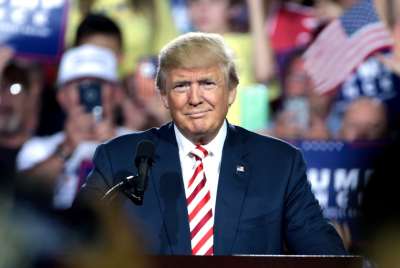
Can Donald Trump Run In 2032? Constitutional 22nd Amendment Rules Detailed
Trump's comments at the Coast Guard Academy spark debate over the 22nd Amendment.

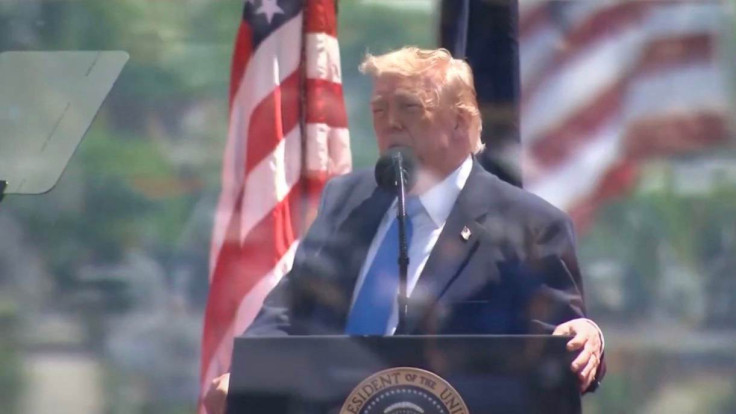
Donald Trump told graduating cadets at the U.S. Coast Guard Academy in Connecticut on Wednesday that he would be 'here in '28' and 'maybe... in '32 too,' prompting fresh anger and renewed scrutiny over whether Donald Trump could legally run for the White House again in 2032 under the US Constitution's 22nd Amendment.
For context, the 22nd Amendment, ratified in 1951, limits US presidents to two elected terms in office. Trump has already served one term and is seeking a second, which has made his recurring jokes and hints about a possible third term a live constitutional question rather than just a punchline.
His latest comments were delivered as the keynote address to the Academy's 145th graduating class of 260 cadets at Cadet Memorial Field, a return appearance after he also spoke at their commencement in 2017 during his first term.
Donald Trump's 2032 Hint Clashes With 22nd Amendment Limits
Standing before the cadets, Donald Trump told the audience: 'I'm gonna be here in '28. Maybe I'll be here in '32 too.' The remark cut directly against the widely understood meaning of the 22nd Amendment, which 'bars a third presidential term,' and immediately fed into an already simmering row about whether Trump respects constitutional limits on his power.
This is not the first time he has pushed that line. In a phone interview with NBC's Kristen Welker on 30 March 2025, Trump insisted he was 'not joking' when asked about the idea of pursuing a third term. He conceded there were 'methods which you could do it,' while also saying it was 'far too early to think about it.' When pressed again on 5 August last year, he first replied 'no, probably not' to the idea of serving beyond two terms, before quickly adding, 'I'd like to.'
Trump: I'm gonna be in office in 2028. Maybe I'll be here in 2032, too. I don't know. Maybe I will pic.twitter.com/6pPmTftf0l
— Republicans against Trump (@RpsAgainstTrump) May 20, 2026
For now, his third-term talk sits in an awkward grey area between provocation and threat, and it is precisely that ambiguity which alarms many of his critics.
Online reaction to the Coast Guard remarks was predictably sharp. One social media user wrote that 'Trump is a lame duck who's aging rapidly,' arguing that in 2032 he would be 85 and claiming he 'already falls asleep and has health issues he's keeping secret.' Another pointed to his criminal record, posting, 'First president convicted of 34 felonies hints at staying until '32. The 22nd Amendment exists. Read it.' A third respondent dispensed with politeness altogether, declaring: 'No he f------- won't. Patriotic Americans will make sure of that.'
Others reached for dark humour. 'The Constitution and his rapidly decomposing purple hands would disagree,' one critic quipped, folding in both the legal ban and questions about Trump's health. The tone of these remarks is partisan and highly charged, but they capture how the idea of a 2032 Trump presidency is being received far beyond legal academia.
Donald Trump, The Courts And A Test Of Constitutional Nerves
If it were just Trump riffing at rallies or ceremonies, the 2032 speculation might be easier to dismiss. What has unsettled constitutional lawyers and some senators is the way this rhetoric appears to be bleeding into the judiciary, or at least into the politics surrounding judicial appointments.
Earlier this month, Trump judicial nominee John George Edward Marck appeared before the Senate Judiciary Committee for a confirmation hearing for a US District Judge seat in Texas. Asked directly about the 22nd Amendment, Marck refused to say whether the Constitution bars a president from serving a third term. His reluctance to give a straight answer fuelled suspicion that he was tiptoeing around Trump's ambitions.
Senator Chris Coons pressed Marck on whether Trump could legally seek and serve a third term, emphasising the two-term limit. Marck called the issue 'hypothetical' and said he would need to 'review the actual wording of' the Constitution before ruling on Trump's eligibility.
On one level, that is a familiar judicial dodge. On another, it was an extraordinary moment: a federal judgeship candidate, in 2025, declining to affirm that the plain language of the 22nd Amendment means what most citizens think it does.
Coons then turned to the rest of the nominees in the room, challenging them to show whether they were 'brave enough' to rule out a third term for Trump there and then. The exchange ignited a backlash against Marck's perceived evasiveness and raised broader questions about how far Trump's personal interests are shaping the views of those who hope to sit on the federal bench.
By 2028, Trump’s cognitive decline will likely prevent him from forming an understandable sentence.
— Vatnik Soup (@P_Kallioniemi) May 22, 2026
By 2032, considering his current lifestyle, he’ll probably be dead. https://t.co/N38ywv7fKZ
None of this changes the black-letter text adopted in 1951, and nothing in the current constitutional framework clearly allows a president to serve three elected terms. There has been no official move in Congress to alter the limit.
That means Trump's line at the Coast Guard Academy remains, for now, a provocation rather than a plan, and the idea of him still being in office in 2032 should be treated with a grain of salt until any legal pathway is actually set out.
Yet when a former president tells a group of new military officers that he might still be commander-in-chief seven years after the Constitution says his time should be up, and when one of his judicial nominees will not clearly disagree, it is hard to pretend the debate is purely theoretical.
© Copyright IBTimes 2026. All rights reserved.
- Recommended For You