

Trump Claims Iran 'Lost Everything' Right After 3 US Troops Were Killed, Then Flees Press Conference Mid-Sentence
A president who vowed to 'end' Iran's nuclear ambitions is now struggling to explain a war that keeps dragging on and a cost that keeps rising.
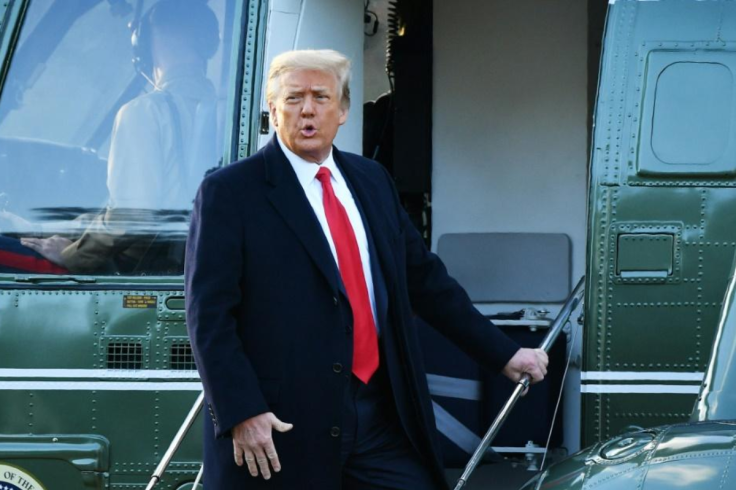
Donald Trump abruptly cut short questions from reporters at Joint Base Andrews in Maryland on Sunday night, walking away mid-sentence after being pressed about the length of his war with Iran and the recent deaths of three US troops. The encounter unfolded moments after Trump, now 80, stepped off Air Force One following a trip to the World Cup final in New Jersey.
The tense exchange came nearly five months into a conflict that Trump himself launched on 28 February, and which his own aides had initially framed as a short, sharply defined operation. Standing on the tarmac, he was reminded by a reporter that what the White House once described as a 'four or five-week' campaign in the Middle East has now stretched close to the five-month mark.
Trump bristled at the suggestion his administration had misjudged the scope or duration of the war. 'This is a far bigger job that we're doing,' he replied, insisting the original mission had been limited in scope. 'We were doing a little job, stopping them from having a certain capability. Now, we're just ending it.'
Donald Trump Insists Iran Has 'Lost Everything' Militarily
Pushing back further, Trump tried to draw a distinction between what he claimed had been the initial aims of the intervention and the current phase of fighting. 'It's really not the same thing,' he said, before asserting that the US is now 'ending any chance where they could have a nuclear missile.'
What followed was a halting attempt to defend his record, and to rewrite the timeline. Trump began to argue that key objectives had been met much earlier than his critics allow. 'If you look at it, after a week-and-a-half... not four weeks, a week-and-a-half, two weeks,' he said, before trailing off. 'We stopped them from probably, but I don't want to have the word 'probably'...'
He never finished the thought. Instead, Trump suddenly broke off, looked directly into the camera and told the gaggle: 'Thank you very much.' Without taking another question, he turned and walked towards Marine One, the helicopter waiting to ferry him back to the White House.
The awkward end to the exchange capped a brief, strained appearance in which Trump had already been challenged over the human cost of his Iran strategy. Reporters had pressed him on the three US soldiers killed over the weekend in what officials described as an exchange of strikes with the Iranian regime, bringing the American death toll in the conflict to 17.
'We feel very badly,' Trump said of the latest fatalities, striking a note of condolence that lasted only a moment. He quickly pivoted back to the broader rationale for the war. 'But those people, those great patriots, are out there fighting [so] that Iran cannot have a nuclear weapon. Iran has been very, very badly damaged. They've lost everything, almost, militarily.'
The president offered no evidence for that sweeping claim. Nor did he reconcile the idea of Iran having 'lost everything' with the fact that the regime had, according to his own officials, successfully resumed hostilities just days earlier and continued to resist diplomatic efforts to end the fighting.
Questions Mount Over Donald Trump's War Narrative
After months of mounting criticism over the lack of a clear endgame in Iran, and unease in Washington over public statements from Trump that often appear untethered from events on the ground. When the war began in late February, administration officials had argued it was necessary to stop Tehran from reaching what they described as a critical 'capability' threshold.
On Sunday, Trump seemed to suggest that limited objective had already been achieved within two weeks of the conflict starting. Yet he also portrayed the current campaign as an expanded mission to 'end' any chance Iran could ever develop a nuclear missile. There was no explanation of what that end state would look like, how it would be verified, or how it sits with the continued risk to US forces.
His characterisation of Iran as having been 'very, very badly damaged' and having 'lost everything, almost, militarily' sits uneasily alongside the reality that Iranian forces were, by his own admission, still capable of killing American troops in combat over the weekend. The article does not provide a Pentagon or State Department response to Trump's remarks, and there is no independent confirmation in the material supplied that Iran's military has been degraded to the extent he claims, so his comments should be treated with caution.
The exchange at Joint Base Andrews also highlighted Trump's discomfort when challenged on timelines and casualties. The moment a reporter pointed out that his 'four or five-week' war is dragging towards the five-month mark, he shifted to arguing that the job had become bigger, that the original measure no longer applied, and then, when his explanation began to tangle, he simply exited.
For all the elaborate messaging around strategy, deterrence and nuclear safeguards, it is the image of a visibly irritated Trump, cutting himself off mid-sentence and walking towards the waiting helicopter, that may linger. It suggested a president keen to project absolute control over a messy, protracted conflict, yet unwilling or unable to fully account for how it reached this point or when it might end.
© Copyright IBTimes 2026. All rights reserved.