US Navy Families Say Thousands in Care Packages Never Reached Sailors Near Iran: '$2,000 and Nothing Arrived'
Sailors ration meals and split portions evenly as an indefinite postal freeze cuts off parcels from home

US Navy families say they have spent thousands of dollars on care packages for sailors deployed to the Iran war, only for the parcels to sit in postal limbo as their loved ones go hungry aboard warships in the Middle East.
A Texas mother told USA Today she has spent more than $2,000 (£1,480) on packages for her son aboard the USS Tripoli, and not one has arrived. The US Postal Service has suspended delivery to 27 military ZIP codes across the region, citing airspace closures and logistical fallout from the conflict.
Her son, one of roughly 3,500 sailors and Marines enforcing President Donald Trump's blockade on Iranian ports, messaged her that the crew 'divvy up food evenly' if one person gets a larger portion, and warned that supplies 'are going to get really low.' Photographs from the ship showed a folded tortilla with a scoop of meat and carrots beside a strip of processed grey meat.
USA Today has released photos showing the meals served to some of the U.S. sailors and Marines aboard warships deployed to the Middle East. pic.twitter.com/Irex1BFZhK
— Breaking911 (@Breaking911) April 17, 2026
Parents Turn to Bulk Shipments as Army Signals No End Date
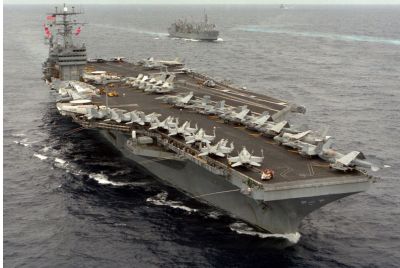
Parents of sailors aboard the USS Tripoli and the aircraft carrier USS Abraham Lincoln have turned to bulk shipments of snacks, medicine, toiletries, and homemade treats, according to reports. The Army says there is no end date for the mail freeze despite a fragile ceasefire. Packages already in transit are being held at secure postal or military facilities until service resumes.
The suspension covers the same theatre where the Pentagon has three aircraft carrier groups and thousands of sailors stationed since the US-Israeli campaign against Iran, known as Operation Epic Fury, began on February 28.
Sailors Ration Meals as Supplies Dwindle
On the USS Tripoli, no port visits are expected before the mission ends, leaving the crew dependent on whatever the ship can carry. Nearby, the USS Gerald R. Ford set a post-Vietnam War record on April 15 after 295 days at sea, breaking the 294-day mark held by the USS Abraham Lincoln since 2020.
A March 12 laundry fire on the Ford injured two sailors, displaced roughly 600 crew from their bunks, and took 30 hours to fully extinguish, the Navy confirmed. Plumbing failures have persisted throughout the deployment, with Navy memos cited by NPR showing about one sewage-system maintenance call per day.
Navy Still Charges Troops $13.65 a Day to Eat
Even as meals shrink, the Navy continues to deduct $13.65 (£10.09) per day from deployed sailors' pay for food, a charge set under the Department of Defense Food Service Rates for 2026. Over 30 days, that totals $409.50 (£302.76) pulled from a monthly Basic Allowance for Subsistence (BAS) of $476.95 (£352.63).
Neither the US Army nor the Air Force charges service members for meals while on duty. A February 2026 article in the US Naval Institute's Proceedings journal argued that the Secretary of Defense has statutory authority to cut the rate to zero and has not used it.
Evacuees Return to Norfolk With Just a Backpack
The hunger reports come weeks after Iranian missile and drone strikes forced 1,500 sailors, their families, and several hundred pets out of Naval Support Activity (NSA) Bahrain, home of the US 5th Fleet. Many landed at Naval Station Norfolk with the clothes on their back, prompting American Legion Post 327 to run a spaghetti dinner and gather hygiene supplies.
The Navy-Marine Corps Relief Society has distributed about $1 million (£739,000) in emergency aid to roughly 2,000 sailors and their families since evacuations began, retired Rear Admiral Dawn Cutler, the group's chief operations officer, told NPR. The money is mostly going out as bridge loans until government reimbursement clears, a process the group says can take months.
Taxpayers are funding a US defense budget that has ballooned to over $1 trillion (£739 billion) amid the conflict, yet the people carrying out the mission are rationing food, paying for meals they cannot get, and leaning on donated toothpaste when they come home.
© Copyright IBTimes 2026. All rights reserved.
- Recommended For You