What Is a Doublet? The Rare Seismic Phenomenon Behind Venezuela's Deadliest Earthquake in Over a Century
Understanding the impact and implications of Venezuela's doublet earthquakes

Most people have never heard the word 'doublet' in the context of earthquakes. When two powerful tremors struck northern Venezuela within seconds of each other on 24 June 2026, seismologists were quick to apply the term — and the distinction matters more than it might seem.
In seismology, doublet earthquakes are characterised as distinct earthquake sequences with two or more main shocks of similar or slightly different magnitudes occurring in a single moment, sometimes within tens of seconds but sometimes separated by years. The similarity in magnitude, often within 0.4 on the scale, is what separates a doublet from a standard aftershock sequence. In short, neither quake is subordinate to the other. Both are mainshocks in their own right.
Why a Doublet Is More Dangerous
Unlike a typical earthquake sequence, where a larger earthquake is followed by significantly smaller aftershocks, doublets are earthquakes of similar magnitude that are causally linked but seismologically distinct. That distinction carries real consequences for people on the ground. A building weakened by the first strike has almost no time to be assessed or evacuated before the second, often stronger, shock arrives.
Seismic wave data from the United States Geological Survey (USGS) suggests Venezuela's two quakes likely originated from different faults with different rupture styles, consistent with previously developed maps of active faults in the region. It is likely the first earthquake triggered the second by increasing stress on the second earthquake's source fault.
Earthquake scientist Judith Hubbard of Cornell University noted the complexity of unravelling events like these. 'It's going to take probably some days or longer for the seismologists to really piece out the event,' Hubbard said, adding that 'they may not have a conclusive idea of, was it one earthquake or two earthquakes?'

A Pattern Seen Before
Doublets are rare, although the Venezuelan region is not unfamiliar with them. According to the USGS, a weaker doublet of 6.2- and 6.3-magnitude earthquakes struck there in September 2025.
The most comparable recent event occurred in 2023, when an earthquake doublet struck Turkey and Syria measuring magnitudes of 7.8 and 7.7, happening just 95 kilometres and nine hours apart, affecting 14 million people and causing widespread damage. Before that, in 1988, a 'triplet' of three earthquakes just half an hour apart struck Tennant Creek in Australia.
Hubbard acknowledged that science still has significant gaps in understanding this phenomenon. 'We don't really have a good sense of which faults produce doublets and which ones don't — or whether there even is a fault type that produces doublets,' she said.
Venezuela's Century-Defining Disaster
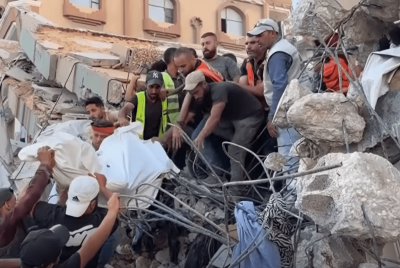
On 24 June 2026, two large strike-slip earthquakes struck northwestern and central Venezuela. The first, measuring magnitude 7.2, occurred at 18:04 local time and was followed 39 seconds later by a magnitude 7.5 mainshock. Both caused widespread damage, particularly in La Guaira and Caracas.
The mainshock became the strongest in Venezuela since the 1900 San Narciso earthquake. At least 920 people have died and another 3,360 were injured, according to National Assembly President Jorge Rodríguez, with at least 172 people still trapped under rubble. Over 50,000 remain unaccounted for according to independent tracking websites, though that figure has not been confirmed by the Venezuelan government.
The disaster struck on a national holiday commemorating the 1821 Battle of Carabobo, meaning many people were at home rather than at work when the earth moved. At least 383 buildings, 13 hospitals, 25 shopping centres and 1,002 other structures were affected, according to Rodríguez.
Jorge Rodriguez, President of the National Assembly, shared the following figures in the wake of the earthquake:
— teleSUR English (@telesurenglish) June 27, 2026
✔️ 1,430 dead
✔️ 3,238 injured
✔️ 3,142 affected families
✔️ More than 12,000 medical consultations
✔️ 73,736 families assisted#Venezuela #LaGuaira… pic.twitter.com/SZZPX6BrLq
While emergency crews continue searching for survivors, scientists are only beginning to understand exactly how the two earthquakes interacted. Doublet earthquakes remain among the rarest and least understood seismic events, and researchers say the Venezuela disaster could become one of the most closely studied examples in recent history. Their findings may help improve understanding of how these unusual earthquake pairs develop and, ultimately, strengthen preparedness for future disasters.
© Copyright IBTimes 2026. All rights reserved.
- Recommended For You