

AirPods Finally Get the Feature Users Have Wanted for 10 Years as Apple Unveils Custom EQ at WWDC
Apple's new custom EQ feature for AirPods debuts with iOS 27, offering users personalised sound settings.
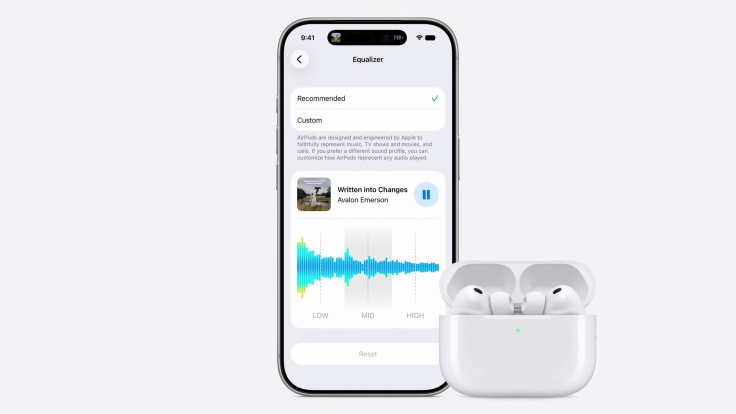
Apple has finally announced a custom equaliser for AirPods, a feature rivals have offered for years, arriving this autumn with iOS 27. For the first time since AirPods launched nearly a decade ago, users will be able to directly shape how their earbuds sound, rather than living with Apple's default tuning or hunting through buried settings.
At its Worldwide Developers Conference 2026, Apple announced that AirPods will gain a custom EQ feature, allowing users to further personalise how their AirPods sound. The announcement came during a keynote held at Apple Park in Cupertino, California on 8 June 2026, the first day of WWDC 2026, which runs through 12 June. Apple briefly showed the new user interface during its presentation, which included 'Recommended' and 'Custom' options, beneath which sits a graph-style interface allowing users to specifically tweak low, mid, and high frequencies.
A Feature A Decade In The Making
The original AirPods launched in December 2016. For nearly ten years, the product line accumulated hundreds of millions of users worldwide, and not one of them could independently adjust the device's frequency output from within the AirPods' native settings.
Apple had buried a very small selection of preset EQ profiles within the Accessibility section of the Settings app since iOS 14, rigid, predefined options including 'Balanced Tone', 'Vocal Range', and 'Brightness'. These were designed for users with hearing difficulties, not for fine-tuning personal listening preferences. There was also an EQ buried inside Apple Music, but that option did not help users of other streaming apps, and did not preserve the EQ setting when switching between devices or applications.
The gap between what AirPods offered and what the rest of the market provided had become difficult to ignore. Custom EQ is a feature that virtually every other pair of wireless earbuds has offered for some time; Apple is only now getting on board.
THERE’S A CUSTOM EQUALIZER COMING TO AIRPODS IN IOS 27😭😭😭 #WWDC pic.twitter.com/SLje94jwna
— 𝗱𝗮𝗻𝗻𝘆🫧💚 (@beyoncegarden) June 8, 2026
What The New Custom EQ Actually Does
The new Custom EQ capability lets listeners adjust the balance of different sound frequencies, including bass, mids, and treble, to tailor audio output to personal taste. Boosting the bass makes music feel punchier, for example, while lifting the treble adds more clarity to vocals and instruments.
A live waveform plays within the interface, meaning users can see the result on the sound signature in real time, as well as hearing it. The feature will be accessible directly from the AirPods' settings screen in iOS 27, not buried inside a third-party app or a workaround menu. Apple has also included a note within the interface stating: 'AirPods are designed and engineered by Apple to faithfully represent music, TV shows, movies, and calls. If you prefer a different sound profile, you can customise how AirPods represent any audio played.' This language signals that the custom EQ setting will apply universally, across all audio sources played through the headphones.
iOS 27 is compatible with all iPhones from the iPhone 11 onwards. That is a significant installed base, and the update is expected to arrive in September 2026, following several months of developer and public beta testing, in keeping with Apple's standard release calendar.
The Quiet Caveat Behind Apple's Custom EQ
Apple's announcement, while welcome, came with one conspicuous omission. There is no visible option in the screenshots revealed so far to save custom EQ presets, meaning users who want distinct profiles, a punchy setting for workouts and a warmer, neutral one for classical music, for example, may not be able to switch between them easily. Whether a preset-saving function will appear in the final release of iOS 27, or whether Apple intends to leave that functionality to be built via the Shortcuts app, remains unanswered.
The interface Apple has shown does not particularly encourage aggressive tweaking. The description text within the settings screen reads: 'AirPods are designed and engineered by Apple to faithfully represent music, TV shows and movies, and calls', language that subtly steers users toward the status quo rather than enthusiastically inviting experimentation. It is a characteristic Apple caveat: the company gives users a new power while quietly suggesting they probably should not use it too much.
Apple's official press release for WWDC 2026, published on 23 March 2026, confirmed the conference would 'spotlight incredible updates for Apple platforms, including AI advancements and exciting new software and developer tools.' Susan Prescott, Apple's vice president of Worldwide Developer Relations, said in that release: 'WWDC is one of the most exciting times for us at Apple because it's a chance for our incredible global developer community to come together for an electrifying week that celebrates technology, innovation, and collaboration.' The custom EQ feature, understated and entirely practical, is the kind of announcement that can get lost behind AI keynote theatre, yet for the tens of millions of daily AirPods users, it is arguably the most tangible quality-of-life improvement Apple has announced in years.
Favorite things from #wwdc26
— Aaron Zollo (@zollotech) June 8, 2026
Stability, Performance
EQ in AirPods menu
AI that is helpful and simple
Liquid Glass Slider pic.twitter.com/AXBgPN500q
Context: AirPods, Custom EQ, And The Wider iOS 27 Update
The custom EQ feature arrives within a broader iOS 27 update that Apple has positioned internally as a stability and quality release. Bloomberg's Mark Gurman reported in November 2025 that iOS 27 was being framed internally as Apple's 'Snow Leopard' moment, a callback to the 2009 Mac OS X release that prioritised quality over new features, with engineering teams combing through Apple's operating systems to hunt for bloat to cut, bugs to eliminate, and opportunities to meaningfully boost performance.
Alongside the EQ announcement, Apple confirmed that iPhone apps will launch 30 per cent faster under iOS 27, photos will appear up to 70 per cent faster in the Photos app, and AirDrop speeds will improve by 80 per cent. AirPods already support features including Adaptive Audio, Personalised Spatial Audio, and Conversation Awareness; the custom EQ adds what has always been a missing piece of the puzzle: user control over the fundamental sound signature.
A decade is a long time to wait for a settings toggle, but Apple's AirPods users will finally have it, arriving in September 2026.
© Copyright IBTimes 2026. All rights reserved.