

FIFA World Cup Trophy Facts: How Much It's Worth, Who Made It, and Who Gets to Keep It
Sunday's winners will lift 6kg of 18-carat gold, but the version they take home is a plated copy.
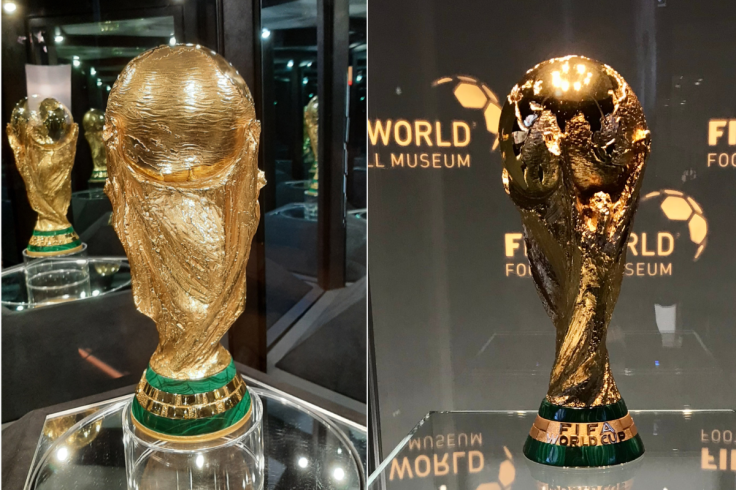
The FIFA World Cup Trophy that will be lifted in New Jersey on Sunday carries about $713,000 (£532,000) of gold in its 6.175kg frame, according to analysis by the London Stock Exchange Group. It was sculpted by the Italian artist Silvio Gazzaniga and cast at the Bertoni workshop in Milan, and the team that wins it will hand it straight back.
Spain and Argentina meet for it on Sunday after beating France 2-0 and England 2-1 in the semi-finals, and whoever prevails flies home with a gold-plated bronze copy while the original returns to a museum vault in Zurich.
The metal alone makes it the most valuable trophy in world sport. It contains 4.93kg of 18-carat gold, which the London Stock Exchange Group values at roughly $713,000 with bullion above $4,100 an ounce, up more than 150% from about $277,000 (£207,000) when Argentina lifted it in 2022, and nearly thirtyfold on its estimated $25,000 material cost at creation. Broader valuations often put the piece itself around $20M (£15M), while the Super Bowl's silver Vince Lombardi Trophy melts down to about $7,230.
Who Made the World Cup Trophy?
When the previous cup was retired, football's governing body ran a design competition that drew 53 entries from sculptors in seven countries, and Gazzaniga's concept of two athletes holding up the Earth won it. The finished piece stands 36.8cm tall, is hollow because a solid version would weigh an estimated 70 to 80kg, far too heavy to hoist, and sits on a base ringed by two bands of green malachite. Gazzaniga described his design as capturing 'the figures of two athletes at the stirring moment of victory,' and it was first raised by Franz Beckenbauer's West Germany in 1974.
Its predecessor packed more chaos into four decades than most artefacts manage in a century. The Jules Rimet Trophy, a winged goddess Nike holding a cup aloft, sculpted by Abel Lafleur in gold-plated sterling silver on a lapis lazuli base, spent the Second World War hidden in a shoebox under the bed of Italian official Ottorino Barassi to keep it from occupying forces. Stolen from a London exhibition in 1966 amid a £15,000 ransom demand, it was found a week later wrapped in newspaper under a hedge by a collie named Pickles, then awarded to Brazil for keeps after their third title in 1970, and finally stolen from Rio in 1983, never to be recovered; it is widely believed to have been melted down, though some doubt it held enough gold to be worth the pot.
The whole saga runs neatly through the 10-minute video below.
Those thefts are exactly why nobody keeps the current cup. The trophy has been the governing body's permanent property since 1974: the winning squad lifts the real one during the on-pitch ceremony, then receives the gold-plated bronze World Cup Winners' Trophy to take home, while the original travels back to the FIFA World Football Museum in Zurich, this year in a bespoke Louis Vuitton trunk built for the presentation.
Even touching it is rationed. Only players and managers who have won the tournament, heads of state, and officials of the governing body may handle the original with bare hands; everyone else gets white gloves or a polite refusal.
How Long Until the Base Runs Out of Space?
Since 1974, every champion's name has been engraved on the underside of the base, where Argentina's from 2022 is the latest entry, and only a few slots remain before the governing body must redesign the base or commission a successor.
Brazil, incidentally, missed the original so much after the 1983 theft that a replica was made using 1.8kg of gold and presented to the country's president the following year.
Sunday settles whether the plate gains Spain's name for a second time or Argentina's for a fourth. Whichever it is, the celebration will follow the modern ritual: 90 minutes or more for the players, a few golden moments with the real thing, and a long flight home sitting next to a copy.
© Copyright IBTimes 2026. All rights reserved.