ISIS Reportedly Calls for Lone-Wolf Attacks on World Cup Events in US, Officials Step Up Security
Global security concerns rise as officials balance ISIS-linked warnings with reassurances of no credible threat ahead of the World Cup.

The global spotlight on ISIS has intensified after reports in a televised segment claimed the group described the upcoming FIFA World Cup as a 'golden opportunity' for lone-wolf style attacks.
According to the broadcast, the messaging framed stadiums, roads, and public gatherings as potential 'full targets,' language that has quickly circulated across security discussions online and in policy circles.
The concern is not tied to a confirmed plot, but to the nature of the messaging itself. In counterterrorism terms, even unverified calls for action can influence individuals acting independently, which is why the phrase World Cup security threats has re-entered global headlines with force.
The Islamic State is encouraging supporters to take advantage of a "golden opportunity" to commit lone-wolf terrorist attacks in the 11 U.S. cities hosting World Cup matches. MORE: https://t.co/Fk6Fw6sOfp pic.twitter.com/8PbJ7YtU6k
— NEWSMAX (@NEWSMAX) June 20, 2026
Officials Reject Credible Threat
Despite the alarming rhetoric, US officials involved in the World Cup task force have stressed there is currently no confirmed danger to the tournament.
Andrew Giuliani, speaking during the broadcast, said intelligence agencies are actively monitoring developments and that there are 'no credible threats at this point.' That distinction has become central to the debate, separating propaganda-style messaging from actionable intelligence.
The FBI, alongside the CIA and Department of Homeland Security, continues to assess incoming leads through layered analysis. In practical terms, this means every report is graded from low to high risk, then investigated further only if corroborating evidence appears.
This is where the tension sits: a high-profile global event generating constant information flow, but only a small fraction of it ever reaches the threshold of an actual threat.
Scale Of Tournament Security Challenge
The 2026 tournament is shaping up to be one of the most complex international security operations ever attempted.
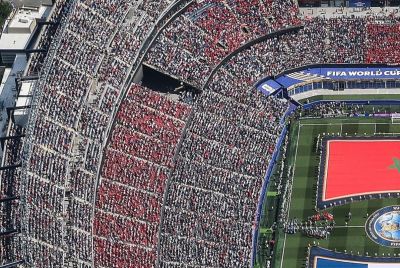
Matches will span 11 host cities in the United States, with additional venues in Canada and Mexico. Officials estimate up to 7 million international visitors could travel across borders for the competition.
That scale alone creates one of the biggest FIFA World Cup terrorism risk environments in modern sport, not because of confirmed threats, but because of sheer exposure.
Security coordination involves multiple agencies working across borders, including joint operations centers designed to process global intelligence streams in real time. Officials compared the workload to a Super Bowl-level event multiplied many times over, where information overload becomes one of the biggest operational challenges.
#ISIS Editorial Calls For Lone Actor Attacks On #FIFA World Cup Matches In U.S. Cities: This Is A Golden Opportunity For 'True Heroism', Renewed Attacks Inside Crusader America https://t.co/KbOm9jZQSd pic.twitter.com/kabrJzzu77
— MEMRI (@MEMRIReports) June 18, 2026
Lone Wolf Risk Explained
Former FBI counterterrorism agent Eric Voitkin explained during the broadcast that the most difficult threats to manage are not coordinated attacks, but isolated individuals inspired by online messaging.
He described threat assessment as a process that relies on pattern building, travel behaviour, communication signals, and logistical inconsistencies. Only when multiple indicators align does a concern escalate into something actionable.
Voitkin also noted that the system is constantly adapting, with analysts refining how quickly they can determine whether a lead is credible or not as events approach.
US security officials on alert for World Cup 'lone wolf' attackshttps://t.co/CjmGKuFXf7
— Insider Paper (@TheInsiderPaper) June 11, 2026
Geopolitical And Visa Scrutiny
Beyond the terror threat discussion, the broadcast also highlighted political sensitivities linked to international participation.
US Homeland Security official Mark Wayne Mullen referenced enhanced visa screening and biometric checks for incoming teams and staff, including scrutiny tied to possible connections with Iran's Islamic Revolutionary Guard Corps.
How Authorities Are Responding
Security preparations include expanded screening processes at venues, increased police presence across host cities, and aerial surveillance measures designed to monitor large crowd zones.
Officials emphasise that much of this work is preventive rather than reactive. The goal is to identify risks before they materialise, while ensuring normal fan movement is not disrupted unnecessarily.
One recurring theme in the discussion is that success in modern security often looks invisible. If nothing happens, the system has worked, even if the public rarely sees the scale of coordination behind the scenes.
Public Vigilance And Final Tension
This brings the story back to its central tension. On one side, ISIS-linked rhetoric frames the tournament as a 'golden opportunity.' On the other hand, intelligence agencies insist there is no credible threat.
Between those two positions sits the reality of modern global sport: massive crowds, international attention, and a security system working in real time to prevent uncertainty from turning into disruption.
The question that lingers is not just whether threats exist, but how global systems respond when perception itself becomes part of the risk.
© Copyright IBTimes 2026. All rights reserved.
- Recommended For You