

Shock Video Captures Thousands of Moroccans Storming Spain's Ceuta Border as Guards Overwhelmed
Spain faces pressure as Ceuta's border struggles with migrant influx from Morocco.
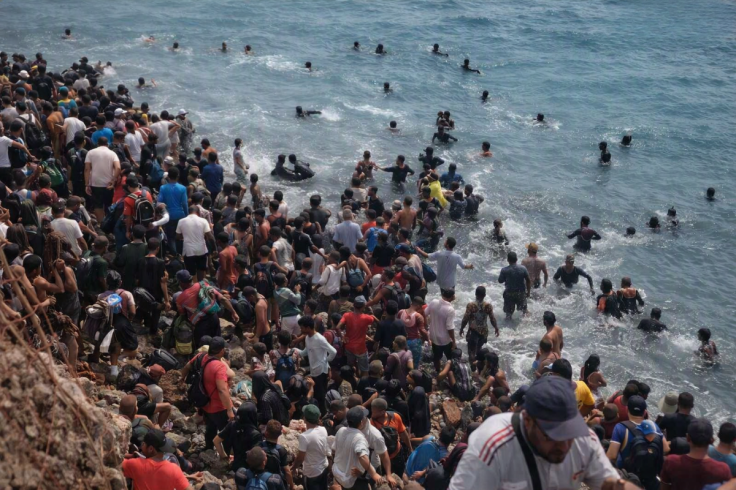
Flip-flops, discarded clothing and abandoned flotation devices now litter Tarajal beach, the debris of a migration surge unfolding in real time online. A video shared on X has amassed 3.7 million views as of writing, showing thousands of people swimming and gathering at Spain's border with Morocco in a bid to reach European soil.
Footage filmed on Thursday shows crowds wading through the water and clambering over the breakwater into Ceuta. Some can be heard shouting 'Viva España!' as they reach dry land, while Spanish Civil Guard officers struggle to hold the line.
Why Thousands of Moroccans Are Racing To Reach Ceuta's Shores
Ceuta sits between Morocco and Spain at the northwestern tip of Africa, a small Spanish city that has belonged to Madrid since 1580. Though geographically part of the African continent, it is legally Spanish, and therefore European Union, territory, separated from Morocco by little more than a fortified fence and a narrow stretch of sea.
That proximity makes it one of the closest routes into Europe for people leaving Morocco in search of work, higher wages or simply a fresh start. Spain's interior ministry blames human-trafficking networks exploiting a recent Supreme Court ruling, which found that migrants intercepted while swimming, rather than climbing the border fence, cannot automatically be turned back.
A Guardia Civil spokesperson told Reuters the ruling had already changed behaviour on the ground. Crossings had been a 'slow trickle' since the judgment, the spokesperson said, but Thursday brought 'an explosion'.
🇪🇸 Insane footage from the Moroccan border with Spain: thousands of migrants are gathering at the border
— Visegrád 24 (@visegrad24) July 30, 2026
This is exactly what Spanish Prime Minister Sanchez was aiming for. pic.twitter.com/Fb1pEKU0jj
Spain Weighs National Emergency as Ceuta's Border Buckles
Ceuta's regional president, Juan Jesús Vivas, has asked Madrid to declare a national emergency and deploy troops, describing the situation as an 'absolute humanitarian and social emergency.' Spain's interior ministry has so far resisted the request, arguing current legislation does not classify migration flows as a national security risk.
Even so, several ministries said they were 'acting in coordination to respond with the utmost speed and efficiency to the situation in Ceuta'. Prime Minister Pedro Sánchez addressed the issue in a statement shared on X (formerly Twitter).
'The Government of Spain is fully committed to providing an immediate response to the situation in Ceuta,' he wrote. 'We are mobilising all necessary resources, working with Moroccan and international authorities, and preparing the necessary measures to restore normalcy as soon as possible. I just conveyed this to President @JuanVivasLara. This is the moment to build solutions, with responsibility and cooperation.'
Morocco, for its part, promised it would work 'faithfully and permanently with Spain' as the crisis continues. 'Moroccan security forces are preventing the arrival of numerous people who are trying to reach Ceuta from Morocco,' officials said.
Spanish and Moroccan authorities are coordinating the return of many migrants who entered during the latest surge.
The 2021 Precedent: Ceuta's Last Migrant Crisis
Thursday's scenes are not without precedent. In May 2021, more than 8,000 people entered Ceuta in just two days, prompting Spain to deploy soldiers and armoured vehicles to the beach.
That episode was tied to a diplomatic row between Madrid and Rabat. This week's surge appears rooted instead in the legal grey area created by the Supreme Court's ruling, though officials on both sides insist they are cooperating closely.
For now, Ceuta's reception centres remain stretched, and its 85,000 residents are watching a border that, once again, has proven difficult to hold.
© Copyright IBTimes 2026. All rights reserved.
- Recommended For You


