

'Massive Brain Stroke': Author Kurt Andersen Predicts Dark Escalator Death for Donald Trump
A veteran Trump critic turns to fiction to imagine what happens when a nation built on spectacle watches its leading showman die on stage.
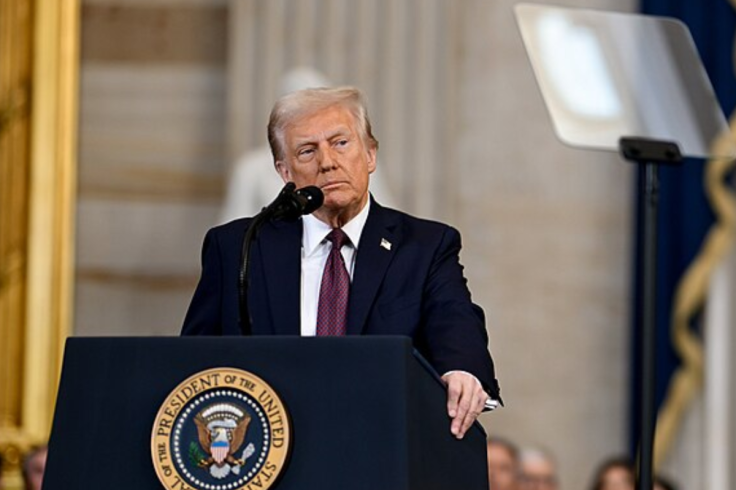
Donald Trump's fictional death on the Trump Tower escalator in 2035 triggers riots, conspiracy theories and a right‑wing uprising in a new novel by American author and journalist Kurt Andersen, who outlined his 'dark prediction' for the president's end on The Daily Beast's podcast.
In The Breakup, due out on 18 August, Trump dies of what Andersen describes as a 'massive brain stroke' while celebrating his 89th birthday, an imagined moment that sends a fractured United States lurching into open chaos.
Andersen, a veteran commentator on American politics and culture, revealed that he originally toyed with the idea of a sober non‑fiction book charting possible futures for the US after Trump.
He told host Joanna Coles he eventually concluded that fiction would let him push further into what he sees as the logical extension of the Trump era, not just in Washington but in the broader psyche of the country. Instead of scenarios and charts, he has written one highly specific alternate history, set a decade from now.
In Andersen's fifth novel, the scene is meticulously staged. It is 2035. Trump is still president. The setting is Trump Tower in Manhattan, the gilded skyscraper that helped forge his public image. Crowds fill the atrium to mark his 89th birthday and the twentieth anniversary of his first presidential campaign. As he descends the same golden escalator he once rode to announce that first run, he collapses and dies on the spot. The cause, in Andersen's telling, is blunt and medical: a catastrophic stroke.
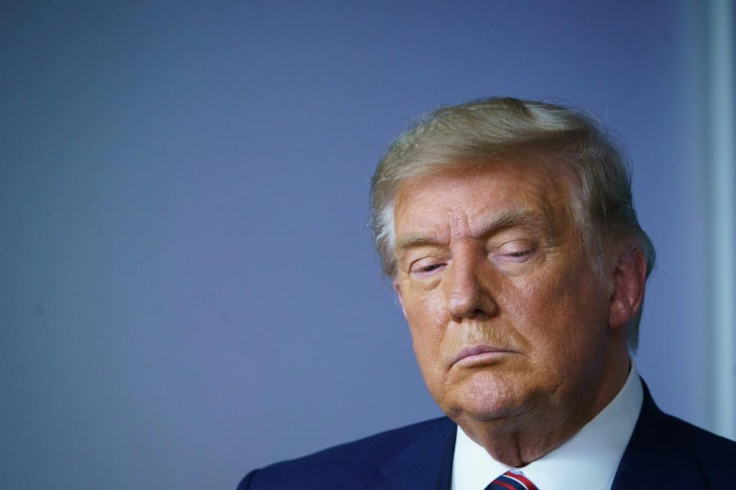
The fallout is anything but clinical. Within the fictional world of The Breakup, Trump's loyalists do not accept the official explanation for their leader's sudden death.
Andersen told the podcast that supporters in his book swiftly brand the stroke a 'deep‑state assassination.'
Fuelled by long‑nurtured suspicions and online conspiracy theories, they pour out of Trump Tower and into the streets of New York, where celebrations turn into unrest and then into what he calls 'the first spectacular piece of violence'.
'Massive Brain Stroke' Scene Sets off Andersen's Donald Trump Dystopia
Andersen is not a passing observer of Trump. He has been writing about him since the 1980s, when he co‑founded Spy magazine with Graydon Carter and gleefully cast the young real‑estate mogul as a totem of 'the vulgarity of New York in the '80s.'
It was Spy that helped cement Trump's reputation as a cartoonish, grasping social climber, years before he moved into politics. That long familiarity gives Andersen's fictional escalation a particular edge. In his account, the street clashes that erupt after Trump's death in 2035 are not a brief spasm.
He told Coles that within a year they harden into 'a true right‑wing uprising, terrorist uprising,' a kind of prolonged insurgency that pushes the US towards the book's title event, the 'breakup of America.' Trump's death, in other words, is less an ending than the fuse.
Andersen said he began writing The Breakup before Trump, now 80 in real life, won a second term in the White House. 'I was basically done when he took off,' he recalled, adding that he had almost completed the manuscript by the time Trump was sworn in again. What changed, he said, was not the skeleton of the plot but the shading.
As the second Trump presidency unfolded in his fictional universe, he went back and, in his own phrase, 'darkened' the story. That meant making the backstory 'more horrible and nightmarish' than in his early drafts.
He does not spell out every change on the podcast, but the implication is plain enough. Events in the real United States in recent years, from violent protests to surging political polarisation, made his earlier dystopia feel oddly mild. 'This time, the horror show of this term, the nightmare beyond what I expected,' he told Coles, arguing that what had once felt fanciful now reads more like an extrapolation.
How Donald Trump Became a Symbol and Catalyst in the Breakup
In Andersen's new work, Trump functions as both symbol and catalyst. He is still a character in the foreground, but the novel's main narrative traces a 23‑year relationship between a Gen Z–millennial couple whose lives run alongside America's slide into fragmentation. Their romance begins in a recognisable country and unravels in one that looks, by 2035, increasingly alien. The personal 'breakup' and the political one reflect each other.
Andersen insists he is not claiming to predict the future, despite the detail with which he imagines Trump's final moments and the violence that follows. This is one possible future, he stresses, drawn from patterns he thinks are already visible.
As with any speculative fiction built so closely on contemporary politics, the line between warning and wish‑casting will be in the eye of the beholder.
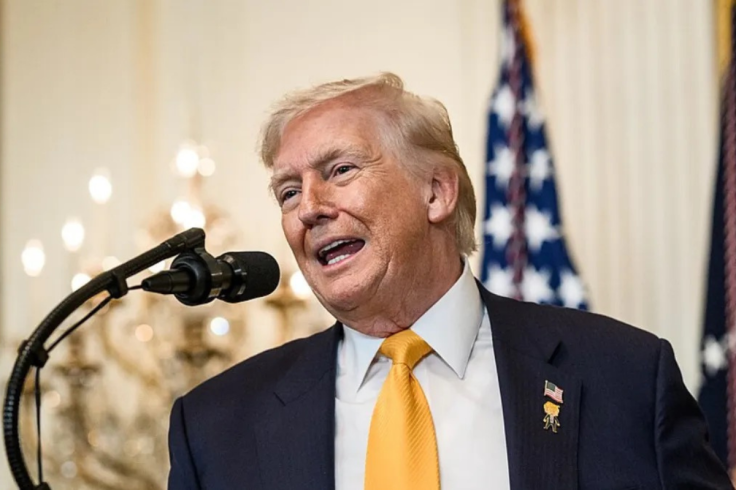
The White House appears in the story only through Trump, but the current administration was at least made aware of his fictional death.
According to a report, a spokesperson did not respond to a request for comment on Andersen's portrayal of an 89‑year‑old sitting president collapsing on his own escalator.
Andersen's previous non‑fiction works, Fantasyland and Evil Geniuses, argued that America's willingness to embrace illusion and to tolerate extreme inequality laid the groundwork for a figure like Trump.
The Breakup takes that argument into the realm of imagined consequences. It asks, in effect, what happens if a country built on spectacle decides to treat the death of its most polarising showman not as a moment to pause, but as a reason to go to war with itself.
© Copyright IBTimes 2026. All rights reserved.