

A Soured Alliance: Why Netanyahu's Emergency Warnings Weren't Enough to Save His Relationship With Donald Trump
Israel's fresh warning about an alleged Iranian plot to kill Donald Trump has collided with a strained Netanyahu–Trump alliance and renewed scrutiny of the president's security choices in the air and on the ground.

Israel recently warned Washington that Iran was weighing a fresh plot to assassinate President Donald Trump, sharing intelligence that reportedly captured Tehran's renewed interest in targeting the US leader even as his once-close relationship with Israeli Prime Minister Benjamin Netanyahu has cooled.
How Israel's Intelligence Put Trump on Alert
For context, The Wall Street Journal reported that Israeli officials passed on updated intelligence to their US counterparts, saying Iran was considering a new plan to kill Trump, a development tied back to longstanding threats made after the US strike on Iranian General Qassem Soleimani in 2020.
The Journal's reporter Anat Peled, speaking on CNN's 'OutFront,' said Israel had 'recently shared this fresh intelligence' indicating Iran was 'contemplating to kill Trump,' framing the assessment as part of a broader pattern of Iranian hostility rather than a single, isolated tip. IBTimes UK could not independently verify these claims, so take everything lightly.
The latest warning landed at a moment when Trump was already talking publicly about Iranian threats, telling reporters aboard Air Force One on Wednesday, 8 July, that he was 'No. 1 on their list' and joking that if he were targeted, others around him would be too.
Reporter: “Were you aware of any credible threat by Iran against Air Force One?”
— TheBlaze (@theblaze) July 9, 2026
Trump: “I have a threat all the time. I'm number one on their list, but if I go, you go, right? So perhaps some of you want to change professions.” 😂 pic.twitter.com/4nRfuievSG
Those remarks, delivered mid-flight and half in jest, nonetheless underlined how openly the president now speaks about the possibility of an attempt on his life, treating the risk as part of the job rather than something best left off the record.
Netanyahu's Emergency Warnings and a Soured Alliance
Israeli intelligence sharing with Washington has intensified throughout the recent war with Iran, with Peled noting that military and intelligence cooperation between the two countries has reached 'unprecedented levels.'
During that conflict, she said Trump and Netanyahu were in 'very frequent' contact, including late-night phone calls, as the two leaders tried to coordinate responses to Iranian actions in real time.
On paper, it looked like a familiar script, the US president and the Israeli prime minister locked in step, trading information and warnings as they faced a common enemy. Yet Peled also said their relationship had 'recently soured,' a striking claim given how central Netanyahu has been to Trump's foreign policy narrative since his first term.

The reasons were not spelled out in the broadcast, and no timeline was attached, but the suggestion was clear enough, that even as Israeli officials were sounding the alarm over a possible assassination plot, the political intimacy that once underpinned the partnership was fraying.
Air Force One, a Qatari Jet and Security Jitters
Trump's security posture was under fresh scrutiny even before Israel's latest intelligence reached Washington, in part because of his decision to stick with an older Air Force One rather than a newly donated luxury jet from Qatar. Qatar's gift, a retrofitted Boeing 747 reportedly worth around $400 million, had been pitched publicly as a symbol of prestige, a flying emblem of Trump's status.
Trump himself told reporters the new aircraft was being flown ahead to military bases in Europe so US troops could see it, describing the jet as 'truly magnificent.' According to CNN's Erin Burnett, however, four US officials said the president's choice to depart the NATO summit on the older Air Force One was driven at least in part by security concerns, not only by showmanship. Security personnel reportedly felt more comfortable with the older, heavily modified Boeing 747, which was built from scratch around presidential safety requirements, than with the Qatari plane that had been 'rushed' into service after a much shorter period of modification.

Trump publicly downplayed any security issue, insisting 'there wasn't a security concern,' even as he acknowledged that 'sleaze bags' and 'sick people' he deals with could make Air Force One a 'dangerous plane.' It is the sort of line that sounds theatrical until you remember the intelligence floating around his briefing folders.
One detail from the CNN reporting speaks volumes, press on the Ankara-to-England leg were asked to lower their window shades on ascent, a small, practical rule that only makes sense if someone believes there is a real-world threat beyond the cameras.
Years of Iranian Threats Against Trump
In case you missed it, Iranian hostility towards Trump did not begin with this latest intelligence warning, it has been building since the US strike that killed Soleimani in January 2020. Federal court filings and Justice Department statements have previously outlined alleged plots by Iranian operatives to target Trump, including surveillance plans and directions from Iran's Revolutionary Guard to prioritise missions aimed at killing the president.
That legal paper trail has made it harder for Trump to shrug off Tehran's rhetoric as mere bluster, even if he sometimes treats it that way in front of the cameras. More recently, funeral processions for Iran's Supreme Leader Ayatollah Ali Khamenei became stages for anti-Trump fury, with mourners carrying placards vowing to 'kill Trump' and, in at least one case, displaying a hanged effigy of the US leader.
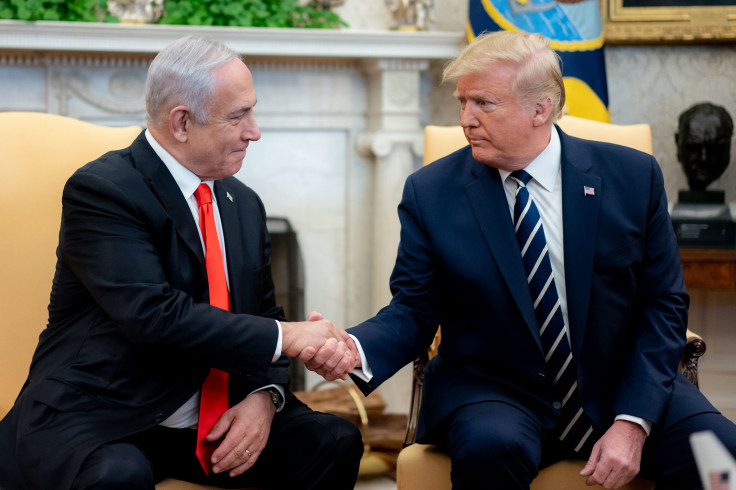
Crowd shots, broadcast on Iranian state television, showed banners calling for death not only for Trump but also for Netanyahu, fusing personal animosity with national grievance in a way that looks frankly wild from the outside. Peled told CNN the fresh intelligence on a contemplated assassination plot 'fits a broader pattern' of Iranian hostility, a phrase that sounds clinical until you picture those clenched fists in Tehran.
Asked on 'OutFront' how advanced the alleged plot was, Peled was blunt, 'We don't have those details right now.' She said what could be confirmed was the depth of Israeli-US cooperation, arguing their intelligence relationship had 'gotten much closer' during the war.
Nothing is confirmed yet so everything should be taken with a grain of salt, and IBTimes UK could not independently verify the specifics of the alleged plot, but the trajectory is clear enough, Trump remains a declared target in Iranian discourse, and Israel, for all the personal cooling at the top, is still sounding the alarm.
© Copyright IBTimes 2026. All rights reserved.