

Israel Reportedly Lost Every Back Channel to Washington It Used to Use Against American Presidents
Netanyahu's traditional strategies in Washington falter as Trump's grip on the GOP tightens and Democratic support wanes.

Benjamin Netanyahu has spent his career mastering the art of the Washington workaround, a strategy that allowed him to defy American Presidents by leveraging Congressional allies and bipartisan donor networks. However, a series of high-stakes events in June 2026 suggests that this era of political manoeuvring is effectively over.
The Israeli Prime Minister now faces a White House where Donald Trump controls the levers of power with near-total authority, leaving Netanyahu with few friends and even fewer options to resist US pressure.
A Washington Post analysis published on 9 June 2026 argues that this is no longer the case. When previous administrations applied pressure on Israel, Netanyahu could reliably exploit rifts in Washington, cultivating Republican allies against a Democratic president, or lobbying pro-Israel donors across both parties to constrain a White House intent on curbing Israeli military action.
Under Donald Trump, those avenues have closed. Trump's dominance over the Republican Party is near-total. Democrats, once a reliable pro-Israel constituency, have shifted sharply away from Netanyahu's government as the Iran war and the Gaza conflict deepened.
The Phone Call That Confirmed a New Equation
The starkest illustration of Netanyahu's diminished position came on 1 June 2026.
Axios reported, citing two US officials and a third source briefed on the call, that Trump berated the Israeli prime minister in an expletive-laden exchange over Israel's escalation in Lebanon against Hezbollah.
A US official summarised Trump's message as: 'You're f*****g crazy. You'd be in prison if it weren't for me. I'm saving your a*s. Everybody hates you now. Everybody hates Israel because of this.' A second source described Trump as 'pissed' and said he shouted: 'What the f**k are you doing?'
Trump's anger was driven by the fact that Netanyahu's escalation in Lebanon was threatening to collapse the US-Iran ceasefire negotiations. Axios reported that after the call, Israel stood down from planned strikes on Beirut. Netanyahu released a statement saying he had told Trump that Israel would strike Hezbollah targets in Beirut if attacks on northern Israel did not stop, but in practice, the Israeli military held off.
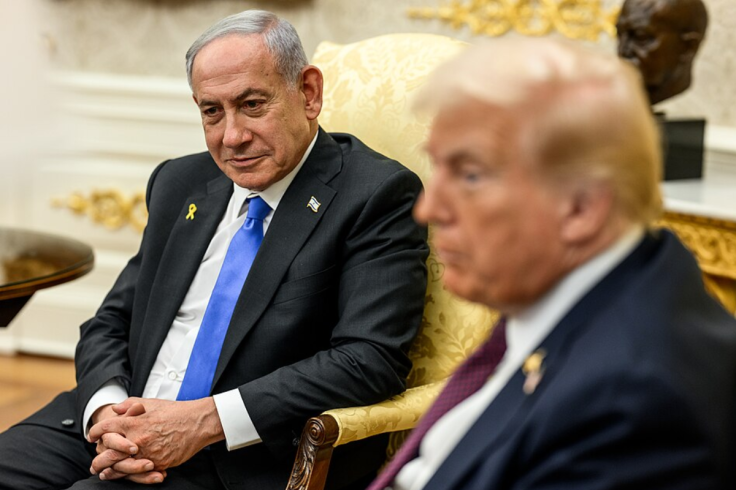
On 3 June 2026, Trump confirmed the call publicly on the 'Pod Force One' podcast hosted by New York Post columnist Miranda Devine. Asked directly whether he had made the explicit comments, Trump replied: 'I did.' He described himself as 'a little bit perturbed at his constantly fighting with Lebanon,' while adding that he liked Netanyahu and worked 'very well' with him.
Israeli officials told the Times of Israel, speaking anonymously, that the call was among the most heated Netanyahu has had with Trump and that the leak had politically damaged the prime minister ahead of upcoming Knesset elections.
How Netanyahu Lost the Republican Party as a Safety Valve
For much of the last two decades, Netanyahu's most reliable insurance policy in Washington was the Republican Party.
During the Obama years, he used Congressional Republicans to openly defy a sitting president, most visibly when he accepted House Speaker John Boehner's invitation to address Congress in 2015 without informing the White House, a move designed to undermine the Iran nuclear negotiations then underway. AIPAC, the American Israel Public Affairs Committee, reinforced that relationship through decades of bipartisan political donations and lobbying.
That structure has eroded at both ends. On the Republican side, Trump's hold over the party is absolute enough that no senator or congressman can serve as a meaningful conduit for Israeli pressure against the president.

The Washington Post reported that Netanyahu now finds himself with almost no avenue of political appeal among American politicians willing to stand between him and an irritated White House. On the Democratic side, the shift has been equally consequential, though for different reasons.
Democratic support for unconditional backing of Israel has been fracturing since the Gaza war began and accelerated sharply with the Iran conflict. The Arab Centre DC noted that in April 2026, the Senate voted on two resolutions to block approximately £355 million ($450 million) in arms sales to Israel over human rights concerns. California Governor Gavin Newsom described Israel as 'sort of an apartheid state' in March 2026, before walking back the remark. Rahm Emanuel, who volunteered for the Israeli army during the 1991 Gulf War, stated publicly that same month that 'the days of taxpayers subsidising Israel militarily — that's over.'
Congress, AIPAC and the Limits of the Pro-Israel Lobby in 2026
AIPAC's operational grip on Congress is also showing signs of strain, even as the organisation continues to spend heavily. Al Jazeera reported in May 2026 that AIPAC has been routing funds through layered political action committee structures to obscure its involvement in primary contests, a sign the organisation recognises its brand has become a liability in competitive races.
In Kentucky, the organisation and allied groups spent more than £7 million ($9 million) in the most expensive House primary in US history, ultimately defeating Republican Congressman Thomas Massie, one of the few Republican critics of Trump. But the financial firepower has not translated into silencing dissent.
Massie had introduced a bill he called the 'AIPAC Act,' demanding the organisation register as a foreign agent. Representative Ro Khanna of California has been among the most vocal congressional critics of the arrangement. 'Everyone in America says that we need to tell Netanyahu that America calls the shots, not the prime minister of any other country,' Khanna told colleagues during a House floor debate over a provision to deepen US-Israeli military integration.
The House voted in June 2026 on a war powers resolution focused on Iran; Democrats voted unanimously against continuing the Iran war without Congressional approval. A parallel measure targeting US support for Israel's war in Lebanon failed 324-92, with 117 Democrats voting against their own party's critics of the Israeli campaign.
The split illustrated exactly where the Democratic Party stands: increasingly hostile toward Netanyahu's government in rhetoric, yet still fractured in translating that hostility into policy.
Netanyahu built his career on the belief that Washington could always be managed, but the Washington he built that strategy around no longer exists.
© Copyright IBTimes 2026. All rights reserved.