

10 Photos of British Journalist Steve Sweeney Injured in Alleged Targeted Israeli Airstrike in Southern Lebanon
Steve Sweeney and his cameraman injured in Southern Lebanon airstrike
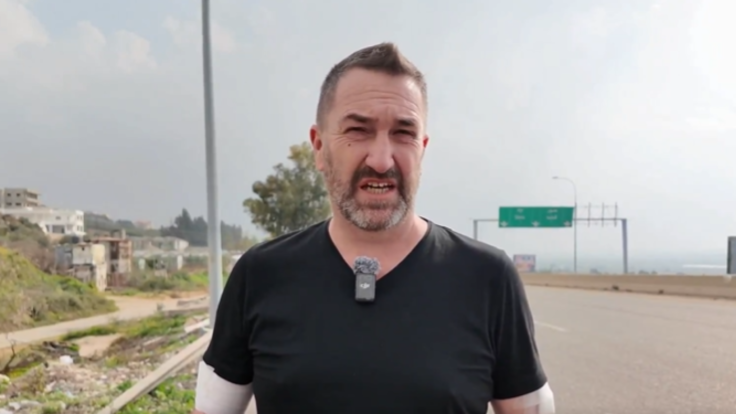
Steve Sweeney, a British journalist and Lebanon bureau chief for the Russian state broadcaster Russia Today (RT), narrowly survived an alleged targeted Israeli airstrike in Southern Lebanon. He was reporting on the Al-Qasmiya Bridge over the Litani River with his cameraman on Thursday, 19 March when an explosion erupted, leaving both media workers with shrapnel injuries.
The video appears to show a missile landed just meters away from where Sweeney was reporting. RT said Sweeney and his cameraman 'miraculously survived' what the outlet described as a targeted airstrike.
Here are ten photos of Steve Sweeney, capturing the journalist in various moments on and off the field.
Airstrike Caught on Video
The moment of the strike was captured in video that has since circulated widely online. In the footage, Sweeney is seen delivering a report before instinctively dropping to the ground as a deafening explosion rips through the air behind him.
The camera is knocked over by the force of the blast, momentarily cutting to black before showing a dust-filled aftermath. The footage has been widely shared across digital platforms, though its full context has not been independently verified.

According to reports, Sweeney and his cameraman, Ali Rida, were 'miraculously' spared from fatal injury but sustained shrapnel wounds to their limbs. Sweeney later shared images of a deep shrapnel wound in his arm, confirming that a piece of metal had been surgically removed at a local hospital near Tyre.
'Targeted Attack' Claims
In a social media post, Sweeney claims that 'Israel tried to kill me in a targeted airstrike in southern Lebanon as I was reporting on was the targeting of bridges and the forced displacement of 1 million people, an ethnic cleansing operation on a larger scale than the Nakba.'
The missile left Sweeney and his cameraman injured. 'I had a shrapnel wound in my arm, deeply embedded in the muscle here. That's been taken out and here it is in this pot here.'

He added, 'I have absolutely no doubt that this was deliberate'. The RT journalist also said that there are no warnings or notifications sent to the Lebanese Army that a missile will strike.
Sweeny concluded: 'We have to say that attacking journalists is a war crime. Attacking civilian infrastructure is a war crime'.
IDF and International Reaction
The Israel Defence Forces (IDF) confirmed that the bridge had been targeted, citing its use by Hezbollah for transporting weaponry. In a statement, the IDF maintained that it does not target journalists and operates in accordance with international law.
Military officials stated that 'explicit warnings' had been issued for civilians to vacate areas south of the Litani River prior to the strikes.
However, the Russian Foreign Ministry has disputed these claims. Spokeswoman Maria Zakharova stated that the incident was 'not accidental' and noted that the missile struck the exact location of the broadcast rather than a 'significant strategic military facility.'
Rising Risks in Conflict Zones
The incident highlights the increasing peril faced by media professionals in conflict areas. Furthermore, the strike on Sweeney's team follows a pattern of incidents involving media personnel since the escalation of hostilities in the region.
The Union of Journalists of Lebanon has condemned the incident, describing the targeting of journalists as a 'flagrant violation of international law.'
Despite his injuries, Sweeney remains defiant. 'If they think they are going to silence us, they are very much mistaken,' he said, confirming his intention to continue reporting from the field.
© Copyright IBTimes 2025. All rights reserved.
- Recommended For You


