Inside the Elon Musk White House Fallout and the Unconstitutional $100M Purge That Broke Trump's Government
Musk's influence in Trump's administration led to significant cuts and legal battles, leaving a lasting impact on Washington.

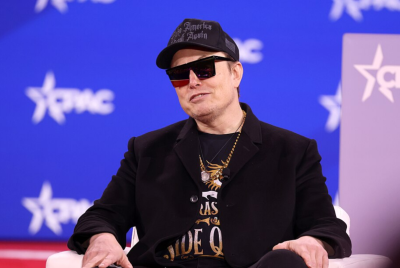
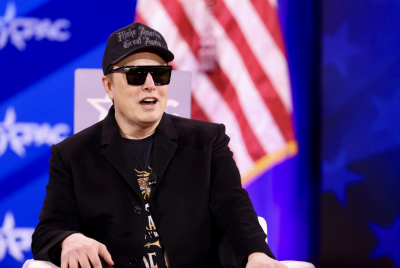
The administrative instability sparked by Elon Musk's time in the White House continues to loom over Donald Trump's second term, following fresh revelations about the controversial Department of Government Efficiency and a costly judicial rebuke.
Journalists Maggie Haberman and Jonathan Swan, whose new book Regime Change: Inside the Imperial Presidency of Donald Trump chronicles the period, have suggested that the administration has 'never quite recovered' from the destabilisation caused by Musk during his stint as the de facto head of the Department of Government Efficiency (DOGE).
The fallout, centred on an unconstitutional $100 million purge of federal grants, has left agencies scrambling to rebuild and ignited a legal reckoning that shows little sign of abating.
In a television interview on Friday, Haberman said that Musk had effectively acted as a co-president while overseeing DOGE, and that the instability he helped to create still persists in Washington.
Elon Musk's Government Efficiency Push And A $100M Courtroom Reversal
Haberman's on‑air description of Elon Musk's impact, that it 'created so much destabilisation' across government, rests heavily on what happened once the DOGE machinery started spinning.
In his short tenure, Musk used his position to drive through what were billed as anti‑waste reforms but, in practice, amounted to a vast cull of programmes and people.
Federal employees have since described a chaotic process of deferred resignations, abrupt firings, and formal reduction‑in‑force orders that resulted in hundreds of thousands of job losses. Some agencies, including the Internal Revenue Service, have reportedly been forced to scramble to rebuild their workforces after haemorrhaging too many skilled staff at once.
The cuts were not confined to payroll. Musk targeted more than $100 million in federal grants, pulling funding from scholars, research organisations and a wide range of programmes, from medical research to school lunch initiatives and staffing at national parks.
Earlier this year, federal judges ruled that those attempts to cancel more than $100 million in grants were unconstitutional, a striking legal rebuke of the way DOGE carried out the purge.
That figure is now central to the legal reckoning. Judges have not only reversed elements of Musk's cuts but also allowed separate litigation over DOGE's access to sensitive data, including a lawsuit involving Social Security information and the student aid system, to proceed.
Lawmakers, particularly Democrats, have called on internal watchdogs at the Social Security Administration and the Department of Education to investigate exactly what data DOGE was allowed to handle and under what authority.
Inside The 'Co‑President' Phase Of Elon Musk's White House Role
Haberman, who has tracked Trump's inner circle for years, told viewers that Musk's first four months effectively placed him alongside the president in shaping day‑to‑day governing decisions.
She stopped short of recounting every detail on air, pointing instead to her new book with fellow reporter Jonathan Swan, Regime Change: Inside the Imperial Presidency of Donald Trump, which delves into Musk's stint as Trump's de facto right hand in the opening stretch of the term.
Musk, she argued, was for a time 'essentially serving not as a co‑president but as a co‑president' and that the political system 'never quite recovered' from the shock.
Swan added colour of a different kind. In the same interview, he recounted how Musk appeared to relish watching his fellow tech titans, Jeff Bezos and Mark Zuckerberg, flatter Trump in private messages.
Trump, according to Swan, showed Musk texts and letters from his rivals. Bezos and his partner, Lauren Sánchez, sent a selfie thanking the president for dinner. Zuckerberg reportedly sent a note in which one of his children praised a new 'golden age of America.'
Meanwhile, Swan told one story about Zuckerberg attending dinner at Trump's Mar‑a‑Lago club when the president decided to play The Star‑Spangled Banner from his iPad, only it was a version recorded by the so‑called J6 Prison Choir, people jailed over the 6 January riot. Zuckerberg, unaware, reportedly stood with his hand on his chest.
Musk's verdict on their behaviour, Swan said, was two cutting words: 'First‑class grovelling.'
Fallout, Court Battles And A Fractured Trump–Musk Relationship
Musk's dominance in the White House did not last. By April 2025, his influence was already fading.
Reports at the time, now echoed in Haberman and Swan's account, described a relationship that had started with public interviews and cosy appearances, including a friendly sit‑down with Sean Hannity, then curdled as policy disagreements and personal tensions mounted.
One reported point of rupture was Musk's accusation that Trump had failed to release more files related to Jeffrey Epstein because he was 'in the Epstein files.' That charge, which Trump's allies denied, marked a clear break from the earlier bromance.
By then, Musk was on his way out of government, leaving behind a trail of lawsuits, shell‑shocked agencies and reinstated employees who had successfully challenged their removals in court.
Outside Washington, Musk's political gamble also had a price. Tesla's stock suffered a sharp hit during the height of his Trump White House association, and Democratic figures such as Minnesota Governor Tim Walz openly celebrated the slump. Teslas were vandalised across the United States by people angry at Musk's ties to the administration.
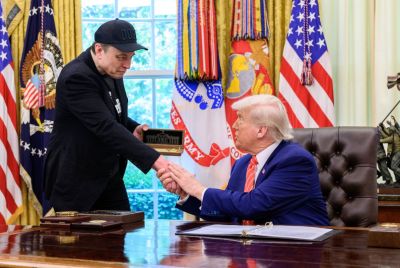
Trump and Musk have since made a show of reconciling, including a public reunion at the memorial service for conservative activist Charlie Kirk last September.
Elon Musk's arrival in Trump's revived White House followed his hefty donations to the president's re‑election campaign and coincided with Trump's promise to gut what he cast as a bloated, unaccountable bureaucracy.
The billionaire was given a bespoke role, put in charge of the Department of Government Efficiency, known as DOGE, and dropped into Cabinet meetings and Oval Office press events as if he had always been part of the political class. Within weeks, long‑serving civil servants were being pushed out, and funding streams that usually take years to rework were slashed almost overnight.
While Trump and Musk have since made public attempts at reconciliation, the legacy of Musk's tenure remains defined by a trail of litigation and an administration still adjusting to the repercussions of his influence.
© Copyright IBTimes 2026. All rights reserved.
- Recommended For You