

Idaho Officials Call for Police Volunteers to Shoot Death Row Inmates Instead of Execution Specialists
Idaho's new execution protocol replaces lethal injection with firing squads, involving volunteer police officers.
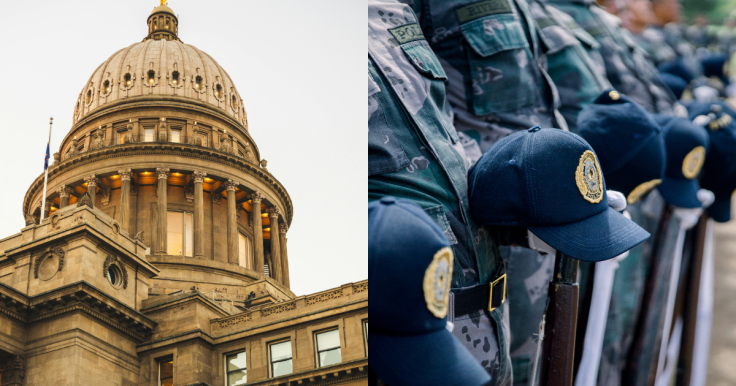
Idaho is preparing to resume executions with a firing squad by recruiting volunteer police officers to carry out the shootings, revealing a detailed protocol that replaces execution specialists with certified law enforcement personnel. The plan follows the state's failed attempt to execute a death row inmate by lethal injection last year and marks one of the most dramatic shifts in US capital punishment in decades.
The state officially made the firing squad its default execution method this week, becoming the only state in the country to adopt it as the primary means of carrying out death sentences. Newly released procedures show Idaho is now seeking volunteer officers to form six-person execution teams as officials move closer to carrying out the sentences of the state's eight death row inmates.
The Protocol After the State Turns to Volunteer Officers
The protocol lays out a tightly controlled process that relies on volunteer Idaho police officers rather than full-time execution personnel.
Three officers will fire the fatal shots while two alternates remain on standby. A sixth officer will act as team leader, overseeing preparations, loading the rifles and directing the execution. If the initial volley fails to kill the inmate, the procedures allow for a second round of gunfire.
Only the prison director and deputy director will know the identities of the volunteers, whose names are protected under Idaho law.
Officials have also imposed strict eligibility requirements. Volunteers must be certified Idaho law enforcement officers with Peace Officer Standards and Training certification and cannot have disciplinary findings involving excessive force or firearm misuse. They are also prohibited from participating if they are related by blood or marriage to either the inmate, the victim or members of their families.
The state will also assess each volunteer's shooting accuracy, requiring candidates to repeatedly strike a heart-sized target during firearms qualification tests without missing.
New Execution Chamber Built After Failed Lethal Injection
The protocol follows Idaho's widely criticised attempt to execute convicted murderer Thomas Eugene Creech in 2024, when prison staff failed to establish an intravenous line before the execution warrant expired.
That incident reignited debate over whether lethal injection remained a practical method of execution and accelerated efforts by state lawmakers to expand the use of firing squads.
Republican Governor Brad Little later signed two bills authorising the changes, although implementation was delayed while Idaho rebuilt its execution chamber at the Maximum Security Institution south of Boise.
The renovation has cost taxpayers around $1.2 million. More than $900,000 has gone towards construction, while roughly $314,000 has been spent on architectural design and engineering work.
State officials have also purchased five Daniel Defence DD5-P rifles chambered in .308 Winchester, along with suppressors, scopes and bipods, at a cost of about $24,000. According to the manufacturer, the rifles are designed for reliability in demanding conditions and incorporate features that reduce recoil.
Idaho Signals a New Direction for Capital Punishment
The latest protocol offers the clearest indication yet of how Idaho intends to carry out future executions.
Under the procedures, inmates scheduled for execution will receive a light sedative on the day of their death and may receive another dose several hours beforehand. Every stage of the process has been carefully prescribed, from recruiting anonymous volunteers to preparing the execution chamber and selecting the firearms that will be used.
Supporters argue the changes provide a more dependable alternative after repeated problems with lethal injection. Critics counter that replacing one execution method with another does little to resolve wider concerns surrounding capital punishment.
Rather than relying on existing prison staff alone, officials have created a system that recruits volunteer police officers, tests their marksmanship and equips them with purpose-built rifles in an effort to ensure executions proceed without the failures that derailed the state's last attempt.
As Idaho prepares to enforce its new law, it has placed itself at the forefront of a renewed national debate over how the death penalty should be carried out and whether firing squads will become a more common alternative as lethal injection continues to face legal and practical challenges.
© Copyright IBTimes 2026. All rights reserved.