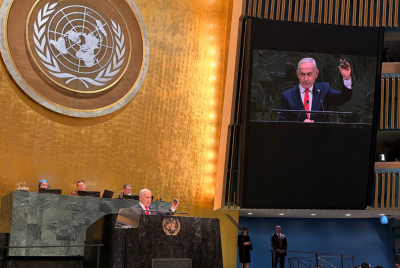
Netanyahu Is Now 80 Testimonies Into a Corruption Trial That Has No End Date Because 'He Decides' When He Shows Up
The ongoing trial of Israeli Prime Minister Benjamin Netanyahu faces further delays amid legal and political complexities.

Six years in, 80 court appearances deep, and still no end in sight: Benjamin Netanyahu's corruption trial ground to another halt on 27 April 2026, the morning it was supposed to resume after a two-month war-related pause, cancelled 90 minutes before proceedings were due to begin.
Netanyahu's lawyer, Amit Hadad, submitted a fresh security objection to the Tel Aviv District Court, blocking testimony that had already been delayed since 24 February 2026, the last date the prime minister actually appeared in the witness box. The cancellation arrived the same morning that President Isaac Herzog publicly ruled out an immediate pardon, instead pushing for mediation between prosecutors and Netanyahu's legal team as a path to a negotiated end to the case.
The trial, which began in May 2020 and has accumulated delays attributed to wars, surgeries, security threats, and procedural motions, has not produced a final verdict, a projected completion date, or any indication that the end is approaching.
Three Cases, One Defendant, a Six-Year Accumulation of Delays
Netanyahu is the first sitting Israeli prime minister to face criminal charges in the country's history. He was formally indicted on 21 November 2019 by then-Attorney General Avichai Mandelblit for bribery, fraud, and breach of trust across three separate cases, each representing a distinct alleged arrangement between Netanyahu and powerful Israeli media and business figures. Trial hearings opened in May 2020. Witness testimony did not begin until April 2021. The prosecution did not rest its case until July 2024.
Case 1000, widely known as the 'gifts affair,' alleges that Netanyahu and his wife Sara received gifts from Hollywood producer and former Mossad operative Arnon Milchan and Australian billionaire James Packer valued at more than NIS 700,000 (approximately £150,000 or $191,000), and that Netanyahu in turn pushed for tax benefits for wealthy expat Israelis and lobbied US officials to renew Milchan's long-term residency visa.

Case 2000 centres on recorded conversations between Netanyahu and Yedioth Ahronoth publisher Arnon Mozes, which prosecutors say reveal a negotiated swap: legislation damaging to Mozes's rival newspaper, Israel Hayom, in exchange for softer editorial coverage of Netanyahu. The charges in both cases are fraud and breach of trust, carrying a maximum three-year sentence.
Case 4000 carries the most serious charge on paper and in the prosecution's estimation. The attorney general's indictment document alleges that from approximately 2012 to 2017, Netanyahu used his concurrent role as communications minister to advance regulatory decisions worth an estimated NIS 1.8 billion (approximately £387 million or $500 million) to telecom giant Bezeq and its controlling shareholder Shaul Elovitch. In exchange, the indictment alleges, Elovitch directed his news website Walla to produce and publish political coverage that served Netanyahu's interests, edited to the prime minister's preferences. The charge is bribery, carrying a maximum sentence of 10 years.
Allegations of Obstruction
The more recent history of this trial is inseparable from the extraordinary confrontation between Netanyahu and former Shin Bet director Ronen Bar, whose sworn affidavit to Israel's High Court of Justice in April 2025 alleged that Netanyahu repeatedly pressed him to issue a security opinion telling the trial court that the prime minister's appearances posed unacceptable physical risk, thereby justifying a halt to proceedings. Bar said he refused, citing his duty to professional independence, and identified that refusal as the reason Netanyahu lost confidence in him and moved to have him dismissed.
Bar's affidavit described a pattern beginning in November 2024, when he said Netanyahu first made the demand. Netanyahu's own sworn counter-affidavit to the High Court denied the characterisation, producing transcripts of meetings to argue he merely sought logistical solutions that would allow testimony to proceed safely, telling Bar in one recorded exchange that he did not want any delay 'even by a single day.'
The dispute between the two accounts remains unresolved in court. What is not in dispute: Bar never issued the opinion Netanyahu's team requested; testimony was moved to a bombproof room in the Tel Aviv District Court, an unprecedented accommodation; and Bar was fired by the Netanyahu cabinet in March 2025.
Israel's Supreme Court later ruled Bar's dismissal unlawful, finding the process 'improper' and noting Netanyahu held a conflict of interest because the Shin Bet was simultaneously investigating alleged ties between his close aides and Qatar. The attorney general had argued, in filings related to the Bar affidavit, that a criminal defendant pressuring a senior official to issue a document that would delay his own trial could constitute obstruction of justice. No criminal charges related to that conduct have been filed.
A Negotiation With No Floor
On 30 November 2025, Netanyahu formally requested a pardon from President Herzog. US President Donald Trump applied pressure in writing, addressing the Knesset in October 2025 and sending a formal letter to Herzog in November, calling Netanyahu a 'great hero' whose trial should be cancelled. By February 2026, Trump escalated publicly, saying Herzog 'should be ashamed of himself' for not having issued the pardon. Herzog's office pushed back: 'Israel is a sovereign state governed by the rule of law. The president will examine the request according to the law, the good of the country and according to his conscience, without any influence from external or internal pressures of any kind.'
Netanyahu’s testimony in his corruption trial was canceled last minute today due to “unspecified security concerns.”
— Clash Report (@clashreport) April 27, 2026
It’s part of a pattern.
Hearings have been repeatedly delayed for “security/diplomatic” reasons.
The trial involves bribery, fraud, and breach of trust charges. pic.twitter.com/0ROXxuHV6b
On 26 April 2026, the day before Netanyahu's testimony was due to resume, Herzog's office confirmed to the New York Times that a pardon was not imminent and that the president would instead seek to broker mediation between prosecutors and Netanyahu's legal team outside the courtroom. The position carries a pointed complexity: a pre-conviction pardon in Israel is legally unprecedented, and it is unclear whether Netanyahu can be pardoned without admitting guilt or resigning from office. Herzog's office has requested supplemental information from the Justice Ministry's Pardons Department on whether such precedents exist.
That request landed in quiet tandem with the latest cancellation. Netanyahu has testified 80 times and is nearing the end of cross-examination on Case 4000 alone, after which the defence phase continues through Cases 2000 and 1000. No projected trial end date has been set by the Jerusalem District Court panel of three judges overseeing the proceedings. Legal analysts cited by Middle East Eye have said that even without further delays, any final ruling remains years away. Netanyahu denies all wrongdoing and has maintained from the first hearing that the cases are a 'witch hunt' and a 'political coup' fabricated by his opponents.
A trial that started when COVID-19 had just shuttered the world's courts now drags on into the era of drone warfare over Tel Aviv, a sitting prime minister with an ICC arrest warrant to his name, and a scheduled court date that was cancelled before breakfast.
© Copyright IBTimes 2026. All rights reserved.
- Recommended For You