

Trump Vows To Scrap Syria's Terror Label After NATO Talks With Al-Sharaa: 'He's Done A Great Job'
US President Trump plans to remove Syria from the state sponsor of terrorism list, marking a significant geopolitical shift.
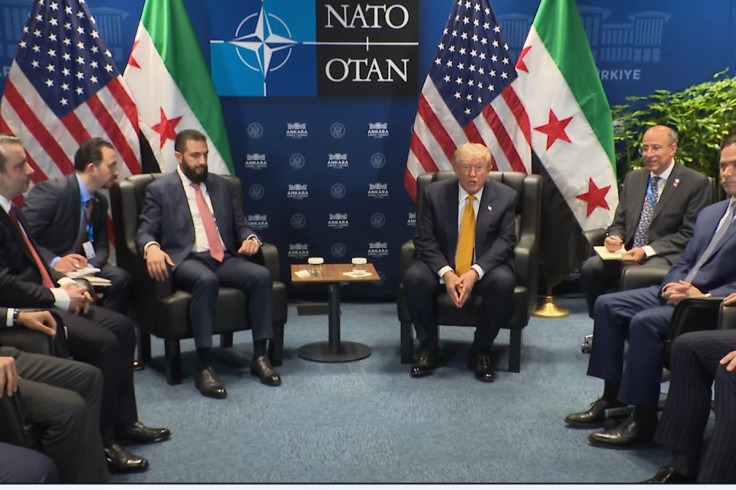
US President Donald Trump announced on Wednesday that he intends to strip Syria of its state sponsor of terrorism designation after talks with Syrian President Ahmed al-Sharaa on the sidelines of the NATO summit in Turkey, saying the former jihadist leader has 'done a great job' since taking power. Asked whether he would officially scrap Syria's terror label, Trump confirmed the move and linked it directly to al-Sharaa's recent performance in office. 'I think I will. Why wouldn't I? He's done a great job,' Trump told reporters. 'Yeah, I will.'
The news came after months of a broader strategic pivot by the Trump administration to engage the government in Damascus and help al-Sharaa court international support to rebuild a nation shattered by a civil war. The Syrian leader is a former jihadist who seized power from Bashar al-Assad in December 2024 and once carried a £7.47 million ($10 million) US bounty on his head.
He was officially designated a terrorist by the US in 2013 before publicly renouncing his allegiance to an al-Qaeda affiliate in 2016. Despite being welcomed to the White House last year and receiving relief from decades-long economic sanctions, Syria had remained on the US State Department's list of state sponsors of terrorism until this latest diplomatic move.
Scrapping Syria's Terror Label And Washington's Pivot
US Secretary of State Marco Rubio clarified the legislative timeline in a formal statement on Wednesday, confirming that Trump had officially informed Congress of his intent to rescind the designation following a mandatory 45-day pre-notification period.
According to Rubio, the policy shift aims to stimulate economic recovery. 'Lifting sanctions on Syria will unlock international trade and investment, give Syria a chance to rebuild, and open up a new chapter for the Syrian people,' Rubio stated.
The US has aligned with Turkey, the host country of the ongoing NATO summit, to help reunify Syria and stabilise its borders. However, the situation on the ground remains complicated by competing interests and various armed factions. More broadly, Syria is a geographical location where both the US and Iran have continuously jockeyed for influence over the past decade.
For Washington, bolstering al-Sharaa is not solely about Syrian reconstruction, as it also affects efforts by the administration to secure a broader peace agreement with Tehran.
Israel Warns Over Shift On Syria
Trump's efforts to change al-Sharaa's international standing and provide sanctions relief have prompted concern in Israel, which has long viewed Damascus as a regional adversary. Tensions between the two neighbouring countries escalated late last year when Israel carried out a series of targeted military strikes against Syrian assets. In response, Damascus formally demanded that Israel withdraw its troops and cease all operations within Syrian territory.
Israeli officials have maintained that their continued military presence was necessary to prevent cross-border attacks similar to the ones carried out by Hamas in October 2023, which initially triggered the war in Gaza.
The regional dynamic is further affected by the ongoing situation in Lebanon. Last month, Trump expressed frustration at Israel's continued military campaign against the Iran-backed militant group Hezbollah.
He suggested that Syria might do a better job at fighting the militant group in Lebanon than Israeli forces have managed. While al-Sharaa has indicated that Damascus could support general stability in Lebanon, he explicitly ruled out any direct military involvement from his government.
When pressed by journalists on Wednesday about whether he still wanted Syria to help manage the Hezbollah threat in Lebanon, Trump kept his answer brief. 'It could help,' he noted.
What Terror Label Removal Means For Al-Sharaa
Securing meetings on the sidelines of the NATO summit could further affect al-Sharaa's international standing. The shift represents a significant policy turn for Washington, given the Syrian president's documented militant history. Yet the process of rebuilding a country damaged by years of civil war involves more than photo opportunities and sanctions relief.
Beyond the economic strains that continue to affect the nation, Damascus still faces internal and external obstacles. These include sectarian tensions that affect national unity, security threats from remnants of the Islamic State, and contested questions regarding Kurdish-held territories.
© Copyright IBTimes 2026. All rights reserved.