Why Lawmakers on Both Sides of the Aisle Are Calling Donald Trump's Iran Deal a 'Political Disaster'
As Iran keeps the Strait of Hormuz closed and follow‑up talks stall, Donald Trump's Versailles‑signed Iran deal is rapidly being framed in Washington as a political disaster.

Donald Trump's tentative Iran deal was thrown into fresh turmoil on Friday in Washington and the Gulf, after Iran's Revolutionary Guards Corps declared the Strait of Hormuz would remain closed, defying a central term of the agreement the president signed in Versailles earlier this week.
The public rebuke from Tehran left the Trump Iran deal looking shaky just as US lawmakers from both parties were already sharpening their attacks and branding the accord a 'political disaster.'
For context, Trump, 80, had spent days hailing the memorandum of understanding with Iran as a breakthrough that would calm the region and restart formal talks. The text of the deal, signed at the Palace of Versailles in France, committed both sides to an immediate reopening of the vital shipping lane and a halt to all military operations, including in Lebanon.
Within hours of the ink drying, however, events in the region and in Washington began to move in the opposite direction.
Iranian officials have now tied any reopening of the strait to Israel withdrawing its forces from southern Lebanon, after four Israeli soldiers were killed and Israel launched strikes on Friday. In other words, a narrow technical step that was meant to kick‑start trust has been re‑wired into the latest round of regional violence.
How the Trump Iran Deal Was Supposed to Work
Under Trump's Iran deal, the reopening of the Strait of Hormuz was meant to be one of the first confidence‑building measures, alongside a staged removal of the US‑led naval blockade of Iranian ports over 30 days.
On Thursday, US Central Command announced that American forces had already lifted the blockade on all maritime traffic entering and leaving Iranian ports and that 'all blockade enforcement efforts had ceased.'
At the same time, the military quietly signalled it was not packing up. US naval vessels would stay in the 'general area,' CENTCOM said, to make sure 'all aspects of the agreement are adhered to, obeyed and in full force and effect.'
That careful phrasing looked neat on paper. Once Iran publicly insisted the strait would stay shut, it started to sound more like wishful thinking.
Pressed by The Daily Beast after the Revolutionary Guards' statement, CENTCOM did not give a clear answer on whether traffic to Iranian ports would, in practice, still be allowed to continue if the chokepoint remained closed. The ambiguity speaks volumes. Washington has begun easing pressure, but it is no longer obvious what it is getting in return.
Diplomacy is in an equally awkward place. Switzerland had been due to host follow‑up talks between US and Iranian officials on Friday, part of a tentative understanding announced by the White House earlier in the week to resume negotiations.
Those talks were abruptly postponed amid the flare‑up in Lebanon and the row over the strait, and officials were already describing the timetable as 'in flux' even before the latest violence.
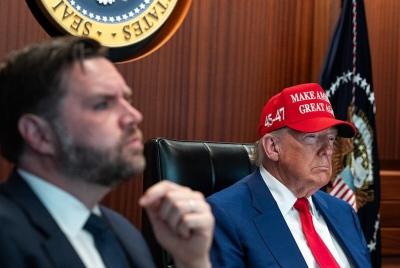
Vice President JD Vance had been picked to lead the so‑called technical discussions with Iranian counterparts, working to flesh out the broad framework over a 60‑day period written into Trump's Iran deal.
But late on Thursday, a White House spokesperson said the timeline had not been finalised and confirmed that Vance would not be travelling to Switzerland on Friday.
The delegation, the spokesperson insisted, was 'prepared to depart at the first available opportunity,' then added that 'logistics of these negotiations have never been simple or predictable.'
Trump Rages Online as 'Political Disaster' Label Sticks
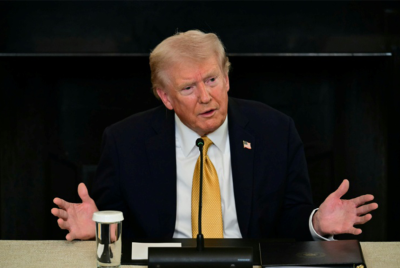
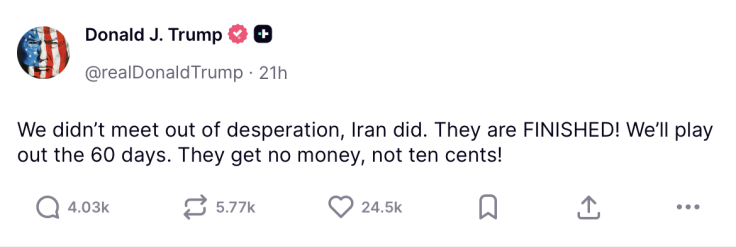
As the deal's practical underpinnings came under strain, Trump reverted to a familiar playbook, venting on Truth Social in a pair of angry posts. He rejected any suggestion that Washington had sought talks from a weak position, insisting instead that Tehran was on its knees.
'We didn't meet out of desperation, Iran did. They are FINISHED! We'll play out the 60 days. They get no money, not ten cents!' he wrote, referring to the agreed 60‑day window for further discussions.
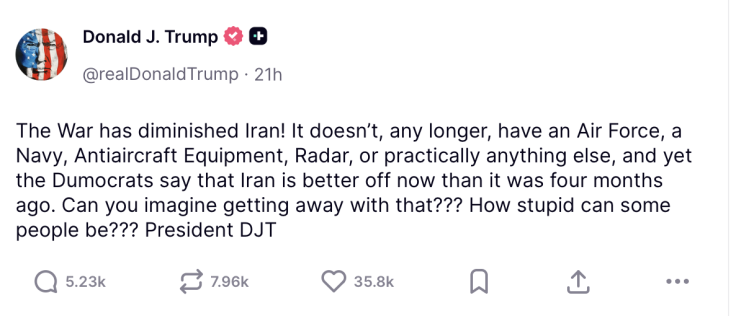
In a second message, he trained his fire on Democrats and critics who argue the temporary accord has left Iran better off.
'The War has diminished Iran! It doesn't, any longer, have an Air Force, a Navy, Antiaircraft Equipment, Radar, or practically anything else, and yet the Dumocrats say that Iran is better off now than it was four months ago,' Trump posted. 'Can you imagine getting away with that??? How stupid can some people be???'
The White House did not immediately issue a detailed response to Iran's refusal to reopen the strait, though officials were pressed by The Daily Beast on how the administration planned to react. Publicly at least, the line remains that diplomacy is still possible, even as the early moves designed to support it fall apart in near real time.
On Capitol Hill, patience is wearing thin. Lawmakers from both parties have questioned why the United States is starting to lift the naval blockade when Iran is not yet implementing its side of the bargain. Critics argue that Trump's Iran deal offers Tehran early concessions without securing verifiable changes in its behaviour, especially around proxy forces in Lebanon.
One CNN data analyst, described in the original report as a 'data guru,' was said to be floored by what he called Trump's 'political disaster' over Iran, capturing a broader sense that the president has walked himself into a mad political bind. He wanted a quick win on the world stage. Instead, he finds himself defending a framework that, so far, is being honoured more in Washington than in Tehran.
Versailles Optics and a Very Modern Backlash
If the mechanics of the Trump Iran deal are messy, the optics are worse. Trump chose to sign the memorandum at the Palace of Versailles, a location that for more than a century has been shorthand for national humiliation rather than durable peace.
The 1919 Treaty of Versailles formally ended the First World War by imposing a punitive settlement on Germany; historians widely argue that it helped sow the seeds for the rise of Nazism and, ultimately, the Second World War.
So when images emerged of Trump sealing an Iran accord beneath the gilded ceilings of the same palace, ridicule online was swift. Critics cast the Versailles photo‑op as tone‑deaf, comparing it to a victory parade held on the site of a previous disaster.
Supporters tried to shrug it off as overblown symbolism, insisting that results on the ground matter more than where the papers were signed. Yet symbolism is precisely the kind of stuff that clings to a deal when its hard outcomes are still uncertain.
For now, the picture is as follows. A White House insists a fragile framework can still hold together. US planners keep warships in the region 'just in case.'
Iran signals that any movement on the Strait of Hormuz will depend on Israeli actions in southern Lebanon, far beyond the narrow wording of the Versailles memo.
And in the middle of it all, an 80‑year‑old president is hammering out posts about how his adversary is 'FINISHED,' even as that adversary keeps one of the world's most critical shipping lanes firmly shut.
© Copyright IBTimes 2026. All rights reserved.
- Recommended For You