Trump Celebrates Landmark Victory as GOP Senate Campaign Finance Lawsuit Destroys Election Spending Caps
The conservative bench increasingly views campaign finance caps as unconstitutional limits on free speech


The US Supreme Court has delivered a monumental decision on election funding that promises to reshape American political campaigns. The historic ruling, which arrived just ahead of critical midterm contests, effectively dismantles decades of restrictions on how political parties deploy cash for their candidates.
This dramatic shift marks a critical turning point for federal elections, instantly triggering fierce debate over the power of wealth in democracy.
Republicans Gain Financial Edge
A major Supreme Court decision has drastically amplified the financial edge held by Republicans, intensifying the pressure on the Democratic National Committee, which is already battling severe fundraising shortfalls.
According to Democrats, Tuesday's ruling permitting unrestricted coordination between parties and campaigns will empower the GOP to wipe out the financial advantage their opponents currently hold in key swing states.
🚨 In a 6–3 vote, the Supreme Court struck down the federal limits on how much political parties may spend in coordination with their own candidates, ruling the restrictions violate the First Amendment and overruling its 2001 decision in Colorado Republican II. pic.twitter.com/Q4PDmgoRYz
— SCOTUS Wire (@scotus_wire) June 30, 2026
While Republicans hold a financial advantage through their congressional campaign arms, the most dramatic gap is at the party headquarters level. The Republican National Committee boasts a $125 million (£94.43 million) war chest, whereas the Democratic National Committee is operating in the red, saddled with $18.3 million (£13.82 million) in debt against just $14.8 million (£11.18 million) in cash.
This massive financial divide was already set to favour the GOP. However, the Supreme Court ruling now allows Republicans to deploy their wealth without restriction, stretching their budget even further to systematically dismantle Democratic funding advantages in crucial swing states. The impact will be felt immediately in high-stakes media buys, as political parties have suddenly gained access to the highly discounted advertising rates historically reserved solely for individual candidates.
Democrats Sound Alarm
Alarm bells are ringing for more than a dozen Democratic operatives embedded in crucial battleground contests stretching from North Carolina to Maine, who voiced deep anxiety following Tuesday's ruling.
Brian Derrick, leader of Democratic fundraising platform Oath, said the verdict 'unequivocally' benefits the RNC.
'They're gonna be able to deploy those funds in more highly-leveraged scenarios to make up for the gap in candidate funding,' Derrick said. 'It's definitely a boost for the Republican Party in the midterms, and it's a shame for the country overall.'
How Campaign Spending Rules Have Changed
Before Tuesday's judicial intervention, strict financial ceilings regulated the amount of capital party committees could spend in direct alignment with their nominees. Limits capped House race coordination spending at between $63,600 (£48,045.03) and $127,200 (£96,090.06), whilst Senate campaigns faced caps ranging from $127,200 (£96,090.06) to $3,946,100 (£2,980,982.59), calculated according to the population of the state or district.
These resources are routinely funnelled into television advertising, which becomes three to 10 times more affordable when purchased alongside a campaign rather than independently by external groups, depending on the market. Under the new framework, however, this spending faces no restrictions whatsoever.
Trump Welcomes Landmark Ruling
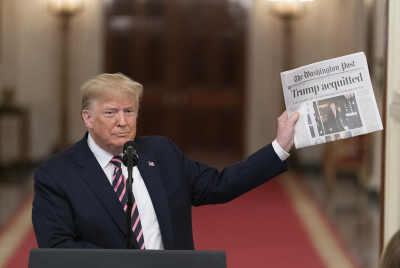
Welcoming the decision, President Trump hailed it as 'a big win for Republicans and, more importantly, the First Amendment', using the moment to build momentum for his SAVE America Act.
The legal battle underscores a persistent domestic dispute surrounding political financing, particularly as the conservative bench increasingly treats expenditure caps as unconstitutional limits on free expression.
What It Means for the Midterms
As political contenders and their respective parties navigate the 2026 midterms, the ruling signals a massive influx of funding for aligned campaign efforts while simultaneously fuelling deep anxiety over the escalating influence of substantial wealth on American democracy.
© Copyright IBTimes 2026. All rights reserved.
- Recommended For You