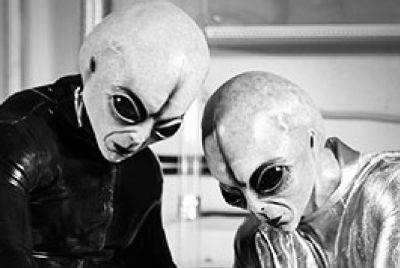
Jesus Was an Alien Hybrid? The Bizarre Flying Saucer Religions Surging in Popularity as UFOs Go Mainstream
When flying saucers crash into theology, the fallout says as much about our need for meaning as it does about the skies above us.

As the film Disclosure Day rolls out in cinemas, director Steven Spielberg is once again pushing audiences to imagine what contact with extraterrestrial life might look like and what it might mean for religion on Earth just as UFO sightings, talk of an 'alien hybrid' Jesus and fringe flying saucer faiths are edging into the mainstream in the US and beyond.
The new wave of UFO fascination has not arrived out of nowhere. In recent months, unidentified anomalous phenomena, or UAPs in official jargon, have migrated from late-night forums to the political and religious establishment. The Pentagon in May released a hefty cache of UFO files with almost no explanation, an information dump that invited the public to connect the dots themselves. Only weeks earlier, former US President Barack Obama lit up the news cycle by declaring in an interview that 'statistically' the universe is so vast that the odds of life out there are good, before stressing he had seen no evidence in office that aliens had actually contacted Earth.
That ambivalence neatly captures the mood. There is no confirmed proof of alien visitors, and officials keep repeating that point, yet the ground is shifting. Curiosity is treated less as a crank obsession and more as a legitimate cultural question, particularly inside religious circles that once ignored or mocked the topic.
Russia 🇷🇺 2002 Restricted Alien Facility Leaked 👽
— The Secret Archives 📜 (@TheSecretFilesX) June 16, 2026
This"containment room" footage, claimed to be from 2002, is one of the most striking leaks that has been hidden for years.#aliens #ufo #mystery pic.twitter.com/5QPtcTmjqj
UFO Belief, Alien Hybrid Ideas and a Challenge to Secular Certainty
Among scholars of religion, some argue that this hunger for UFO stories is not a threat to faith but a quiet rebuke to a flat, purely materialist worldview. Diana Walsh Pasulka, a religion academic at the University of North Carolina Wilmington, puts it bluntly: 'Belief in UFOs is really one of the best things that's happened to religion in a long time. It's a blow to the secular, materialist worldview.'
That may sound counter‑intuitive. Many believers and atheists alike assume that the discovery of intelligent life elsewhere would unravel traditional doctrines that treat humans as unique. If Jesus turns out to be one alien hybrid among many, what happens to salvation history? Yet others see the opposite possibility, that talk of UAPs simply widens the canvas of creation and deepens the sense that reality is stranger and more layered than modern rationalism allows.
Not everyone in the pews is reassured. Some Christian voices insist UFOs are not visitors from another star system at all but something darker. US Vice President JD Vance, a Catholic convert, recently told a podcast he did not think 'they're aliens,' adding: 'I think they're demons.'
That view has currency inside parts of the Catholic world. Monsignor Stephen Rossetti, a long‑time exorcist in the Archdiocese of Washington, suggested in a Facebook video on 29 May that 'many, if not most, of these UFO sightings are in fact demons,' arguing that whatever aliens may be, 'Aliens, if there are aliens, don't possess people.' Days later he was removed from his role, with the archbishop accusing him of making statements that 'gravely undermine' Catholic teaching on demons and the devil.
Rossetti has since posted an apology online, asking forgiveness 'for any ways that I have not been faithful to the teachings of the Church's Magisterium.' Christopher Baglow, who leads a science‑and‑religion programme at the University of Notre Dame, said he was surprised by the sacking, noting that Rossetti had clearly framed his view as personal opinion, and speculated that other, undisclosed factors may be involved. That uncertainty is telling: even inside one church, the lines around UFOs and demonology are far from settled.
Baglow argues the wider Catholic tradition is more open to the prospect of life elsewhere than some of its loudest voices. Theologians, he notes, have speculated for centuries about 'plurality of worlds,' while official teaching has never ruled definitively for or against extraterrestrials. When Pope Francis met astronomy students at the Vatican last year, he spoke of the 'ancient light of distant galaxies' and the 'mysterious joy' stirred by contemplating the cosmos. Some listeners took that as a discreet nod to the possibility of other inhabited worlds, though nothing in the remarks explicitly confirmed it.

From Cold War UFOs to Full‑Blown Flying Saucer Religions
The idea of alien beings is not modern, even if the language is. Philosophers in ancient Greece toyed with the notion of multiple worlds. What is new, as Pasulka points out, is the specific image of the flying saucer, which took shape only after 1945. Jeffrey Kripal, a historian of religions at Rice University, traces the modern UFO to a Cold War imagination of invasion and aerial threat. That narrative helps explain why so many reported encounters tilt towards the hostile, or at least the ominous.
Over time, though, the picture has splintered. For some, UFOs are not harbingers of doom but bearers of revelation. New religious movements built around extraterrestrial contact now sit awkwardly alongside older faiths. Scientology, with its own elaborate cosmic backstory and star‑studded membership, is one example. The Nation of Islam offers another, with some followers expecting their founder to return at the end of days aboard a spacecraft.
Jonathan Caplan KC on UFO's: "The UFO Phenomena is a very real. Some are interdimensional & others extraterrestrial aliens. The truth is the US & China both don't fully understand that is why we have not had disclosure"
— Interstellar (@InterstellarUAP) June 16, 2026
The Barrister & UFO researcher appeared on GB News to… pic.twitter.com/oYEujhyo0R
Then there are the explicitly UFO‑centred religions. The International Raëlian Movement, founded in France in the 1970s and now most active in parts of Asia, Africa and Canada, reinterprets sacred history in frankly science‑fiction terms. Its founder, who calls himself Raël, claims to be a direct descendant of Yahweh after visiting the planet Elohim in 1975. In Raëlian teaching, figures such as the Buddha, Jesus and Muhammad are all alien hybrid beings, produced by a fusion of human and extraterrestrial genetics and presented as Raël's half‑brothers.
Sociologist Susan Palmer, who studies new religious movements at Concordia University in Montreal, describes Raëlism as unusually positive in its attitude to UFOs compared with other groups she has researched. They are not waiting for space wars, she says, but for a kind of benevolent reunion. If that sounds eccentric, it is still part of a broader pattern.

Kripal, who runs Rice's 'Center for the Impossible' archive of reported paranormal experiences, says he is watching colleagues change their tone. Reports of encounters with entities once dismissed as delusion are now being logged and studied as religious experiences in their own right. In his words, people are telling stories that are 'religious through and through,' and academics 'are really starting to listen in a different way.'
For all the headlines, nothing about alien visitors, hybrids or UFO intentions has been proven, and every bold claim still has to be taken with a grain of salt. Yet as pop culture, presidents and popes circle the same question, the boundary between science fiction and spiritual possibility looks less settled than it did a decade ago.
© Copyright IBTimes 2026. All rights reserved.
- Recommended For You