

Russian Troops' New Anti-Drone Unit Nearly Kills Its Own Soldier in Gun Test Gone Wrong
Improvised Defences Reveal Flaws in Russian Military's Anti-Drone Strategy
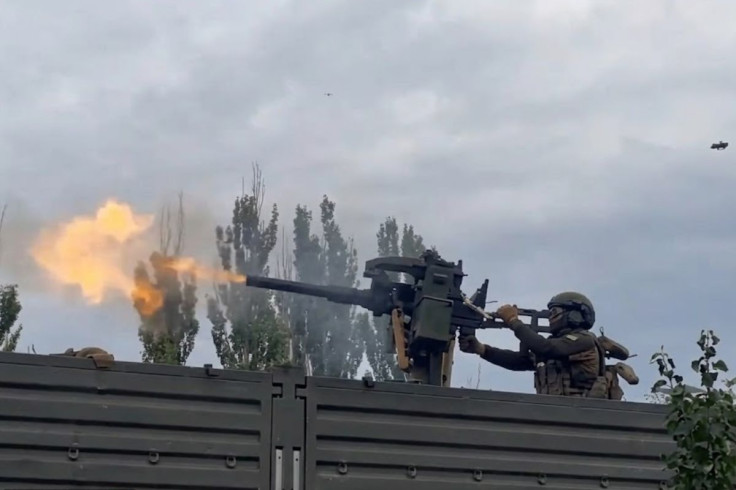
Russian troops testing a new anti-drone 'mobile fire unit' almost killed one of their own soldiers when a repurposed helicopter machine gun spun out of control and sprayed bullets across a training ground.
In video widely shared by military bloggers this week, a Yak-B 12.7mm heavy machine gun, hastily mounted on a flatbed truck, can be seen whipping round at high speed, hurling the primary gunner from his position and sending live fire in all directions during an undisclosed exercise.
The incident comes as Moscow steps up efforts to counter Ukrainian drone attacks that have struck deep inside occupied territory and repeatedly disrupted key logistics and supply lines towards Crimea. Local commanders have rushed to field improvised defences to shield vulnerable convoys from unmanned aircraft.
Gun Test Spirals Out Of Control
Russian forces have increasingly relied on forming specialised 'mobile fire units' tasked with intercepting medium-range Ukrainian drones before they can hit trucks and fuel tankers. The newly surfaced video shows the testing of one such system.
Troops had taken a Yak-B 12.7 heavy machine gun, a rotary weapon designed primarily for the turrets and gun pods of Mi-24 attack helicopters, and bolted it onto the back of a standard military transport vehicle.
Helicopter gunships are built to absorb the torque and recoil generated by a four-barrel weapon firing thousands of rounds a minute. A stationary flatbed truck and a human operator standing exposed in the open are not equipped for such force.
When the gunner opened fire during the exercise, he failed to account for the weapon's asymmetrical recoil.
Because the gun was improperly secured on a free-spinning mount, the force of firing thousands of heavy rounds a minute ripped his grip away. The recoil whipped the machine gun out of control, throwing him from the firing position.
The weapon continued to discharge rounds across the training ground. A second soldier standing in the back of the truck was briefly in the line of fire. He avoided a burst of gunfire by a fraction of a second, ducking as the barrel passed his head.
After several attempts while the machine gun rotated, this second soldier managed to regain physical control of the weapon and stop the firing sequence.
INSANE FOOTAGE: Russian troops mounted a YakB-12.7 helicopter machine gun on a fixed stand for training, but the exercise quickly went wrong. pic.twitter.com/MDbuG1C1eJ
— Breaking911 (@Breaking911) July 12, 2026
Makeshift Anti-Drone Tactics Under Strain
The training accident comes amid pressure on Russian logistics hubs across occupied regions. Ukrainian forces have spent months targeting the key routes supplying the Russian war effort.
They have deployed various explosive drones to hunt down supply convoys ferrying fuel and ammunition to the southern front. The loss of material has prompted a rethink of how rear-echelon troops defend themselves against a threat they may not see or hear until it is close.
To protect these convoys, Russian military planners ordered the creation of mobile defence teams capable of travelling alongside the supply chains. The idea is that a fast-moving truck equipped with heavy weaponry can put up a dense volume of fire to destroy incoming airborne threats before they reach their targets.
The footage indicates problems in frontline engineering and field testing.
Bolting aviation-grade weaponry onto ground transport is described as a practice driven by immediate necessity. The number of Ukrainian drone strikes has outpaced the availability of purpose-built air defence systems, leaving frontline troops to adapt equipment from existing stocks.
Whether this specific unit will continue using the helicopter gun remains unknown.
© Copyright IBTimes 2026. All rights reserved.