Dementia or Normal Aging? Top Doctors Demand Answers Over Donald Trump's G7 Health Warning Signs and Swollen Cankles
Swollen ankles, bruised hands and guarded medical bulletins have turned Donald Trump's ageing body into a running test of how far presidential secrecy can still stretch.

Donald Trump's swollen ankles triggered a fresh wave of health scrutiny on Tuesday, 16 June, after cameras captured the 80-year-old US president's visibly bulging 'cankles' during a G7 summit meeting in Évian-les-Bains, France, with Qatar's Emir, Sheik Tamim bin Hamad Al Thani.
Trump's physical and cognitive fitness, as images of his mottled hands, apparent daytime drowsiness and increasingly laboured speech have fuelled speculation that his problems extend beyond normal ageing. The White House insists he remains 'in excellent health' and fully able to serve, but a growing number of medical voices are no longer taking those assurances at face value.
Meloni looks like she wants off the planet as Trump rants and raves at length to G7 leaders about UFC pic.twitter.com/JiZFPENYQn
— Aaron Rupar (@atrupar) June 16, 2026
Doctors Flag CVI, Bruising and Trump's 'Cankles'
The latest flashpoint began with something apparently mundane. As Trump sat for the bilateral meeting in Évian-les-Bains, his trouser legs rode up just enough for photographers to capture his lower legs and ankles. The pictures, widely shared online, showed marked swelling around the ankles on both sides, a classic presentation of what clinicians call bipedal oedema.
Trump was diagnosed in 2024 with chronic venous insufficiency, or CVI, according to the reporting. CVI is described as a benign but chronic condition seen frequently in adults over 70, occurring when the valves in the leg veins no longer push blood efficiently back towards the heart. The result is blood pooling in the lower limbs and fluid leaking into surrounding tissues, which can cause persistent swelling.
White House medical staff had previously prescribed compression socks to manage the condition, a standard approach intended to support circulation in the legs. Trump himself told the Wall Street Journal that he stopped wearing the socks because he disliked how they felt. The choice might be understandable on a human level, but medically it has obvious consequences: without compression, the swelling is more likely to return, and to be noticeable.
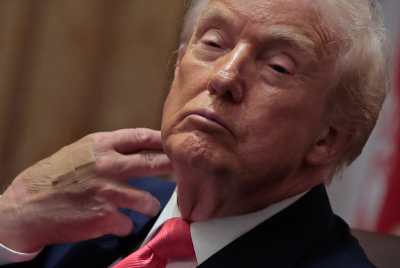
The ankles are not the only visible clue. Photos of Trump's hands, often showing heavy make-up and notable discolouration, have been trending alongside the cankle images. According to the White House, the change in colour is due to easy bruising from a daily high-dose aspirin regimen, rather than any underlying blood disorder. Aspirin is widely used to reduce clotting risk, but it can increase bruising, particularly in older adults.
This is not an isolated episode. Similar images of his swollen lower legs have surfaced multiple times over the past year, including during meetings with Canadian Prime Minister Mark Carney and German Chancellor Friedrich Merz. The pattern has not gone unnoticed by specialists who are used to reading bodies as closely as they read charts.
Following Trump's most recent comprehensive medical exam at Walter Reed National Military Medical Center, the administration released a memorandum declaring the president to be 'in excellent health' with normal cardiac function and a normal neurological assessment. On paper, at least, there is nothing to see.
Dementia Fears, Sleepiness and the Question of Transparency
The physical memo, however, has not settled the political argument. If anything, it has sharpened it. Some psychiatrists and psychologists have gone public with their doubts, arguing that the official line does not fully square with what the world has been watching on television.
Clinical psychologist Dr John Gartner is among the most outspoken. He has pointed to Trump's speech patterns and behaviour, suggesting they indicate possible cognitive decline or even frontotemporal dementia, a serious degenerative brain condition that can affect language, judgement and personality. Gartner has argued that what he and others are observing looks 'far more serious than normal aging.' These claims remain unproven, and Trump has not been diagnosed with dementia, but they are not coming from amateurs on social media.
Donald Trump’s latest health report is sparking plenty of conversation. 👀 A new White House memo declared the 79-year-old president in “excellent health” and fully fit to serve as commander-in-chief following a recent medical evaluation at Walter Reed: https://t.co/tdMyTxyI1l pic.twitter.com/bw3b9N7cN8
— OK! Magazine USA (@OKMagazine) June 3, 2026
Cardiologist Dr Jonathan Reiner, a professor of medicine at George Washington University and a CNN medical analyst, has also been unusually blunt for someone in his position. He has repeatedly questioned why obvious physical signs such as bruised hands, bipedal oedema and Trump's frequent daytime sleepiness during public engagements are brushed off in short statements, rather than explained in a detailed briefing.
Reiner has urged the administration to allow the president's physician to take live questions from journalists. After Trump's latest physical, he said, 'With lingering concerns following the president's recent physical exam, and the president's prolonged absence from the public eye, the White House should make available the president's physician to answer questions from the press.' It was a pointed reminder that health is not just a private matter when the patient holds the nuclear codes.
Pulmonologist Dr Vin Gupta has joined that chorus, querying the mix of symptoms that keep turning up in photographs and video clips: swelling in the lower legs, heavy reliance on make-up to disguise bruising, and scenes where Trump appears lethargic or drowsy during high-level meetings. None of these signs, on their own, is definitive of anything. Together, they paint a picture that many clinicians would, at minimum, want to investigate.
"238 pounds"
— Molly Ploofkins (@Mollyploofkins) June 16, 2026
"excellent health, demonstrating strong cardiac, pulmonary, neurological, and overall physical function"
Blood pressure: 105/71
Total cholesterol 143
"Cardiac age approximately 14 years younger than his chronological age" pic.twitter.com/87LIghqCib
The White House line is that everything clinically significant has already been disclosed. Critics reply that the disclosures feel curated, with uncomfortable details relegated to vague language and reassurances. The memo from Walter Reed, for example, speaks of a normal neurological assessment without offering test scores or naming the cognitive tools used.
Much of the debate now turns on what the public is entitled to know. Trump is 80, on daily aspirin, with diagnosed CVI and repeated episodes of visible swelling. The administration says his heart is fine and his brain is fine, and that the rest is cosmetic. A cluster of prominent doctors, looking at the same ankles, the same bruises and the same long pauses in his sentences, are asking whether that really covers it.

Nothing in the available reporting confirms a diagnosis of dementia or any other undisclosed condition, so all suggestions in that direction should be treated with caution. Yet until the president's medical team submits to sustained questioning, those swollen ankles in Évian-les-Bains are likely to be read not just as a circulatory issue, but as a symbol of how much or how little the public is being allowed to see.
© Copyright IBTimes 2026. All rights reserved.
- Recommended For You