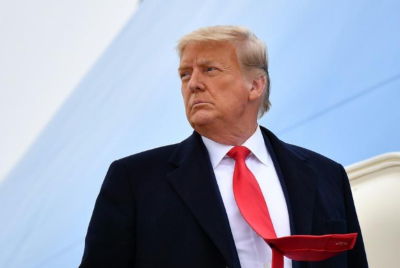
'Frontal Lobe Failure': Former Trump Attorney Ty Cobb Claims President Donald Trump Is 'Insane'
Ex-White House lawyer Ty Cobb says Trump's mental decline has 'accelerated' and brands the president 'insane', deepening concerns over his fitness to govern.


President Donald Trump is 'insane' and showing signs of an accelerating mental decline in his second term, according to former White House attorney Ty Cobb, who told US network MS Now on Thursday, 16 April, that the president's behaviour suggests a 'frontal lobe failure.'
The news came after months of intensifying scrutiny over Trump's public performances, verbal slips and outbursts, which have become a running feature of his second term in the White House. Trump, who returned to office after his 2024 election comeback, has long been accused by critics of erratic conduct. Supporters, meanwhile, tend to dismiss such concerns as partisan attacks, arguing that his provocative style is precisely what they voted for. Cobb's intervention is different. He is not a liberal pundit or anonymous staffer, but a lawyer who once worked inside Trump's legal bubble.
Ty Cobb's 'Frontal Lobe Failure' Claim About Trump
Cobb, who served as a White House attorney during Trump's first term, did not hedge his language. 'I don't think there's any doubt about it,' he said, when asked whether he believed Trump was 'insane.' He then acknowledged his own limits: 'I'm not a psychiatrist,' he told MS Now, but argued that Trump's conduct lines up with what mental health specialists have been warning about in public commentary.
'Every day there's a publication out there where respected psychiatrists and mental health professionals are quoted on the symptomatology,' Cobb said, pointing to a growing body of commentary rather than a formal diagnosis. None of those professionals, as far as the public record shows, has personally examined Trump in office. That gap matters. Under longstanding norms in US psychiatry, many clinicians avoid diagnosing public figures at a distance, however strong their views.
Cobb nevertheless described what he sees as a visible deterioration. He cited what he called Trump's shrinking vocabulary, his struggle to 'finish sentences,' and a pattern of 'resorting to profanity and threats, totally impulsive.' Those traits, he argued, are 'suggestive of the absence of any frontal lobe controls,' invoking the part of the brain associated with planning, judgement and impulse regulation.
To be clear, Cobb offered no medical records, test results or private health details to substantiate his description. The White House has not released any new formal cognitive assessments of Trump during his second term, and there is no independently verified medical evidence in the public domain confirming a specific neurological condition.
Trump Mental Decline Debate Deepens In Second Term
Concerns about Trump's mental state have followed him since his first campaign. Supporters often celebrated his off‑script rants as authenticity. Detractors framed them as warning signs. What Cobb adds is the suggestion of acceleration. He told MS Now that Trump's cognitive issues have 'definitely accelerated' since his first term, implying a noticeable change over the last several years.
That escalation, Cobb suggested, is not simply the wear and tear of age in a demanding job. He contrasted Trump directly with former president Joe Biden, a frequent target of Trump's 'Sleepy Joe' jibes and of relentless speculation from MAGA supporters about Biden's own mental fitness.
'The difference between Biden's, sort of, benevolent grandpa losing his memory and Trump's malignant narcissism is shockingly consequential,' Cobb said. It is a loaded comparison. Biden's public lapses are widely mocked, but framed here as relatively harmless forgetfulness. Trump's, in Cobb's telling, are wrapped in aggression, grievance and a hard‑edged self‑regard that could translate into dangerous decision‑making.
The White House has not issued any detailed rebuttal to Cobb's interview. In past controversies around Trump's health, officials have tended to respond by stressing that the president is 'sharp,' 'engaged' and working long hours, sometimes pointing to his frenetic schedule as proof of stamina. Without a fresh, independently conducted medical evaluation, voters are left to triangulate between those reassurances, Trump's own performances and the testimony of former insiders like Cobb.
There is also a broader unease that hangs over this argument. When a former government lawyer publicly raises the spectre of 'frontal lobe' problems in a sitting president, it cuts to the heart of how power is wielded in Washington. This is not a question of policy disagreement or ideological distaste. It is a question of whether the person with unilateral authority over nuclear weapons and national emergencies is, in the eyes of someone who once defended him, still fully in command of his faculties.
Nothing in Cobb's comments has been medically confirmed, and his characterisations should be taken with a degree of caution. Yet his decision to use the word 'insane,' on air and on the record, reflects a shift in how some former Trump allies are now prepared to talk. The real test, as ever in American politics, will be whether voters see what Cobb says he sees, or whether they decide this is just one more voice in an already deafening partisan argument.
© Copyright IBTimes 2026. All rights reserved.
- Recommended For You