Humans May Be 'Autonomous Probes' Created by Aliens, Avi Loeb Claims
If Avi Loeb is even partly right, humanity may not be the architect of its own story so much as the payload of someone else's grand experiment.

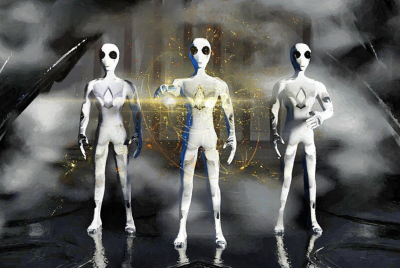
Avi Loeb has suggested that humans themselves may be 'intelligent, self-replicating and self-repairing autonomous probes' built by an advanced alien civilisation, arguing in a new essay published online that our biology could be the product of extraterrestrial synthetic engineering rather than a purely natural evolution on Earth.
Loeb, the high-profile Harvard astronomer who now chairs the UAP Science Advisory Council for the White House, the Pentagon, the Office of the Director of National Intelligence, the FBI and other US intelligence agencies, responded publicly to a question from a university student in France. The student had asked him about the classic von Neumann probe idea: if a technologically superior civilisation sent out self-replicating robots capable of travelling at just one per cent of the speed of light, the Milky Way could be 'colonised' in a few hundred thousand years.
"Young man, in mathematics you don't understand things. You just get used to them."
— Mathematica (@mathemetica) May 6, 2026
—John von Neumann pic.twitter.com/5Ayv6rQvIt
On cosmic timescales, that is essentially nothing. Yet, as the student pointed out, we do not see such probes, nor giant, unmistakable feats of alien engineering in our galaxy. For many scientists, that absence has been taken as circumstantial evidence that no vastly superior civilisation has ever arisen nearby.
Loeb thinks that conclusion is far too hasty. Writing on Medium, he recounts telling the student that he already deals with intelligent, self-repairing autonomous probes every day. 'They are called humans,' he notes, half in jest and half in provocation. Whether those humans arose through familiar evolutionary processes or were, at some remote point, seeded or engineered by extraterrestrials is, he insists, still an open question.
Avi Loeb Turns The Von Neumann Probe Question Back On Us
von Neumann probes are a long-standing thought experiment in astrophysics and philosophy. Named after the mathematician John von Neumann, they are hypothetical machines that can build copies of themselves from raw materials they find on other worlds, spreading across a galaxy in exponential fashion. The French student's argument was simple enough: if this is possible, and any civilisation in the Milky Way got a technical head-start of a few hundred thousand years over us, why is the sky so quiet?
Loeb's answer upends one of the premises. The traditional image of a von Neumann probe is a metal robot with silicon-based artificial intelligence. Yet our own attempts at AI, Loeb points out, are astonishingly clumsy when compared with biology. Modern AI systems run on chips refined from quartz-rich sand, turned into ultra-pure silicon wafers through intensive heating and chemical processing. Those chips, stacked in server farms, gulp gigawatts of power to perform tasks that a human brain can still handle more gracefully while drawing about 20 watts less than a typical household lightbulb.
Super! 💫
— NASA (@NASA) June 16, 2026
Data from @chandraxray has uncovered possible remains of a supernova in the middle of our Milky Way galaxy. If confirmed, this supernova piece would be one of the closest to our galaxy’s central black hole that we have ever found. https://t.co/gI5TfSJ45E pic.twitter.com/9FJx02K8lt
In Loeb's view, that disparity tells us something important about where a truly advanced technology might go. If, in the far future, humans master synthetic biology, we may be able to build artificial 'astronauts' whose brains are not etched in silicon but grown, designed and tuned like biological tissue. Fed by nutrients from a planetary surface, able to repair their own damage, such beings would be far more energy‑efficient and adaptable than metal robots locked into rigid hardware.
Scaled up beyond human capabilities and engineered for near-indefinite self-repair, they would look very much like the ideal von Neumann probes that futurists have been imagining for decades. The twist is that they would not be machines in the usual sense, but life forms.

Are Humans The Kind Of Probes Avi Loeb Describes?
From there, Loeb pushes the thought experiment one step further. Most stars in the Milky Way formed billions of years before the Sun. If technological civilisation is not unique to Earth, it is statistically plausible that someone else has already travelled the long arc from basic tools to synthetic-biology astronauts. In that scenario, he asks, 'is it possible that humans represent intelligent, self-replicating and self-repairing autonomous probes which were constructed thanks to the synthetic biology skills of an alien civilization?'
He does not claim this is established fact. The suggestion is framed as a possibility, and Loeb repeatedly stresses that 'whether human existence on Earth was a result of alien visitation remains to be explored.' There is, at present, no direct evidence that our species is the product of extraterrestrial design. Nothing is confirmed, and everything should be taken with a grain of salt.
Still, he clearly believes the idea should not be ruled out simply because it sounds outlandish. In his essay, Loeb also takes aim at the near‑term techno‑utopian focus on silicon‑based AI and the so‑called 'singularity,' the notion that machine intelligence will soon outstrip and perhaps replace us. Compared with the potential of synthetic biology to build entirely new forms of intelligence, he argues, the anticipated AI leap may look rather modest in hindsight.
That is a decidedly minority view in mainstream astronomy and biology, disciplines which usually treat life on Earth as an emergent property of local chemistry and physics, not a product of off‑world engineering. But Loeb, who has previously courted controversy with his claims that strange interstellar objects such as 'Oumuamua might be artificial in origin, is not in the habit of steering away from speculative territory if he believes it is testable.
🚨 Earth may be at the center of a 2-billion light-year cosmic void…
— Astronomy Vibes (@AstronomyVibes) June 16, 2026
It could explain why our local universe appears to be expanding faster than expected.
Earth and the Milky Way might be drifting through a colossal cosmic void spanning two billion light-years, according to a… pic.twitter.com/NU4Ff85WbV
What might actually test it is his day job. As chair of the US government's UAP Science Advisory Council, Loeb says he wants rigorous investigation of any credible reports that suggest non‑human technology operating in our skies or beyond. 'I hope we can find out whether we are being visited and if so what is the nature of the intelligence of our guests,' he writes.
His notion that we could ourselves be someone else's probes lives in the same space as many ideas at the edge of science: unproven, arguably unsettling, and very difficult to rule out entirely with the evidence currently to hand.
© Copyright IBTimes 2026. All rights reserved.
- Recommended For You