Are Aliens True or Fake? Top Astrophysicist Explains Why Government UFO Cover-Ups Are 'Total Nonsense'
Dr. Emma Chapman argues for the existence of intelligent life while dismissing UFO cover-up theories.
A leading British astrophysicist has argued that intelligent alien civilisations 'absolutely' exist somewhere in the cosmos but insists there is no evidence they have ever visited Earth, dismissing government UFO cover-up claims as 'total nonsense' in a new book exploring whether aliens are true or fake.
The debate over whether aliens are true or fake has intensified in recent years, fuelled by leaked cockpit footage, viral social media clips and a drumbeat of conspiracy theories that accuse governments of hiding crash sites, secret pacts and even underground bases. Against that noisy backdrop, Dr. Emma Chapman, an astrophysicist at the University of Nottingham and a specialist in radio astronomy, is trying to ground the conversation in what can actually be measured through telescopes and data rather than speculation.
In the book "The Echoing Universe: How Radio Astronomy Helps Us See the Invisible Cosmos," astrophysicist Emma Chapman describes the hidden corners of space that only radio… https://t.co/Hs5xjtYljX #Aliens #Astrophysics #RadioAstronomy #ExtraterrestrialLife #SpaceExploration
— Vitalize Contexts (@vitalizeone) May 21, 2026
Her starting point is uncompromising. In The Echoing Universe: How Radio Astronomy Helps Us See the Invisible Cosmos, Chapman writes that she is 'always a little taken aback' when audiences ask if she believes in intelligent aliens at all. Her answer is blunt.
'I am always a little taken aback, as is the audience, when they hear my emphatic answer, "Absolutely. I have no doubts at all,"' she explains. For her, the sheer scale of the galaxy, combined with the torrent of new discoveries of planets beyond our Solar System, makes some form of intelligent life elsewhere not just plausible but almost inevitable.
Why Scientists Say Life Is 'Out There'
Chapman's confidence rests on what astronomers have been uncovering over the past few decades. For starters, there is now what she calls an 'absolute avalanche' of newly discovered exoplanets, many of them roughly Earth-sized and orbiting their stars at distances where liquid water, and therefore life as we understand it, could exist.
In other words, the question of aliens true or fake, in her view, becomes less a matter of belief and more one of statistics. With billions of stars in our galaxy alone, and an ever-growing list of potentially habitable worlds, she writes that it is 'mathematically implausible' that Earth is the only place where complex life has taken hold.
What to read this week: Emma Chapman's mind-expanding Radio Universe | New Scientist https://t.co/Rblz8aiJY3 An imaginative and compelling book reveals how radio waves help us tune in to our universe – and even search for alien civilisations, says Karmela Padavic-Callaghan
— breizh2008 🚜 (@breizh2008) April 17, 2026
'My surprise comes about because, as a radio astronomer, I have no doubt that life is out there, and I sometimes forget that there can even be a question about the matter,' she notes in the book. That quiet astonishment is telling. To those who work daily with the data, the loneliness of humanity looks like the stranger proposition.
Yet Chapman draws a sharp line between accepting that intelligent aliens exist somewhere and endorsing the folk stories that have built up around flying saucers, alien abductions and secretive state agencies hiding the truth.
Why UFO Cover-Up Theories Are 'Total Nonsense'
'Have aliens visited our planet?' she asks, before answering herself just as emphatically, 'Absolutely not. I have no doubts at all.' For all the heat around alleged UFO sightings, she argues, there is still 'no evidence for interference by extraterrestrial life on Earth.'
That means no aliens building the pyramids, no UFOs crafting complex crop circles and 'no secret government cover-ups,' as she puts it. The claims might be colourful, but in her assessment they do not stand up to basic scrutiny.
Bob McGwier: "These UFO's are NOT our technology - They are non human" 👽🛸
— Interstellar (@InterstellarUAP) May 23, 2026
The ex CIA, NSA & DARPA Scientist said "No government on earth or corporate entity that I am aware of can do what we are observing"
The veteran of decades in classified intelligence programs is certain… pic.twitter.com/XQFeN90aU9
Chapman suggests that many supposed flying saucers are far more mundane. Bright points low on the horizon often turn out to be the planet Venus. Other incidents, she writes, can be chalked up to optical illusions or simply 'terrible camera work.'
She points to an awkward detail for conspiracy theorists. If alien craft were regularly buzzing the skies, the age of smartphones should have produced a torrent of crisp, unambiguous images. Instead, she notes, the quality of UFO footage stubbornly refuses to improve.
For her, that mismatch is telling. At a time when billions of people carry high-resolution cameras in their pockets, the fact that UFO evidence still looks shaky 'belongs firmly in the realm of conspiracy theories,' not systematic observation.
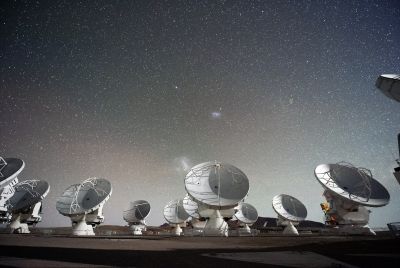
That does not mean scientists are complacent. On the contrary, as Chapman stresses, astronomers are actively listening for signs of intelligent life using some of the most sensitive radio telescopes on Earth.
More than 50 years ago, Frank Drake, a pioneer of the Search for Extraterrestrial Intelligence, used the giant Arecibo radio dish to beam a coded mathematical message towards a distant star cluster known as M13. That signal, travelling at the speed of light, has so far crossed just 50 light years of the roughly 21,000 it must cover before it reaches its target.
At the time, the idea of announcing our presence to the universe did not sit well with everyone. The then Astronomer Royal, Sir Martin Ryle, was, as Chapman recounts, 'absolutely furious,' warning that any advanced civilisation might be 'malevolent – or hungry.' His fear was simple, advertising our location could invite a visit we might not survive.
Chapman is unconvinced by that apocalyptic scenario. She argues that the practical barriers to interstellar travel are so immense that an invasion fleet is vanishingly unlikely. The energy required to ferry living beings across such distances at even a fraction of light speed, she notes, would be enormous. She sides instead with Drake's own cooler logic. If he genuinely believed extraterrestrials were on their way in person, he once remarked, 'I would just sit outside in a lawn chair and wait for them to show up.'
In reality, astronomers expect that any first contact, if it ever arrives, will not be a gleaming saucer hanging over a capital city but a faint, structured radio signal buried in the background hiss of the universe. Because the laws of physics are the same everywhere, radio waves make a kind of universal phone line, efficient, cheap and detectable across vast distances.
That means an extraterrestrial transmission could, in theory, already be inching its way across the galaxy towards Earth. For Chapman, that is where the serious version of the aliens true or fake question really sits, not in grainy videos and whispered cover-ups, but in the patient work of listening for a pattern in the static.
© Copyright IBTimes 2026. All rights reserved.
- Recommended For You