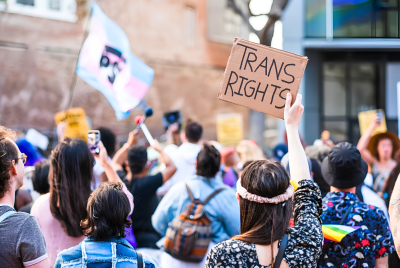
135 Labour MPs Seek to Block EHRC Guidance on Single-Sex Spaces Over Concerns for Transgender People
Concerns grow over the practicality and implications of the EHRC's new code of practice on biological sex.

As the Equality and Human Rights Commission's (EHRC) new code of practice moves closer to becoming law, concerns are growing not only about its impact on transgender people but also about whether it can realistically be implemented in everyday settings.
A group of 135 MPs, including 69 Labour MPs, has signed a Commons motion calling for the EHRC guidance to be blocked. While the motion is unlikely to stop the code from taking effect, it highlights mounting unease among lawmakers who argue that the rules remain unclear, difficult to enforce and could create unintended consequences for public services, workplaces and healthcare providers.
The EHRC guidance follows last year's Supreme Court ruling that the term 'sex' in the Equality Act refers to biological sex. The guidance states that transgender people should generally not use single-sex facilities designated for the gender they identify as and, in some circumstances, may also be excluded from facilities corresponding to their biological sex. It recommends providing gender-neutral facilities where possible.
Critics argue the guidance could create significant difficulties for transgender people, particularly in healthcare settings, while also leaving organisations struggling to interpret and apply the rules consistently.
Why Labour MPs Are Questioning the Ehrc Guidance on Biological Sex
Opposition to the EHRC guidance has been building across different wings of the Labour Party, with critics arguing that the proposed framework leaves too many practical questions unanswered.
Several MPs have raised concerns about how organisations would apply the guidance in real-world situations. Some fear the code could place employers, service providers and public bodies in difficult positions where they risk legal challenges regardless of the decisions they make.
One Labour MP said concerns extend beyond political factions within the party.
'Looking at the list, it's not just a mix of the left and right of Labour, but it's people from surprising bits of the left and the right. The concern is really cutting through,' the Labour MP explained. 'The motion won't change the law. The supreme court judgment will stand, unless there is legislative action. It's about building momentum for the future, officially recording on the public record people's opposition to this.'
Another Labour backbencher argued that, even after revisions and additional examples were added to the guidance, it remained unworkable.
'It doesn't seem logical that we have introduced this system where we can challenge people on the way they look on whether or not they can use certain services. Because it's so unclear what people should do, it feels like it has opened the door to a series of legal challenges.'
EHRC Guidance Is 'Not Ready, Not Practical, and Not Safe'
Questions about the guidance intensified after EHRC chair Mary-Ann Stephenson and chief executive John Kirkpatrick appeared before the Commons Women and Equalities Committee.
Among those raising concerns was Labour MP Kevin McKenna, a former nurse, who questioned how the proposed rules could operate in healthcare settings where resources are already stretched.
McKenna specifically highlighted concerns about hospital wards and the suggestion that transgender patients could be accommodated in gender-neutral side rooms. He noted that such rooms are often limited and are frequently required for clinical reasons, such as isolating infectious patients.
In a statement following the hearing, McKenna said he feared the code 'may not survive contact with reality'.
'This guidance is not ready, not practical, and not safe to implement. It will lead to terrible situations for trans people and their friends and families. It will not make life any safer for anyone else.'
My Statement on the EHRC evidence session at the Women and Equalities Committee
— Kevin McKenna MP (@kevinmckenna.co.uk) June 11, 2026 at 12:19 AM
[image or embed]
Other Labour MPs reported hearing similar concerns from transgender constituents. According to them, the fear of ward placement is causing several individuals to avoid seeking necessary medical care actively.
'Several people have told me they are actively avoiding seeking medical care over fear of what ward they will be put on,' one backbencher said. 'One trans man said he would rather die than be put on a women's ward.'
Another MP criticised the guidance's reliance on what they viewed as subjective judgments.
'Mary-Ann Stephenson kept talking about "common sense",' the MP said. 'You can't operate that way because it's completely subjective. Organisations will be worried they will be sued if they get it wrong.'
What the EHRC Guidance Means and What Happens Next
The EHRC guidance was drafted in response to the Supreme Court's ruling on biological sex and is intended to help organisations understand how equality law should be applied.
Supporters argue the guidance provides greater clarity around single-sex spaces and services. Critics, however, contend that many practical scenarios remain unresolved, particularly in healthcare, workplaces and public facilities.
The 40-day parliamentary period for the code to be laid before Parliament is due to end early next month. After that, the guidance is expected to become law in the weeks or months that follow.
A government source defended the process, saying officials had worked closely with the EHRC to make the code as practical as possible.' While acknowledging the strong opinions surrounding this guidance, the creators reportedly worked to ensure it is practical, legally sound, and rich with examples for service providers. However, they note that the document cannot anticipate every possible legal scenario.
© Copyright IBTimes 2026. All rights reserved.
- Recommended For You