

Forbidden Egypt Tour Promises Access Near Giant Underground Chambers Said to Stretch for Miles Beneath Giza
A tour is set to uncover hidden structures beneath Egypt's Giza Plateau.
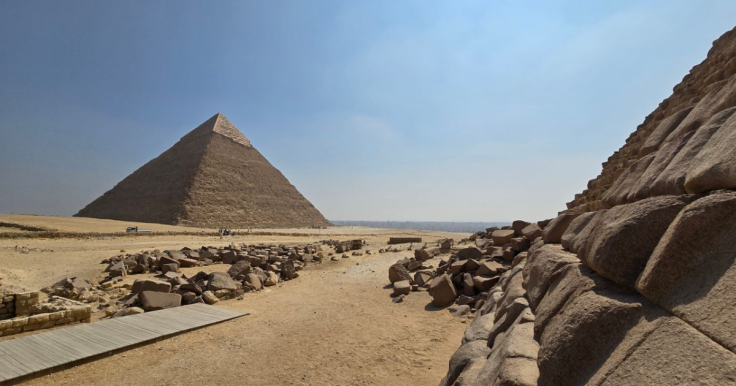
Renewed interest in the mysteries of ancient Egypt is being fuelled by claims that advanced scanning technologies have revealed extensive underground structures beneath the Giza Plateau. It has prompted debate among researchers, historians, and enthusiasts about the true nature of the ancient site.
During a recent YouTube live broadcast, author and alternative-history researcher Billy Carson argued that recent scientific investigations support long-standing theories about massive subterranean chambers and labyrinths hidden beneath Egypt's most famous pyramids. Carson cited reports of satellite imaging, radar scanning, and other remote-sensing technologies that allegedly identified deep underground formations extending below the Giza complex.
What's Hidden Underneath
According to Carson, the discoveries align with descriptions found in ancient texts and legends that speak of vast underground halls, chambers, and knowledge repositories beneath the desert. He linked these accounts to stories involving the Anunnaki, the Neters of ancient Egypt, and other legendary beings referenced in various ancient traditions around the world.
Central to Carson's claims is the idea that the newly reported underground structures resemble the legendary 'Halls of Amenti,' a mythical realm described in esoteric writings associated with the Emerald Tablets. He asserted that ancient accounts of subterranean cities and hidden chambers may have been based on real locations rather than symbolic narratives.
The discussion also referenced the Greek historian Herodotus, who wrote about a labyrinth in Egypt that he described as surpassing even the pyramids in scale and complexity. Carson argued that modern findings may lend credibility to those ancient descriptions.
Beyond archaeology, the presentation explored broader claims that ancient civilisations possessed advanced scientific knowledge that modern society is only beginning to rediscover. Carson pointed to contemporary developments in physics, acoustics, and military technology as examples of concepts he believes were described in ancient texts thousands of years ago.
Among the examples discussed were experiments involving sound frequencies and light, as well as modern non-lethal crowd-control systems that use directed energy. Carson suggested these technologies bear similarities to devices and abilities described in ancient writings, although such interpretations remain controversial and are not widely accepted within mainstream academic circles.
A Promising Tour Is Happening
The broadcast concluded with the promotion of an upcoming tour of Egypt that will take participants to several archaeological sites, including Giza, Saqqara, and the Fayoum region. Planned visits include exploration of underground passages, ancient monuments, and the Valley of the Whales, a UNESCO-recognised fossil site known for preserving evidence of prehistoric marine life in what is now desert terrain.
'It's going to be an amazing tour,' Carson raved. 'It's going to be also a very sacred tour because we are going to do things that hardly anyone gets to do.'
'We will go into the great pyramid complex. We will explore the exterior of the great pyramid complex not just to stand there and talk and wait for tourists to go around and go in and out. Now, we're going to explore some of the remnants of ancient technology, the evidence of ancient technology around the base of the pyramid structures and the temples at Giza.'
Scholars Caution on Underground Claims
Mainstream archaeologists continue to approach claims of advanced prehistoric civilisations and hidden underground megastructures with caution, emphasising the need for peer-reviewed evidence and direct archaeological verification. While remote-sensing technologies have increasingly been used to investigate ancient sites without excavation, experts note that interpretations of subsurface data often require extensive confirmation before definitive conclusions can be drawn.
Nevertheless, reports of possible underground discoveries beneath Giza have reignited public fascination with one of the world's most studied archaeological landscapes, ensuring that questions about what may still lie hidden beneath Egypt's sands remain a subject of intense curiosity and debate.
© Copyright IBTimes 2026. All rights reserved.