'Is Trump the Antichrist?': Marjorie Taylor Greene and Tucker Carlson Spark Panic Over Truth Social AI Post
When every election looks like a rehearsal for Armageddon, even a doctored image can feel like a sign of the end.
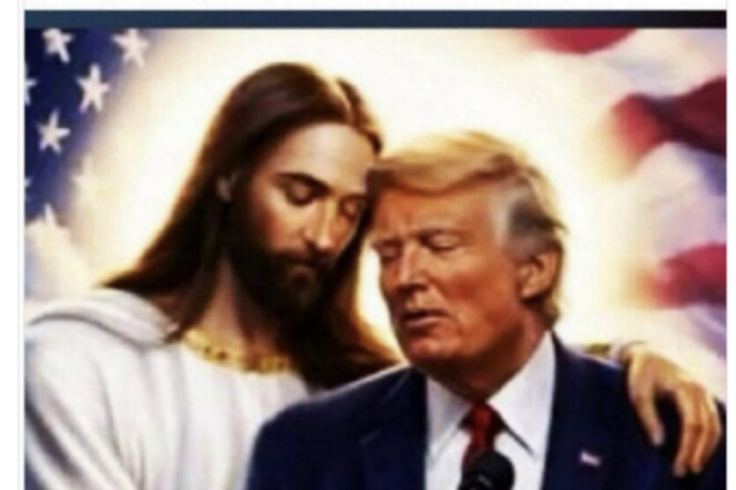
'Is Trump the Antichrist?' The question, once confined to fringe prophecy blogs and late‑night sermons, crashed into the mainstream this week after Donald Trump shared an AI-generated image of himself as Jesus on Truth Social, triggering a backlash among some Christian supporters and prompting far-right allies Marjorie Taylor Greene, Tucker Carlson and Nick Fuentes to openly speculate about whether the President could be the biblical villain himself.
Trump tried to tamp down the controversy by insisting he was meant to be depicted as a doctor rather than as Christ. By then, the image had already ricocheted across social media and right‑wing platforms, reigniting a very old American obsession. Talk of the Antichrist has long seeped into US politics, particularly among conservative Protestants who see current events as markers on a prophetic timetable. The latest storm around Trump is not an aberration so much as the newest chapter in a story that stretches back well over a century.

The modern American fixation on the Antichrist took shape in the late 19th century, according to Matthew Sutton, a historian at the University of Washington and author of 'Chosen Land: How Christianity Made America and Americans Remade Christianity.' In an interview with Vox's 'Today, Explained' podcast, Sutton traced the turn away from an earlier optimism, when many Protestants believed they were helping to build the kingdom of God on Earth, towards a darker, end-times worldview shaped by civil war, industrial upheaval and mass immigration.
Once American Christians had watched 'Christians killing Christians' in the Civil War, Sutton argued, it became harder to sustain that hopeful theology. A growing minority of Protestants concluded they were not constructing a utopia at all. They were hurtling towards Armageddon. They began poring over newspapers and their Bibles in tandem, hunting for signs that a global leader foretold in scripture would emerge to persecute believers and remake the world order.
By the early 20th century, these ideas had cohered into a movement. Conferences were organised. Books circulated, speculating about who and where the Antichrist might be and how close his rise would place humanity to the end times. Out of this ferment came what would later be branded 'fundamentalism.' After the Second World War, the label shifted to 'evangelical,' but the basic conviction remained unchanged: history is on a countdown, and political events are coded warnings.
How Donald Trump Landed in an Old Prophetic Frame
To recall that history is to see why an AI image of Trump as Jesus was never going to be treated as a harmless meme in certain circles. The movement Sutton describes has long relied on a set of recurring 'signs.' Some are nebulous and conveniently elastic, such as claims that society is 'falling away' from true Christianity or that contemporary sexual morality proves the end is near. Others are chillingly specific.
Many fundamentalists pinned their end‑times timeline on the return of Jews to Palestine and the eventual creation of Israel as a nation‑state. Sutton notes that as early as the 1880s and 1890s, American prophecy teachers were predicting precisely that development. When Zionism gathered pace and Israel was founded in the late 1940s, those believers took it as confirmation they had read their Bibles and their newspapers correctly.
They added world war to the list. Jesus's warning about 'wars and rumours of wars' became, in their reading, a bright flashing signal. The slaughter of 1914–18 was treated as proof they had got it right; the even greater horror of the Second World War seemed to seal the case. Emerging international bodies such as the League of Nations and later the United Nations were then folded in as possible platforms from which a charismatic world ruler could eventually dominate the globe.

Within that worldview, naming the Antichrist is both irresistible and treacherous. The Bible describes him as a deceiver, so any confident identification risks missing the point. That has not stopped waves of speculation. In the 1930s, Benito Mussolini, dreaming aloud of reviving the Roman Empire, looked to many American prophecy watchers like the perfect fit. Decades later, Saddam Hussein, building monuments amid the ruins of ancient Babylon, slotted neatly into the role.
American leaders have usually been cast differently. Because the biblical writers had no conception of the United States, many conservative Christians have felt the Antichrist himself would come from elsewhere. Yet US presidents and globalist‑leaning politicians have often been portrayed as his unwitting accomplices.
Sutton points to Franklin Roosevelt and Barack Obama as two who attracted intense suspicion among fundamentalists, accused of laying the groundwork for a 'new world order' in which US sovereignty would be surrendered to a sinister global regime.
Evangelicals, End Times and the Politics Around Donald Trump
All of this bears directly on the current Trump drama. When figures such as Greene or Carlson toy aloud with the idea that Trump might be the Antichrist, they are not inventing a new script. They are dipping into a very familiar one, in which every election and every international treaty can be read as a move in a cosmic chess game.
Sutton argues that this theology has repeatedly shaped modern American politics, often more than its opponents care to admit. The rise of the New Deal in the 1930s coincided with a surge in fundamentalist, fiercely anti‑liberal activism, grounded in apocalyptic fears. Later, the religious right found an eager ally in Ronald Reagan, who, Sutton says, was personally fascinated by ideas about the Antichrist and the end times. Reagan's policies may not have been dictated by prophecy charts, but his comfort with that language helped cement an alliance that still defines the Republican Party.

The power of the Antichrist idea is not that it makes believers withdraw from politics. It does the opposite. If you are convinced the Antichrist is imminent and that Jesus will return immediately after, Sutton notes, you are under pressure to act. You need to be found 'a good and faithful servant,' using every political tool available to prepare others and to resist evil. That impulse to 'get their asses out there and get to work,' as he bluntly puts it, has helped drive conservative mobilisation for decades.
In that light, the Truth Social outrage over Trump is not just about taste or blasphemy. It touches the nerve of a culture that has been trained to see leaders either as bulwarks against the Antichrist or as the advance guard of his system. Once political disagreement is reframed as a battle against absolute spiritual evil, compromise becomes suspect. Supporting or opposing the United Nations, Sutton warns, stops being about diplomacy and starts being about whether you are siding with the Antichrist himself.

Nothing about Trump's AI Jesus image or the flurry of 'Is he the Antichrist?' speculation has been independently verified as anything more than political theatre and online panic. None of it proves where anyone, let alone Trump, sits on a prophetic timetable. For now, it is another reminder that for a sizeable slice of American Christianity, every new crisis slots into a very old story, and that story still has the power to warp the country's politics far beyond the church pews.
© Copyright IBTimes 2026. All rights reserved.
- Recommended For You