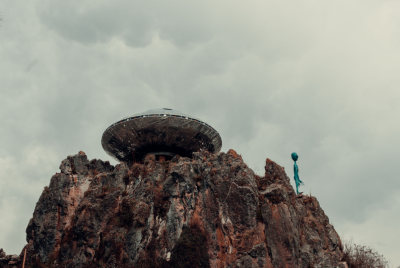
Are ET Spy Probes Tracking Us? Trump's New Space Advisory Chief Claims Interstellar Threat Is Real
A serious scientific appointment has collided with one of the strangest alien theories in recent memory.

Donald Trump's new UAP Science Advisory Council has given Harvard astrophysicist Avi Loeb a central role, putting a scientist who has floated the idea of an interstellar 'mothership' releasing alien spy probes at the heart of the administration's latest push on unexplained aerial phenomena.
The council met for the first time last Tuesday under the Office of the Director of National Intelligence, with the White House saying it was created to support the president's drive for greater UAP transparency.
Avi Loeb And Trump's New UAP Gamble
For context, UAP, or Unidentified Anomalous Phenomena, is the Pentagon's preferred term for unexplained sightings, and Loeb is no stranger to controversy. He has already triggered debate with his suggestion that 3I/Atlas could be more than a lump of rock, a theory that has made him one of the most talked‑about figures in the UFO world.
Loeb, who has joined the new council's Science Advisory Council, said the aim is to help the government separate credible data from noise. Speaking to the New York Post, he said: 'The government is not a scientific organisation. They don't have first class scientists. So we can help them figure things out.'
A UAP governance board aiming for transparent data—what could it change?
— UFO/UAP News & Content (@ufo_uap_news) June 22, 2026
Donald Trump has formed a UAP Governance Board with Avi Loeb and a science advisory team to study declassified files and coordinate across agencies. The effort operates on a zero-budget and focuses on… pic.twitter.com/FB1extZsKs
He added that if the available material is too thin to support conclusions, his team can tell the government what should be collected next. On paper, the brief is straightforward: bring scientific methods to a field long dominated by secrecy, speculation and poor‑quality data.
The council's first meeting was held last Tuesday, according to ODNI, and the stated purpose was to support Trump's directive on UAP transparency. An ODNI insider said the wider objective is to bring together intelligence, military, law enforcement and civilian bodies to assess possible national security risks in US airspace.
The 3I/Atlas 'Mothership' Claim
Loeb's appointment is closely tied to his own headline‑making theory about 3I/Atlas, which he has suggested might be an alien mothership capable of dropping probes. That claim has been widely disputed in scientific circles, but it has helped turn Loeb into a fixture in the public conversation around UAPs and interstellar objects.

In remarks reported by the New York Post, Loeb said the simplest explanation for some reports would be that unusual orbs were drones capable of producing smaller drones. He also cited a figure he said came from the Pentagon‑linked All‑domain Anomaly Resolution Office, claiming 40 per cent of observed phenomena could not be explained by US technology or known adversary systems. That figure is presented as Loeb's characterisation rather than a number published in an official standalone release in the material available here.
Who Is Advising Trump On UAP?
The council's make‑up has drawn attention of its own. Loeb has assembled a group that includes sceptic Michael Shermer, Stanford's Dr Gary Nolan, UAP researchers Dr Kevin Knuth and Dr Matthew Szydagis, and retired Rear Admiral Tim Gallaudet. Gallaudet said he was 'very pleased and not surprised' by the appointment, adding that he had been urging the executive branch to prioritise UAP for years.
Bringing together outspoken believers, mainstream academics and sceptics suggests an attempt to bridge sharply divided camps in the UAP debate, even as arguments continue over how far current evidence can support claims of non‑human technology.
Why Loeb's New Role Matters Now
For all the online noise around aliens and spy probes, the larger shift is institutional. Trump's team is treating unexplained aerial sightings as a matter of intelligence, science and national security, not just late‑night conspiracy fodder. That helps explain why Loeb's appointment has grabbed attention well beyond the usual UFO community.
There is also the question of credibility. Loeb is a serious academic, but he is also the scientist who has repeatedly been willing to push the outer edge of speculation, and that makes him useful to believers and frustrating to sceptics in equal measure. Whether the new council produces solid answers or simply more debate will depend on what evidence it can obtain and analyse.
For now, the White House has a new space advisory chief, a fresh UAP board and a scientist who thinks the universe may be looking back. The combination ensures that questions about UAPs, interstellar visitors and possible surveillance probes will remain on the political agenda.
© Copyright IBTimes 2026. All rights reserved.
- Recommended For You